How Much Does a Crown Cost Without Insurance? Self-Pay Guide
How much does a crown cost without insurance? See what drives self-pay fees, your right to a good faith estimate, and lower-cost options in the US.
Editorially reviewed. This article has not been reviewed by a clinician. How we work

On this page
How much does a crown cost without insurance? There is no single US price: the self-pay fee depends on the crown material, the tooth, any extra work such as a core buildup or root canal, and where you live. As an uninsured patient, you are generally entitled to a written good faith estimate before treatment.
Paying for a crown out of pocket is common in the United States. The ADA Health Policy Institute reports that 21% of adults aged 19 to 64 have no dental benefits, and 54% of adults 65 and older have none (a figure that excludes Medicare Advantage plans). This guide covers what shapes the fee, the federal estimate rules that protect self-pay patients, and the lower-cost routes worth checking.
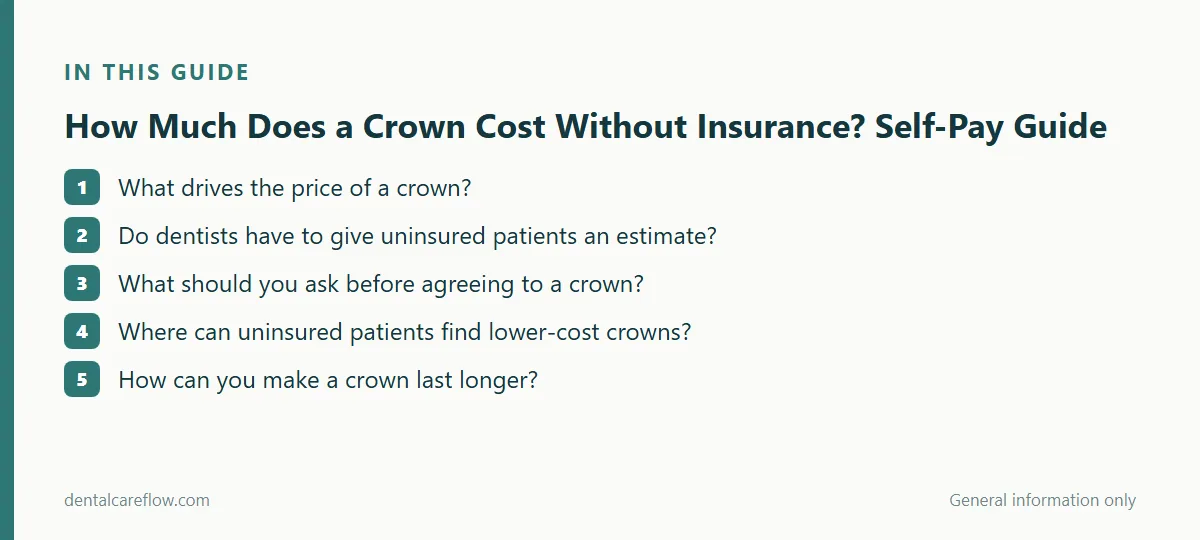
What drives the price of a crown?
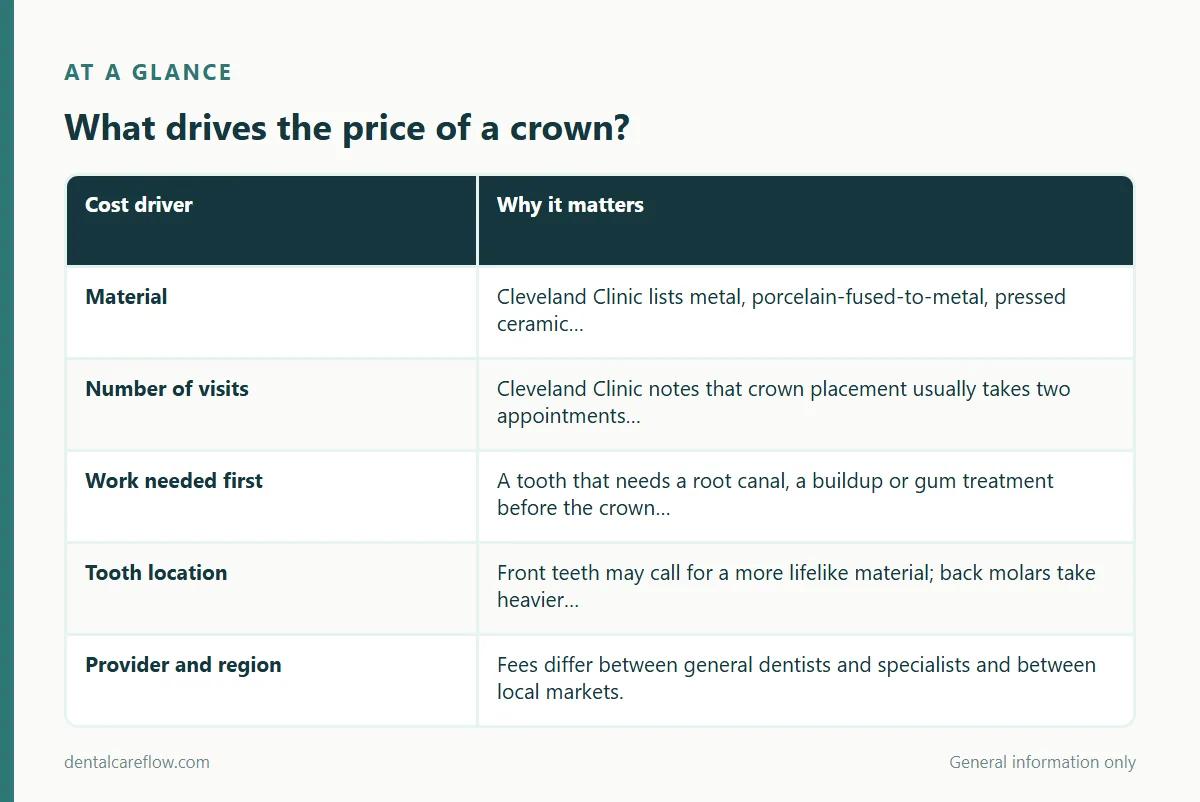
| Cost driver | Why it matters |
|---|---|
| Material | Cleveland Clinic lists metal, porcelain-fused-to-metal, pressed ceramic, all-ceramic (including zirconia), same-day milled ceramic and all-resin crowns. All-resin is usually the least expensive but more fragile. |
| Number of visits | Cleveland Clinic notes that crown placement usually takes two appointments, with a temporary crown in between. Same-day milled crowns can be finished in one visit, but not everyone is a candidate. |
| Work needed first | A tooth that needs a root canal, a buildup or gum treatment before the crown adds separate fees. |
| Tooth location | Front teeth may call for a more lifelike material; back molars take heavier chewing forces. |
| Provider and region | Fees differ between general dentists and specialists and between local markets. |
For a closer look at how materials compare, see our guide to dental crown types and prices.
Do dentists have to give uninsured patients an estimate?
Generally, yes. Under the federal No Surprises Act rules, CMS explains that if you aren't using health insurance, your provider must give you a good faith estimate of expected charges when you schedule care at least three business days ahead or ask for one. ADA News reported in February 2023 that CMS confirmed to the ADA that dental providers are generally required to give uninsured or self-pay patients such an estimate. According to the same report, if your final bill is at least $400 more than the estimate, you can start the federal patient-provider dispute resolution process.
One nuance: ADA News also noted that someone enrolled in a limited-scope dental plan is generally not treated as uninsured, with exceptions, for example when the plan doesn't cover the service and you have no other coverage for it.
What should you ask before agreeing to a crown?
- What is the total self-pay fee, including the temporary crown, any buildup and follow-up adjustments?
- Which material do you recommend for this tooth, and is a less expensive material reasonable here?
- Do I need a root canal or other treatment first, and is that priced separately?
- Do you offer a cash or prompt-payment fee, or a payment plan?
- What happens, and what will it cost, if the crown chips or comes loose?
- Can I have the good faith estimate in writing?
Where can uninsured patients find lower-cost crowns?
The National Institute of Dental and Craniofacial Research lists several options:
- Dental school clinics, where students treat patients under the supervision of licensed dentists at reduced cost.
- Community health centers funded through HRSA, which charge based on income.
- State and local health departments and the 2-1-1 helpline, which may know of free or reduced-cost programs.
- Clinical trials, which sometimes provide limited free or low-cost treatment for the condition being studied.
It is also worth checking whether you qualify for Medicaid. Medicaid.gov explains that children's coverage includes restoration of teeth, while adult dental benefits are set by each state.
How can you make a crown last longer?
Cleveland Clinic puts the average lifespan of a crown at five to 15 years, noting that crowns can last longer with good care. Its advice includes brushing twice daily with fluoride toothpaste, flossing daily, avoiding ice, very hard nuts and sticky candy, and asking about a custom mouth guard if you grind. Since a replacement crown means paying again, those habits are part of the cost picture.
If you are comparing local self-pay fees with treatment abroad, our article on what drives the difference between US and Turkish dental costs explains the factors involved.
Sources
- Cleveland Clinic, Dental Crowns: Types, Procedure and Care
- CMS, Good faith estimate
- ADA News, ADA receives clarification on No Surprises Act (February 2023)
- ADA Health Policy Institute, Coverage, Access and Outcomes
- NIDCR, Finding Dental Care
- Medicaid.gov, Dental Care
This article is general information and is not a substitute for advice from your own dentist. Fees and rules can change, so confirm details with your provider.
Ask about treatment and costs
Two quick questions. General information only, no diagnosis.