How Much Does a Cavity Filling Cost With Insurance? Do the Math
How much does a cavity filling cost with insurance? Learn how deductibles, coinsurance and annual maximums set your share, with a step-by-step calculation.
Editorially reviewed. This article has not been reviewed by a clinician. How we work

On this page
How much does a cavity filling cost with insurance? Your share is usually any unmet deductible plus your coinsurance percentage of the plan's allowed fee, because most US dental plans treat fillings as a "basic" service that they pay for in part. The exact dollar amount depends on your plan and your dentist's fee.
Rather than guess at a national price, this guide shows you how to work out your own number. Once you know four figures from your plan and one from your dentist, the math takes a minute.
How do dental plans pay for fillings?
MetLife's consumer guide explains that dental plans typically sort care into preventive, basic and major services, and that fillings, along with extractions and root canals, sit in the basic tier, which is usually partially covered. Delta Dental of Kansas gives the example of a plan that covers fillings at 80%, where the plan pays 80% of the cost and the member pays the rest. Your plan may use a different percentage, so check your summary of benefits.
Delta Dental of Arkansas notes that a deductible usually applies to basic and major services but not to preventive care, and that once you meet it, it doesn't apply again in that benefit period.
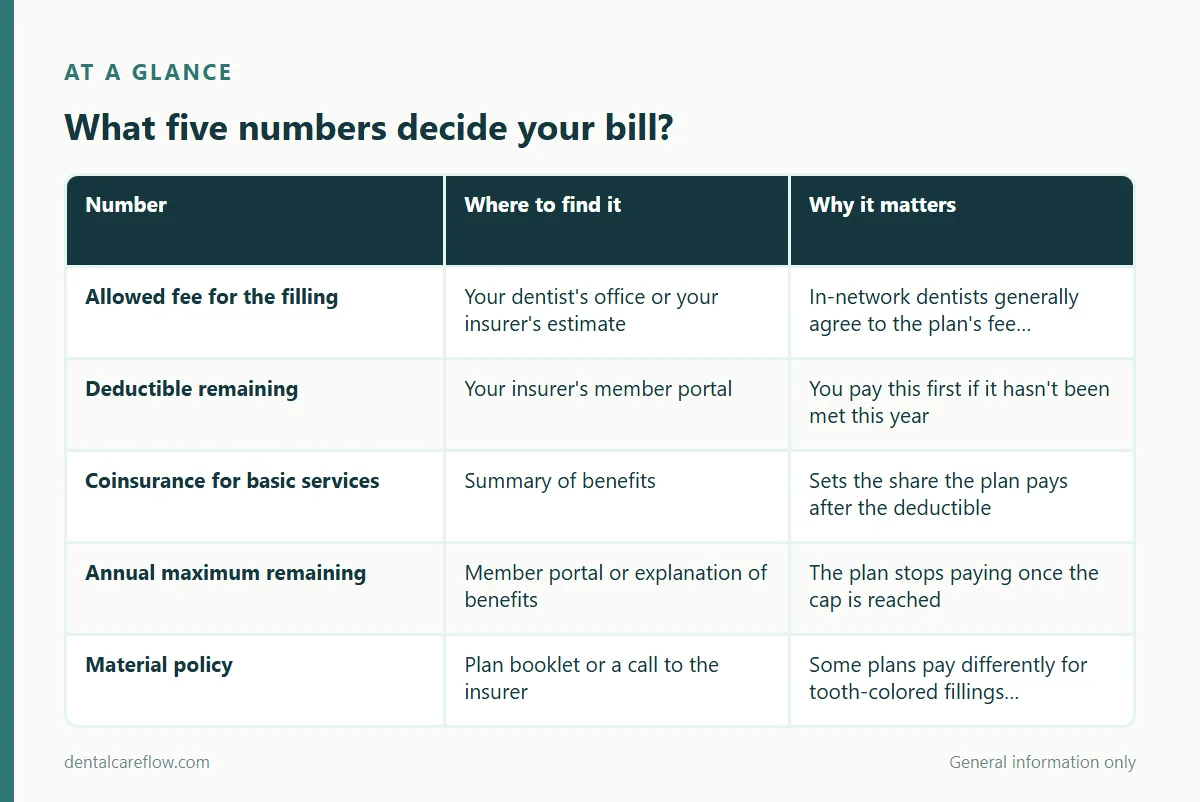
What five numbers decide your bill?
| Number | Where to find it | Why it matters |
|---|---|---|
| Allowed fee for the filling | Your dentist's office or your insurer's estimate | In-network dentists generally agree to the plan's fee schedule |
| Deductible remaining | Your insurer's member portal | You pay this first if it hasn't been met this year |
| Coinsurance for basic services | Summary of benefits | Sets the share the plan pays after the deductible |
| Annual maximum remaining | Member portal or explanation of benefits | The plan stops paying once the cap is reached |
| Material policy | Plan booklet or a call to the insurer | Some plans pay differently for tooth-colored fillings on back teeth |
How do you calculate your share step by step?
- Start with the allowed fee for the specific filling, which depends on the tooth, the number of surfaces involved and the material.
- Subtract any deductible you still owe. That portion is yours.
- Apply coinsurance to the rest. If your plan pays 80% for basic work, you pay the remaining 20% of what is left after the deductible.
- Check the annual maximum. If the plan's share is more than what remains of your cap, you pay the difference.
- Add any non-covered extras, such as a material upgrade the plan doesn't pay for. MetLife notes that costs for non-covered services do not count toward your deductible or annual maximum.
The result is your estimated out-of-pocket cost. For the most reliable figure, MetLife recommends a pretreatment estimate submitted through your dentist.
Why might two fillings cost you different amounts?
- Size and surfaces. A small filling on one surface takes less time and material than one wrapping around several surfaces.
- Material. Cleveland Clinic describes direct fillings (amalgam, resin composite and glass ionomer) placed in one visit and indirect fillings (gold and porcelain) made in a lab, which usually need two visits. Indirect options generally cost more.
- Location of the tooth. Plans may pay for a tooth-colored filling on a front tooth but only at the amalgam rate on a molar.
- Timing in the plan year. Early in the year you may still owe the deductible; late in the year you may have used most of your annual maximum.
What about Medicaid, CHIP and Medicare?
Medicaid.gov states that children's Medicaid dental benefits must include restoration of teeth, and that separate CHIP programs cover dental services needed to prevent disease and promote oral health. For adults, each state decides what dental benefits Medicaid covers. Medicare.gov says Original Medicare doesn't cover fillings in most cases, though some Medicare Advantage plans include dental benefits.
Is it worth filling a cavity early?
Cleveland Clinic notes that treating a cavity with a filling can mean less money spent in the long run, and warns that lingering sensitivity after a filling can sometimes point to nerve problems that need a root canal or extraction. Small cavities are generally simpler to fix than large ones. If you are uninsured or want to compare treatment costs across options, our dental treatment price breakdown guide covers the main cost drivers.
Sources
- MetLife, What Does Dental Insurance Cover?
- Delta Dental of Kansas, What is an annual maximum?
- Delta Dental of Arkansas, Dental Insurance Terms Explained: Deductible
- Cleveland Clinic, Dental Fillings: Types, Materials and What They're For
- Medicaid.gov, Dental Care
- Medicare.gov, Dental services
This article is general information and is not a substitute for advice from your own dentist or insurer. Your costs depend on your plan and treatment.
Ask about treatment and costs
Two quick questions. General information only, no diagnosis.