How Long Does It Take to Fill a Cavity? Appointment Timeline
How long does it take to fill a cavity? Most fillings take about an hour. See how material and size change the time, how long numbness lasts and when to eat.
Editorially reviewed. This article has not been reviewed by a clinician. How we work

On this page
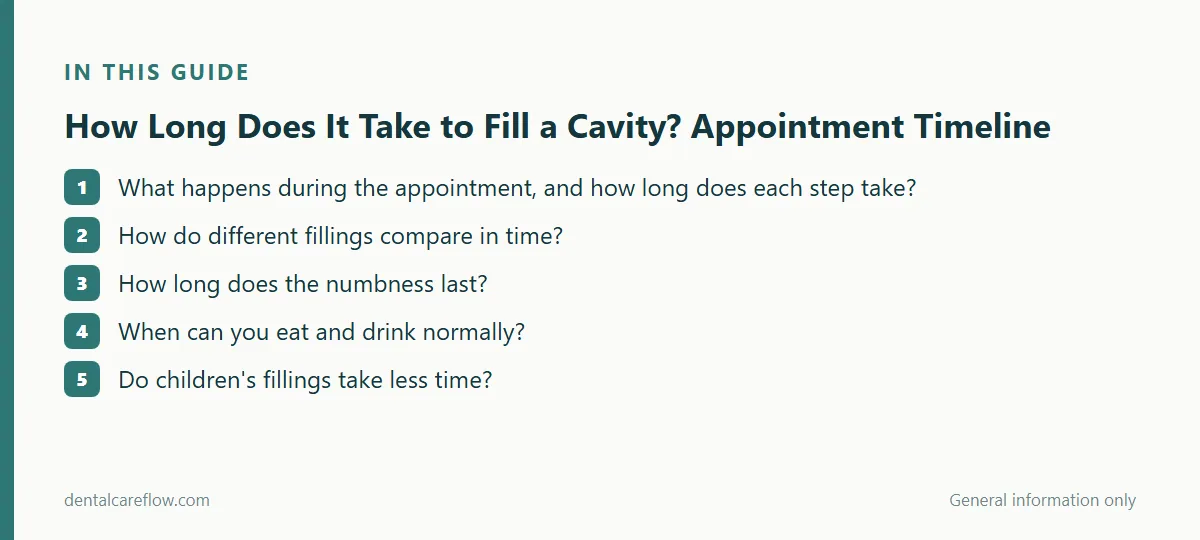
- What happens during the appointment, and how long does each step take?
- How do different fillings compare in time?
- How long does the numbness last?
- When can you eat and drink normally?
- Do children's fillings take less time?
- What if you need more than one filling?
- How can you keep the appointment short?
- Sources
How long does it take to fill a cavity? Most fillings take about an hour, and a simple one can take as little as 20 minutes, according to Healthline. Direct fillings are finished in one visit, while lab-made gold or porcelain fillings usually need two appointments.
The time in the chair depends on the size of the cavity, the material and whether it is a new filling or a replacement. Numbness lasts longer than the appointment itself, so it helps to plan the rest of your day too. This article lays out the timeline step by step.
What happens during the appointment, and how long does each step take?
Healthline describes the typical sequence:
- Exam and possibly an X-ray of the tooth.
- Numbing with local anesthetic, which may be skipped for very shallow fillings.
- Removing the decay, usually with a drill; lasers or air abrasion are less common.
- Cleaning and filling the space; some materials are hardened with a blue curing light.
- Polishing and checking your bite.
Cleveland Clinic explains that direct fillings, such as amalgam, resin composite and glass ionomer, are placed in a single office visit, while most indirect fillings, made of gold or porcelain in a lab, require two visits, unless the office uses CAD/CAM technology to make them the same day.
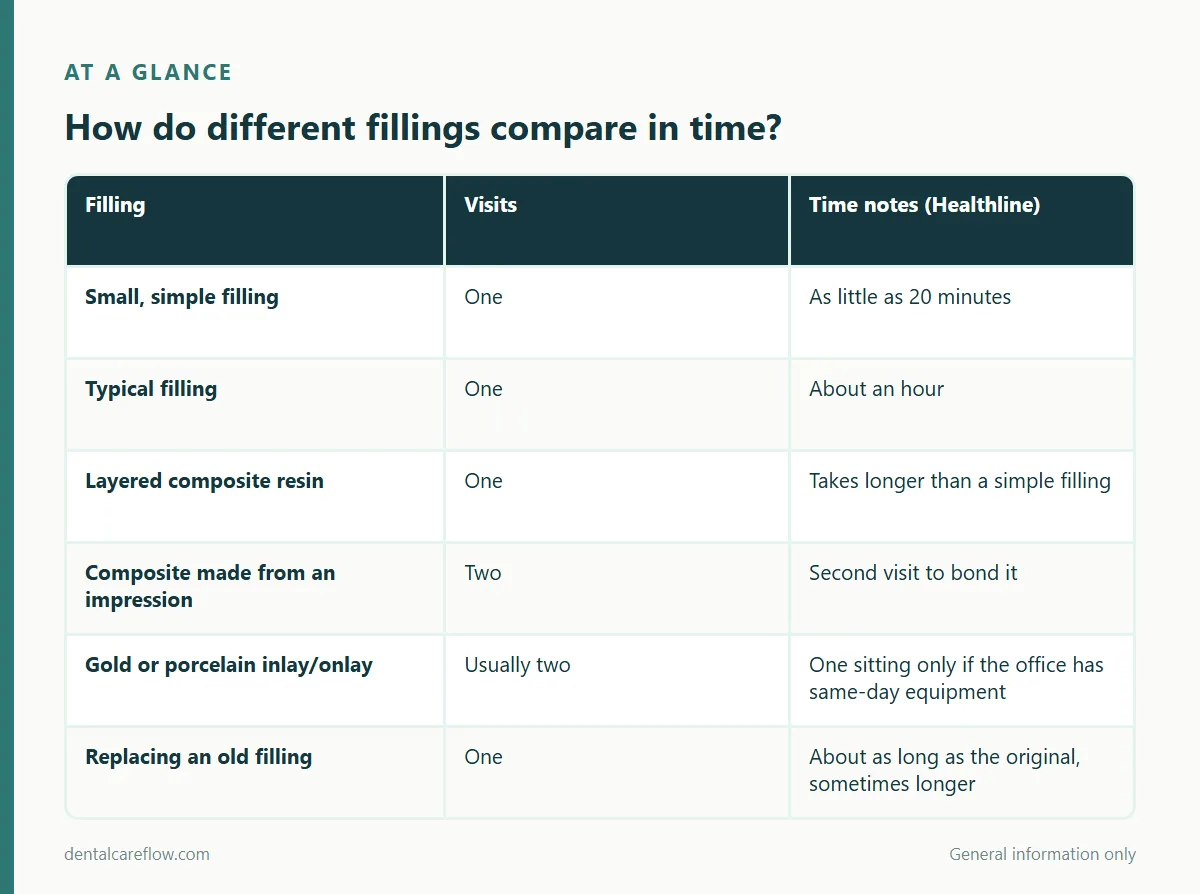
How do different fillings compare in time?
| Filling | Visits | Time notes (Healthline) |
|---|---|---|
| Small, simple filling | One | As little as 20 minutes |
| Typical filling | One | About an hour |
| Layered composite resin | One | Takes longer than a simple filling |
| Composite made from an impression | Two | Second visit to bond it |
| Gold or porcelain inlay/onlay | Usually two | One sitting only if the office has same-day equipment |
| Replacing an old filling | One | About as long as the original, sometimes longer |
How long does the numbness last?
Healthline notes that local anesthesia can take 2 to 7 hours to wear off completely, with some "pins and needles" as feeling returns. Cleveland Clinic advises waiting for numbness to wear off so you don't accidentally bite your cheek, and says that unless you had sedation, you can return to routine activities right after the appointment.
When can you eat and drink normally?
- Once the numbness wears off, you can generally eat as usual, per Healthline.
- Avoid very hot or very cold food and drink for a day or two.
- With amalgam, avoid hard foods for about 24 hours while it reaches full strength.
- Skip very acidic, cold or sticky foods the first evening.
Cleveland Clinic adds that mild sensitivity and gum soreness are normal and should go away in a week or two. Pain when biting may mean the filling needs adjusting, which your dentist can do quickly.
Do children's fillings take less time?
Not usually. Healthline notes that fillings for children take about as long as fillings for adults. If your child is nervous, ask the office ahead of time how they approach first fillings, how they explain the steps and whether you can stay in the room.
What if you need more than one filling?
Several fillings in the same area of the mouth can often be done together in a single, longer appointment, since that area only needs to be numbed once. Fillings on opposite sides of the mouth are sometimes split into separate visits so you can still chew comfortably on one side afterward. Your dentist will suggest a plan based on how many teeth need work and how large the cavities are.
How can you keep the appointment short?
- Treat cavities early. Small cavities are faster to fill than large ones.
- Ask about the material in advance, so you know whether to expect one visit or two.
- Bundle work sensibly. Ask whether neighboring fillings can be done in the same visit.
- Check coverage beforehand. Knowing what your plan pays avoids delays on the day.
If you are wondering about costs, our dental treatment price breakdown guide explains the main drivers.
Sources
- Healthline, How Long Do Fillings Take for Tooth Cavities?
- Cleveland Clinic, Dental Fillings: Types, Materials and What They're For
This article is general information and is not a substitute for advice from your own dentist.
Ask about treatment and costs
Two quick questions. General information only, no diagnosis.