How Long Does a Deep Cleaning Take? Appointment to Recovery
How long does a deep cleaning take? Usually one to two hours, in one or two visits. See the full timeline from numbness and soreness to follow-up checks.
Editorially reviewed. This article has not been reviewed by a clinician. How we work

On this page
- Why does a deep cleaning take longer than a regular cleaning?
- What affects how long your appointment takes?
- What does the full timeline look like?
- How should you plan your day around it?
- Is one long visit or two shorter visits better?
- How long until the gums heal?
- When should you call your dentist?
- Sources
How long does a deep cleaning take? Cleveland Clinic says scaling and root planing takes one to two hours. It may be done in one visit or split into two, with half the mouth treated each time, and most people return to their normal routine the same day.
The appointment itself is only part of the timeline. Numbness, gum soreness, sensitivity and follow-up visits all stretch over the following days and weeks. Here is what to plan for, from booking to the recheck.
Why does a deep cleaning take longer than a regular cleaning?
Cleveland Clinic notes that most routine cleanings take 30 to 60 minutes. A deep cleaning takes longer because the provider works below the gumline on each affected tooth, first removing plaque and tartar (scaling) and then smoothing the root surfaces (root planing). The gums are numbed with local anesthesia first, which adds a few minutes at the start.
What affects how long your appointment takes?
- How many teeth are involved. Treating one area is quicker than treating the whole mouth.
- How much tartar has built up below the gums.
- One visit or two. Cleveland Clinic says the choice depends on your situation, your preferences and your dental insurance plan.
- Added treatment, such as antibiotics placed near the roots.
What does the full timeline look like?
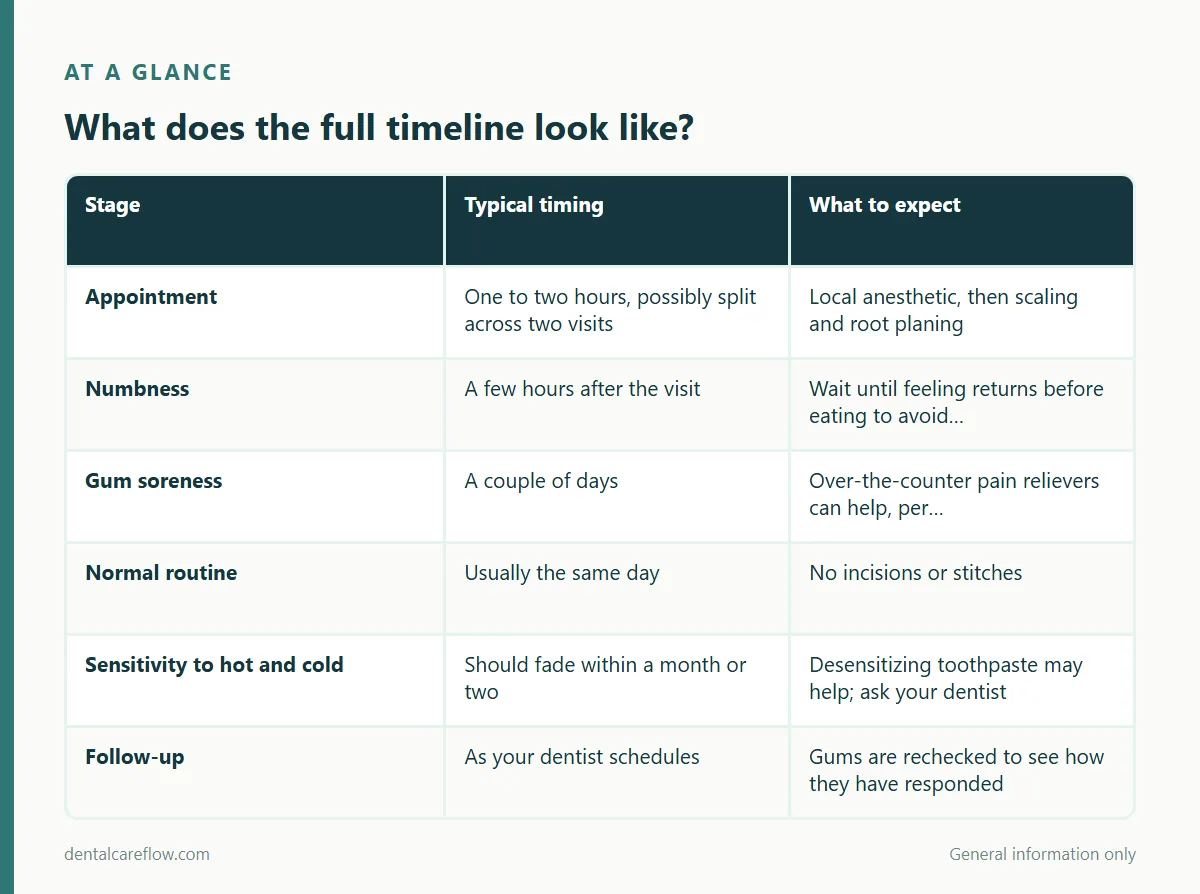
| Stage | Typical timing | What to expect |
|---|---|---|
| Appointment | One to two hours, possibly split across two visits | Local anesthetic, then scaling and root planing |
| Numbness | A few hours after the visit | Wait until feeling returns before eating to avoid biting your cheek |
| Gum soreness | A couple of days | Over-the-counter pain relievers can help, per Cleveland Clinic |
| Normal routine | Usually the same day | No incisions or stitches |
| Sensitivity to hot and cold | Should fade within a month or two | Desensitizing toothpaste may help; ask your dentist |
| Follow-up | As your dentist schedules | Gums are rechecked to see how they have responded |
How should you plan your day around it?
- Ask whether it is one or two visits when you book, and how long each will take.
- Eat beforehand, since you may want to wait until the numbness wears off afterward.
- Plan soft foods for the evening in case your gums are tender. Cleveland Clinic says you can eat and drink as long as it doesn't hurt.
- Check your insurance. Your plan may affect whether the treatment is done in one appointment or two.
- Keep the follow-up. It shows whether the gums are healing or need more treatment.
Is one long visit or two shorter visits better?
Neither is right for everyone. A single visit means one round of numbing and one recovery period, which suits people who find it hard to take time off. Two visits, with half the mouth treated each time, keep each appointment shorter and leave one side comfortable for chewing while the other settles. Cleveland Clinic notes the choice depends on your situation, your preferences and your insurance plan, so it is worth asking your dental office which option your plan supports before you book.
How long until the gums heal?
Healing happens gradually as inflammation settles. The National Institute of Dental and Craniofacial Research (NIDCR) stresses that any gum disease treatment requires good daily care at home: brushing twice a day with fluoride toothpaste, flossing daily or using interdental brushes or water flossers as advised, and keeping regular checkups. NIDCR also notes that quitting tobacco can improve treatment results.
Cleveland Clinic says that, ideally, you will need scaling and root planing only once, with regular cleanings and good hygiene helping prevent a repeat. If gum disease is more advanced, surgical treatments such as flap surgery or grafts take one to four weeks to recover from.
When should you call your dentist?
Cleveland Clinic advises calling if bleeding doesn't stop, if pain isn't relieved by medication, or if you have severe swelling. If you are considering implants in the future, healthy gums come first; our article on dental implants with gum disease explains why.
Sources
- Cleveland Clinic, Scaling and Root Planing
- Cleveland Clinic, What Happens During a Dental Cleaning?
- NIDCR, Periodontal (Gum) Disease
This article is general information and is not a substitute for advice from your own dentist or periodontist.
Ask about treatment and costs
Two quick questions. General information only, no diagnosis.