What Is Dental Scaling? Routine vs Deep Cleaning Explained
What is dental scaling? Learn how tartar is removed at a routine cleaning, how deep scaling for gum disease differs, what it feels like and what to ask.
Editorially reviewed. This article has not been reviewed by a clinician. How we work

On this page
What is dental scaling? It is the removal of plaque and hardened tartar from your teeth with hand instruments or an ultrasonic tool. Scaling is part of every routine professional cleaning, and a deeper version below the gumline is used to treat gum disease.
The word "scaling" shows up on US dental bills and insurance explanations of benefits more often than patients expect, sometimes for a regular checkup cleaning and sometimes for a separate, deeper treatment. This guide separates the two, explains what each feels like, and gives you questions to ask so you know which one you are getting.
Why does tartar have to be scaled off?
Plaque is a sticky film of bacteria. According to the National Institute of Dental and Craniofacial Research (NIDCR), plaque can harden into tartar, which only a dental professional can remove. Brushing and flossing at home keep fresh plaque under control, but once tartar forms, it takes professional instruments to lift it off. That is the job of scaling.
What are the two kinds of scaling?
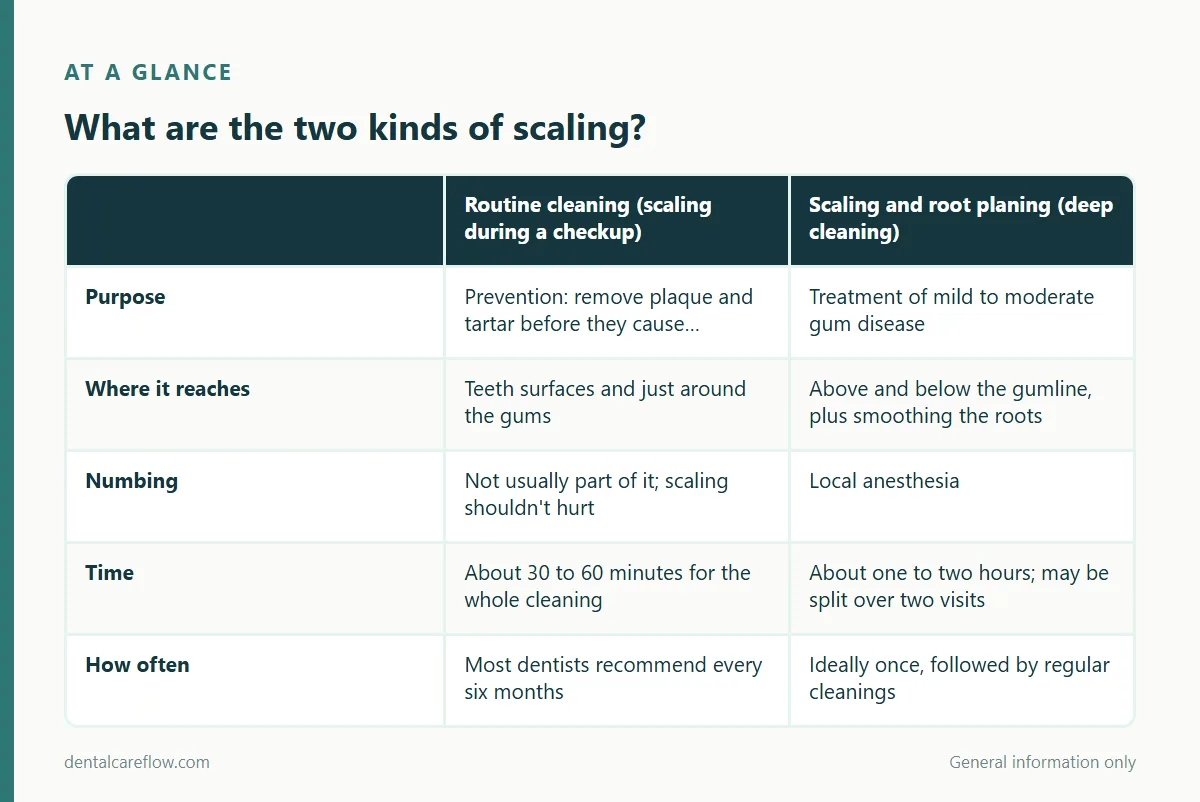
| Routine cleaning (scaling during a checkup) | Scaling and root planing (deep cleaning) | |
|---|---|---|
| Purpose | Prevention: remove plaque and tartar before they cause problems | Treatment of mild to moderate gum disease |
| Where it reaches | Teeth surfaces and just around the gums | Above and below the gumline, plus smoothing the roots |
| Numbing | Not usually part of it; scaling shouldn't hurt | Local anesthesia |
| Time | About 30 to 60 minutes for the whole cleaning | About one to two hours; may be split over two visits |
| How often | Most dentists recommend every six months | Ideally once, followed by regular cleanings |
The figures in this table come from Cleveland Clinic's pages on dental cleanings and on scaling and root planing.
What happens during routine scaling?
Cleveland Clinic describes a routine cleaning in a few steps:
- A dentist or hygienist removes plaque and tartar using special tools, which may include an ultrasonic scaler, a vibrating instrument that breaks up deposits.
- You may hear scraping, but Cleveland Clinic notes that scaling shouldn't hurt.
- Teeth are polished with a soft rubber cup and a special toothpaste.
- Fluoride may be offered as an extra step to strengthen teeth.
- X-rays are sometimes taken to spot problems that are not visible.
What happens during deep scaling?
When gum disease has set in, scaling has to reach deeper beneath the gums. Cleveland Clinic explains that your gums are numbed with local anesthesia, plaque and tartar are removed above and below the gums, and then the roots are smoothed (root planing). Your dentist may also place antibiotics around the roots or prescribe them. Most people go back to their usual routine the same day.
Afterward, Cleveland Clinic says it is common to have some bleeding, tender gums for a couple of days, and sensitivity to hot and cold that should fade within a month or two. Call your dentist for bleeding that will not stop, pain that medication does not relieve, or severe swelling.
How do you know if you need more than a routine cleaning?
The CDC lists signs of gum disease that are worth mentioning at your next visit:
- Red, swollen, tender or bleeding gums
- Gums pulling away from the teeth
- Loose or sensitive teeth, or pain when chewing
- Changes in your bite or in how a partial denture fits
It is common. The CDC reports that about 4 in 10 US adults aged 30 and older had some level of periodontitis in 2009 to 2014 data, and about 60% of adults 65 and older. Because gum disease can become serious before you notice symptoms, the CDC recommends seeing a dental provider at least once a year.
Questions to ask before scaling
- Is this a routine cleaning or scaling and root planing?
- If it is a deep cleaning, which areas of my mouth need it, and will it be split over two visits?
- How will it be billed to my insurance, and can you send a pre-treatment estimate?
- What follow-up cleaning schedule do you recommend afterward?
If you are planning implants and have gum problems, our guide to dental implants with gum disease explains why gum health comes first.
Sources
- Cleveland Clinic, What Happens During a Dental Cleaning?
- Cleveland Clinic, Scaling and Root Planing
- NIDCR, Gum Disease
- CDC, Gum (Periodontal) Disease
This article is general information and is not a substitute for advice from your own dentist.
Ask about treatment and costs
Two quick questions. General information only, no diagnosis.