What Is Deep Cleaning of Teeth? Deep vs Regular Cleaning
What is deep cleaning of teeth? Compare scaling and root planing with a routine cleaning: purpose, numbing, time, recovery and why gum disease needs it.
Editorially reviewed. This article has not been reviewed by a clinician. How we work

On this page
What is deep cleaning of teeth? It is scaling and root planing, a nonsurgical treatment for gum disease that removes tartar and bacteria from below the gumline and smooths the tooth roots so plaque has a harder time reattaching. It goes deeper than a routine cleaning and is usually done with local anesthesia.
If your dentist or hygienist has recommended a deep cleaning, it usually means your gums show signs of gum disease rather than just everyday plaque. This article compares deep cleaning with a regular cleaning side by side, so you can see what changes and why.
How is a deep cleaning different from a regular cleaning?
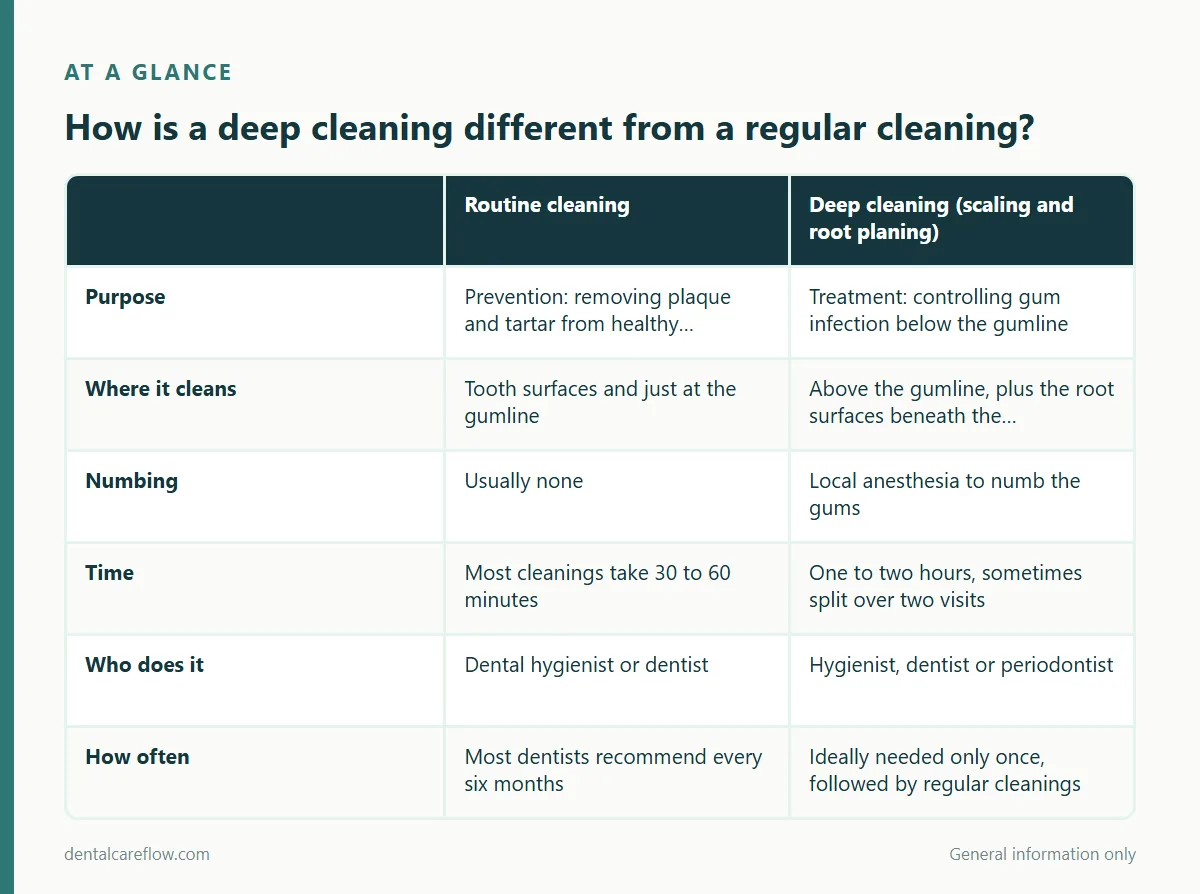
Cleveland Clinic describes scaling and root planing as "sort of like a regular dental cleaning, except it reaches deeper beneath your gums." Here is how the two compare:
| Routine cleaning | Deep cleaning (scaling and root planing) | |
|---|---|---|
| Purpose | Prevention: removing plaque and tartar from healthy teeth | Treatment: controlling gum infection below the gumline |
| Where it cleans | Tooth surfaces and just at the gumline | Above the gumline, plus the root surfaces beneath the gums |
| Numbing | Usually none | Local anesthesia to numb the gums |
| Time | Most cleanings take 30 to 60 minutes | One to two hours, sometimes split over two visits |
| Who does it | Dental hygienist or dentist | Hygienist, dentist or periodontist |
| How often | Most dentists recommend every six months | Ideally needed only once, followed by regular cleanings |
Figures in the table come from Cleveland Clinic's pages on dental cleanings and on scaling and root planing.
Why would someone need a deep cleaning?
The National Institute of Dental and Craniofacial Research (NIDCR) explains that gum disease is an infection that causes inflammation of the tissues holding your teeth in place. Plaque can harden into tartar, which only a dentist or hygienist can remove. Early gum disease can often be reversed with daily brushing and flossing, but if it advances, it can spread to the bone that supports the teeth. NIDCR lists scaling and root planing as one of the main treatments.
Signs your dentist may be looking for include:
- Red, swollen or tender gums that bleed easily
- Gums pulling away from the teeth
- Loose or sensitive teeth
- Persistent bad breath
NIDCR names smoking as the most significant risk factor for gum disease, along with diabetes, older age, genetics and stress.
What happens during the two parts of the treatment?
- Scaling: Cleveland Clinic explains that hand scalers or ultrasonic tools remove plaque and tartar from above and below the gumline.
- Root planing: the provider smooths rough spots on the roots, which helps keep bacteria and plaque from reattaching and gives the gums a chance to heal.
- Possible medication: antibiotics may be placed near the roots or prescribed by mouth.
What does it feel like afterward?
Cleveland Clinic says most people return to their normal routine the same day, with no incisions or stitches. Gums may feel sore for a couple of days, some bleeding is normal, and sensitivity to heat and cold should fade within a month or two. Call your dentist if bleeding doesn't stop, pain isn't relieved by medication or swelling is severe.
Is a deep cleaning worth it compared with waiting?
Waiting lets gum disease progress. NIDCR notes that advanced cases can lead to loose teeth or tooth loss and may require surgery. Cleveland Clinic adds that more advanced procedures, such as flap surgery or grafts, involve one to four weeks of recovery. Gum health also matters if you are considering implants later; see our article on dental implants with gum disease.
After a deep cleaning, NIDCR's prevention advice applies: brush twice a day with fluoride toothpaste, floss daily or use interdental brushes or water flossers as advised, keep regular cleanings and quit tobacco.
Sources
- Cleveland Clinic, Scaling and Root Planing
- Cleveland Clinic, What Happens During a Dental Cleaning?
- NIDCR, Periodontal (Gum) Disease
This article is general information and is not a substitute for advice from your own dentist or periodontist.
Ask about treatment and costs
Two quick questions. General information only, no diagnosis.