What Type of Dentist Removes Wisdom Teeth? Who Does What
What type of dentist removes wisdom teeth? See when a general dentist can do it, when an oral surgeon is needed, and what to ask at the consultation.
Editorially reviewed. This article has not been reviewed by a clinician. How we work

On this page
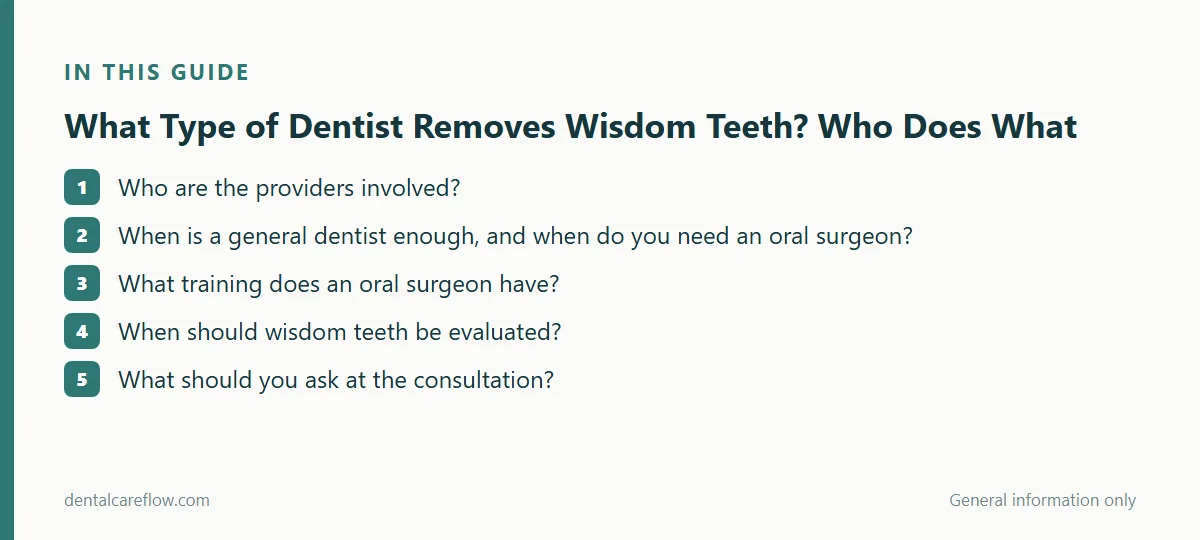
What type of dentist removes wisdom teeth? Usually an oral and maxillofacial surgeon, a dental specialist with advanced surgical training. General dentists also remove some teeth, including straightforward wisdom teeth, and refer complex or impacted cases to a specialist.
For many Americans, the path starts with a general dentist spotting a problem on an X-ray and ends with a referral to an oral surgeon. Knowing who does what helps you understand that referral, ask the right questions and plan for anesthesia and recovery.
Who are the providers involved?
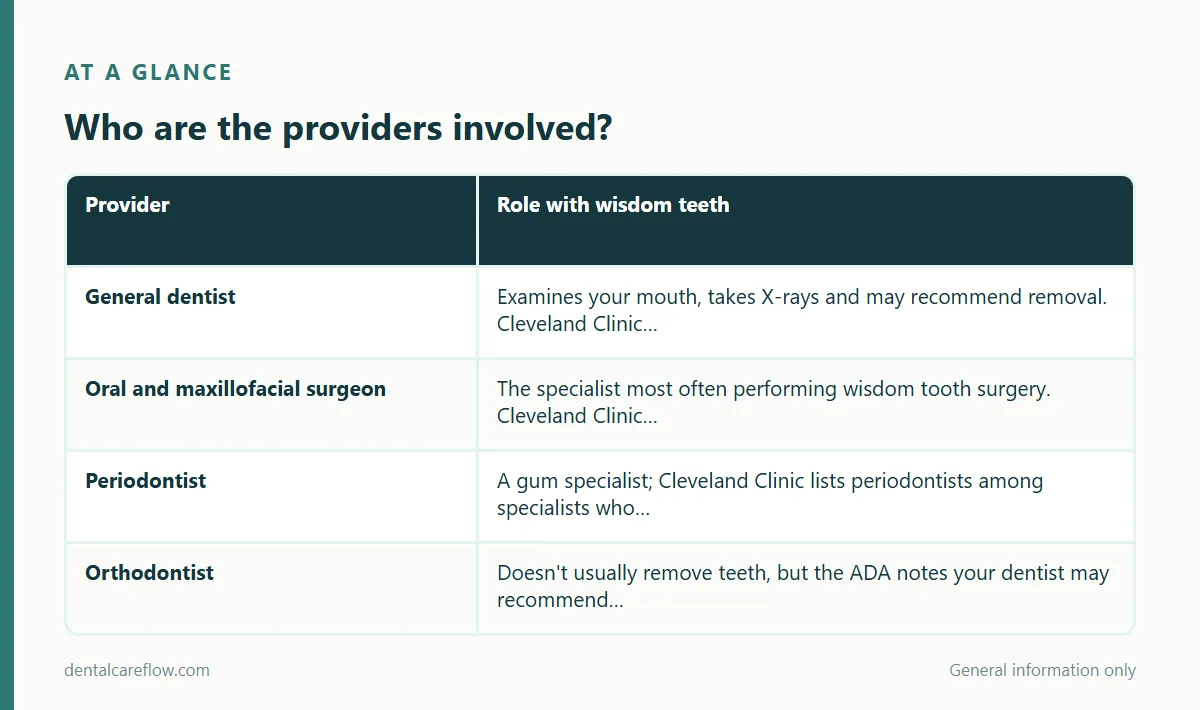
| Provider | Role with wisdom teeth |
|---|---|
| General dentist | Examines your mouth, takes X-rays and may recommend removal. Cleveland Clinic notes general dentists do plenty of extractions, while more complex cases are usually referred to specialists. |
| Oral and maxillofacial surgeon | The specialist most often performing wisdom tooth surgery. Cleveland Clinic describes wisdom tooth removal as a common oral surgery procedure done after a consultation with an oral surgeon. |
| Periodontist | A gum specialist; Cleveland Clinic lists periodontists among specialists who perform extractions. |
| Orthodontist | Doesn't usually remove teeth, but the ADA notes your dentist may recommend wisdom tooth removal as part of treatment for braces. |
When is a general dentist enough, and when do you need an oral surgeon?
Every case is different, but a referral is more likely when:
- The tooth is impacted, meaning trapped under the gum or bone.
- It is growing sideways or crooked. Cleveland Clinic lists teeth growing in crooked or sideways among the reasons for removal.
- Several wisdom teeth need to come out at once.
- You would prefer, or need, deeper sedation.
- There are cysts, infection or damage to nearby teeth or bone.
A wisdom tooth that has fully erupted and is easy to reach may be removed by your general dentist like any other extraction.
What training does an oral surgeon have?
Cleveland Clinic explains that oral surgeons and maxillofacial surgeons have the same educational pathway and credentials, and that the specialty manages conditions affecting the teeth, jaws and lower face. In practice, the titles "oral surgeon" and "oral and maxillofacial surgeon" usually refer to the same specialist.
When should wisdom teeth be evaluated?
The ADA's MouthHealthy site says third molars usually come in between ages 17 and 21, and advises seeing your dentist right away if you have pain. Reasons the ADA lists for removal include pain, infection, cysts, tumors, damage to neighboring teeth, gum disease and decay that can't practically be restored. Cleveland Clinic adds that dentists sometimes recommend removal as a preventive measure.
What should you ask at the consultation?
- Do all my wisdom teeth need to come out, or just some?
- Are any impacted, and how close are they to nerves or sinuses?
- Which anesthesia do you recommend? Cleveland Clinic notes local anesthetic is used and sedation may be offered; with sedation you can't drive for at least 24 hours.
- How long will the surgery take? Cleveland Clinic says about an hour for typical cases.
- Is the surgeon in network for my dental plan, and is any part billed to medical insurance?
What does recovery look like?
Cleveland Clinic outlines a typical course: light bleeding, swelling and pain in days one to three; most people back to their routine by day five; side effects often settled by week two; and gum tissue growing over the socket in weeks three to four. Full socket healing can take more than a month. If you are planning time off, our guide to returning to work after dental treatment can help you schedule around recovery.
Sources
- Cleveland Clinic, Wisdom Teeth Removal
- Cleveland Clinic, Tooth Extraction
- Cleveland Clinic, Oral Surgery
- ADA MouthHealthy, Wisdom Teeth
This article is general information and is not a substitute for advice from your own dentist or oral surgeon.
Ask about treatment and costs
Two quick questions. General information only, no diagnosis.