Can Emergency Rooms Remove Teeth? What ERs Really Do
Can emergency rooms remove teeth? Usually not. Learn what US ERs do for dental pain, when the ER is the right place and who can pull a tooth instead.
Editorially reviewed. This article has not been reviewed by a clinician. How we work

On this page
Can emergency rooms remove teeth? Usually not. Most US hospital emergency departments do not have dentists on staff, so they typically treat dental problems with pain relief and antibiotics and then refer you to a dentist or oral surgeon who can actually pull the tooth.
That can be frustrating if you arrive at the ER at 2 a.m. with a throbbing tooth and expect it to come out that night. Knowing what an emergency department can and cannot do for a bad tooth helps you decide where to go first, how to avoid paying twice, and when the ER really is the right call.
Why don't most ERs pull teeth?
It comes down to staffing and equipment. A 2025 study of US emergency department visits for non-traumatic dental conditions, published in the Journal of Public Health Dentistry, notes that emergency departments typically do not have oral health care providers on staff, and that most of these conditions are better managed in outpatient dental settings. The same study found that treatment in the ER often involves palliation with analgesics, antibiotics or both.
The ADA's Emergency Department Referral Program page makes the same point from a different angle: emergency departments mainly provide palliative care, and successful local programs pair ER patients with a referral to a dental clinic or oral surgeon so the underlying problem gets fixed.
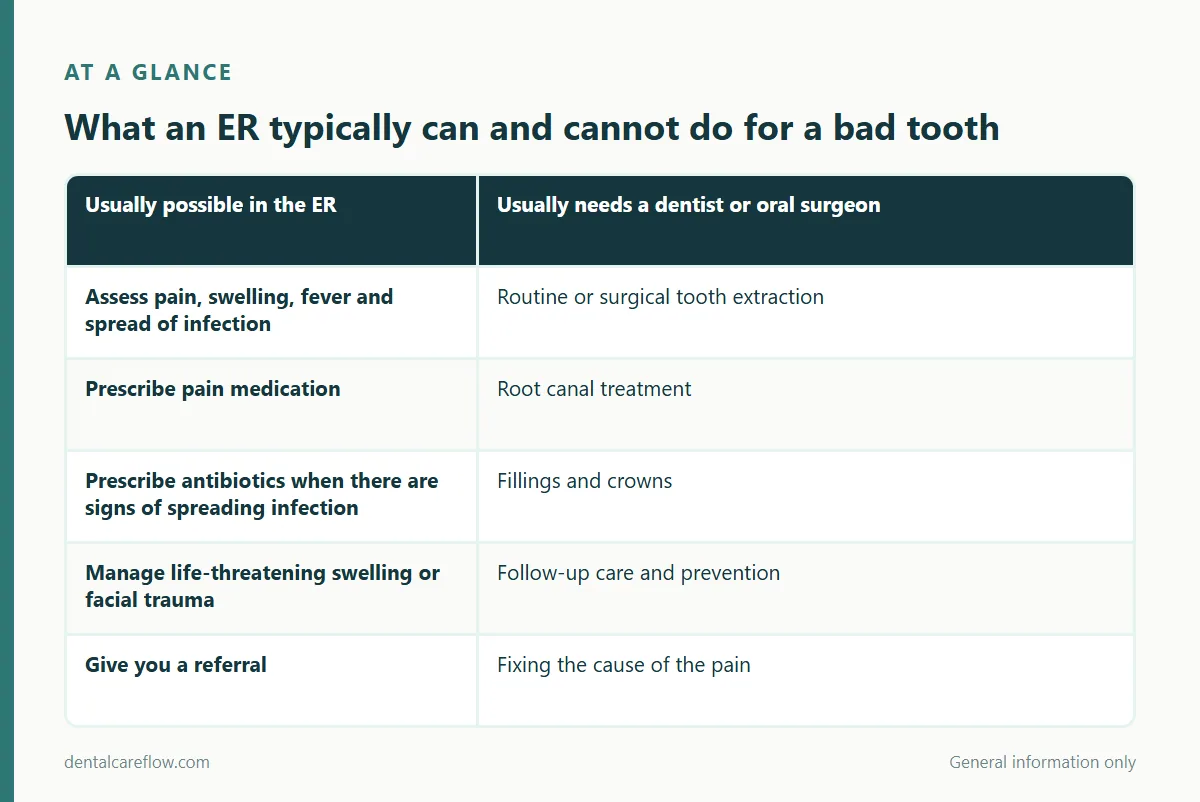
What an ER typically can and cannot do for a bad tooth
| Usually possible in the ER | Usually needs a dentist or oral surgeon |
|---|---|
| Assess pain, swelling, fever and spread of infection | Routine or surgical tooth extraction |
| Prescribe pain medication | Root canal treatment |
| Prescribe antibiotics when there are signs of spreading infection | Fillings and crowns |
| Manage life-threatening swelling or facial trauma | Follow-up care and prevention |
| Give you a referral | Fixing the cause of the pain |
There are exceptions. MedlinePlus notes that a severe tooth abscess may require extraction, surgical drainage or admission to the hospital, and some hospitals run their own dentistry and oral surgery departments. That is different from what you should expect on a typical walk-in ER visit.
When is the ER still the right place?
Some dental problems are true emergencies. The ADA's guidance on what constitutes a dental emergency lists:
- Uncontrolled bleeding
- Cellulitis or a diffuse infection with swelling inside or outside the mouth that could compromise the airway
- Trauma involving the facial bones that could compromise the airway
MedlinePlus also describes swelling of the upper or lower jaw from a tooth abscess as a very serious symptom. If swelling is spreading, you have trouble breathing or swallowing, or you have had a facial injury, go to the ER or call 911. ADA MouthHealthy advises using your local emergency room if an accident happens when your dental office is closed.
Who can remove a tooth instead?
For an extraction itself, these are the usual options in the US:
- Your general dentist. The Bureau of Labor Statistics lists repairing or removing damaged teeth among a dentist's typical duties. MouthHealthy notes that most dentists set aside time for emergency patients, so call first and describe your symptoms.
- An oral surgeon. Cleveland Clinic lists oral surgeons as the specialists who handle extractions and other complex surgeries, often on referral.
- Dental school clinics. NIDCR notes that dental schools often run clinics where students treat patients at reduced cost under licensed dentists' supervision.
- Community health centers. NIDCR points to federally funded health centers where you pay based on your income.
What does an ER visit for tooth pain cost?
The ADA estimates around 2 million US emergency department visits for dental pain each year. Its referral program page cites dental-pain ER visits at roughly $400 to $1,500, compared with about $90 to $200 at a dentist. Since the ER usually cannot remove the tooth, you may pay for the ER visit and then again for the extraction. Coverage also matters: Medicare.gov says Original Medicare does not cover extractions in most cases, and Medicaid.gov explains that adult dental benefits vary by state.
If an infected tooth is already causing swelling after recent dental work, our guide to infection signs and prevention covers what to watch for.
Sources
- Journal of Public Health Dentistry (via PubMed Central), Pharmacologic Management of Non-Traumatic Dental Conditions in US Emergency Departments, 2018–2022
- American Dental Association, Emergency Department Referrals
- American Dental Association, What Constitutes a Dental Emergency?
- ADA MouthHealthy, Dental Emergencies
- MedlinePlus, Tooth abscess
- NIDCR, Finding Low-Cost Dental Care
- Cleveland Clinic, What Is a Dentist?
- US Bureau of Labor Statistics, Occupational Outlook Handbook: Dentists
- Medicare.gov, Dental services coverage
- Medicaid.gov, Dental Care
This article is general information and is not a substitute for advice from your own dentist. In a medical emergency, call 911.
Ask about treatment and costs
Two quick questions. General information only, no diagnosis.