How Can I Fix My Teeth? A Starting Map for US Patients
How can I fix my teeth? Match your problem to common treatments, see a sensible order for dental work and find lower-cost care options in the US.
Editorially reviewed. This article has not been reviewed by a clinician. How we work

On this page
How can I fix my teeth? Start with a dental exam, because the right fix depends on the problem: fillings for cavities, bonding or veneers for chips and stains, crowns for weak or cracked teeth, braces or aligners for crooked teeth, and bridges, dentures or implants for missing teeth.
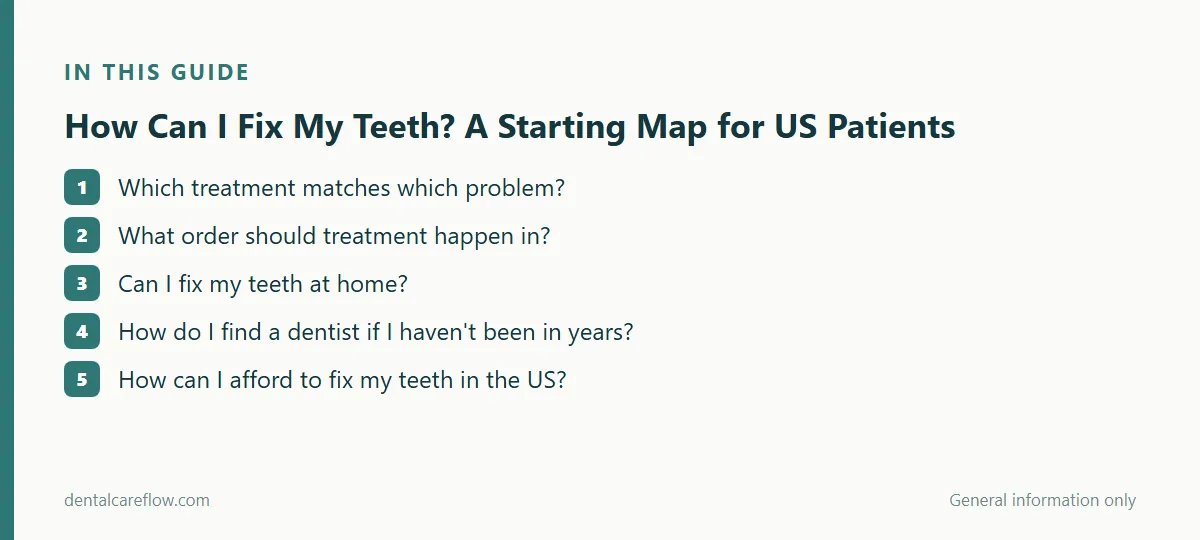
If you have been putting off dental work, the list of possible treatments can feel overwhelming, and the cost can feel even more so. This guide is a starting map for people in the US: match your main concern to the treatments dentists typically use, then work out a sensible order and a way to pay for it.
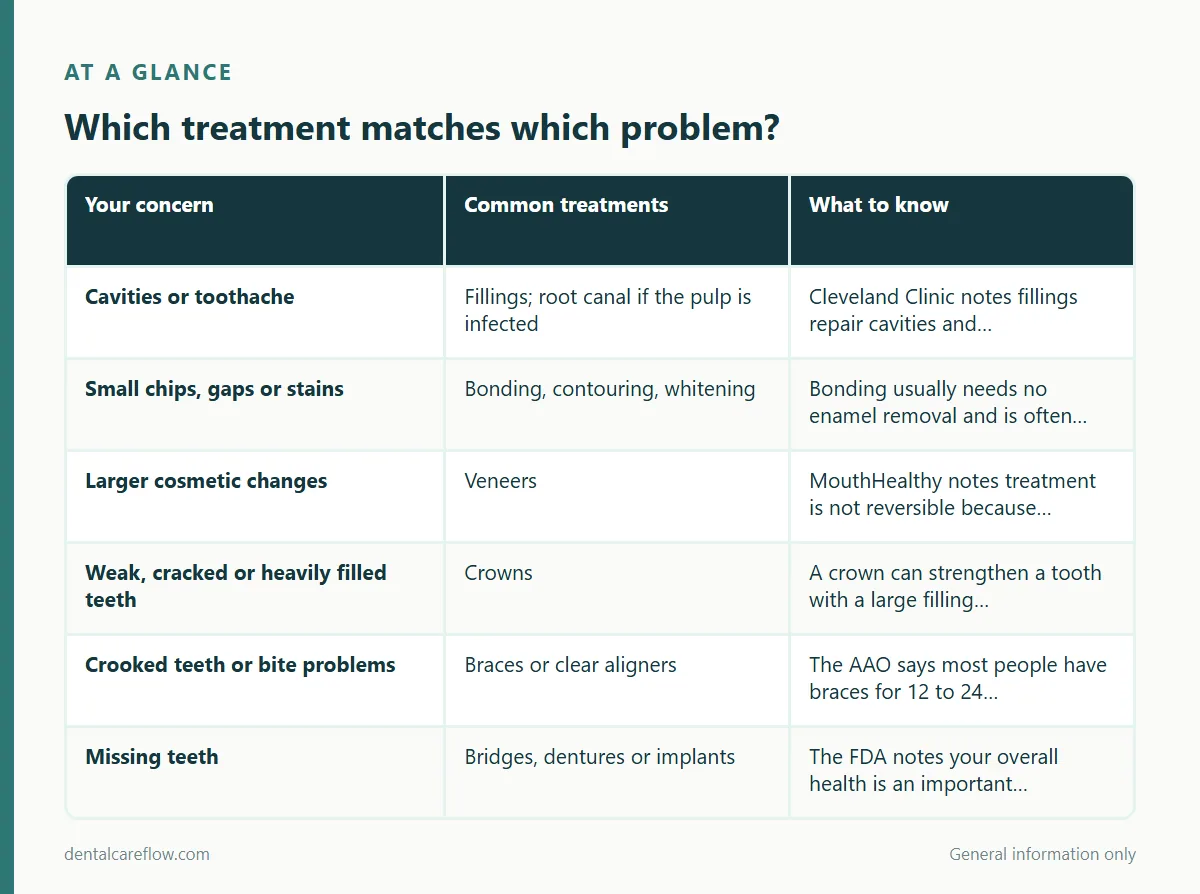
Which treatment matches which problem?
| Your concern | Common treatments | What to know |
|---|---|---|
| Cavities or toothache | Fillings; root canal if the pulp is infected | Cleveland Clinic notes fillings repair cavities and minor chips and help preserve natural tooth structure |
| Small chips, gaps or stains | Bonding, contouring, whitening | Bonding usually needs no enamel removal and is often done in one visit (Cleveland Clinic) |
| Larger cosmetic changes | Veneers | MouthHealthy notes treatment is not reversible because enamel is removed |
| Weak, cracked or heavily filled teeth | Crowns | A crown can strengthen a tooth with a large filling when there isn't enough tooth left (MouthHealthy) |
| Crooked teeth or bite problems | Braces or clear aligners | The AAO says most people have braces for 12 to 24 months, followed by a retainer |
| Missing teeth | Bridges, dentures or implants | The FDA notes your overall health is an important factor in whether implants suit you |
| Bleeding or receding gums | Professional cleaning; scaling and root planing | The CDC describes deep cleaning as a main non-surgical treatment for gum disease |
What order should treatment happen in?
Health problems usually come before cosmetic ones. Cleveland Clinic notes, for example, that veneers are an option only if you are free of extensive cavities and gum disease, and that serious oral health problems should be treated first. One simple way to think about the order, to discuss with your dentist:
- Urgent problems: pain, infection, swelling or broken teeth.
- Disease control: fillings for decay and treatment for gum disease.
- Rebuilding: crowns, root canals or replacing missing teeth.
- Alignment: braces or aligners if needed.
- Cosmetic finishing: whitening, bonding or veneers.
Your dentist may adjust this order for your situation, but asking for a phased treatment plan helps you budget and prioritize.
Can I fix my teeth at home?
Home care prevents problems; it does not repair damage. Cleveland Clinic states that a cracked tooth can't heal and advises against trying to fix one at home. The American Association of Orthodontists warns that DIY "fashion braces" can worsen your bite and alignment and use adhesives that are not medical-grade. What you can do at home is protect what you have: the CDC recommends brushing twice a day, flossing daily, and seeing a dental provider at least once a year.
How do I find a dentist if I haven't been in years?
Cleveland Clinic describes general dentists as the people who look after your overall oral health and refer you to specialists when needed, so a general dentist is the usual first stop. At the first visit, ask for:
- A full exam and any needed x-rays
- A written list of problems, ranked by urgency
- A phased treatment plan with estimated costs for each phase
- Options for each problem, including less expensive alternatives
How can I afford to fix my teeth in the US?
NIDCR lists several lower-cost routes:
- Dental school clinics, where students treat patients at reduced cost under supervision
- Federally funded community health centers that charge based on income
- State and local health department programs; calling 2-1-1 can point you to them
- Clinical trials that sometimes provide limited free or low-cost treatment
On public coverage, Medicare.gov says Original Medicare does not cover most dental services, while Medicaid.gov explains that Medicaid covers dental care for all children enrolled and that adult benefits vary by state. If you are researching treatment abroad to save money, read cheap dental treatment risks explained first, and for missing teeth specifically see the best dental solution for missing teeth.
Sources
- Cleveland Clinic, What Is a Dentist?
- Cleveland Clinic, Dental Fillings
- Cleveland Clinic, Dental Bonding
- Cleveland Clinic, Dental Veneers
- Cleveland Clinic, Cracked Tooth
- ADA MouthHealthy, Crowns
- ADA MouthHealthy, Veneers
- American Association of Orthodontists, How Do Braces Work?
- American Association of Orthodontists, The Dangers of Fashion Braces
- FDA, Dental Implants: What You Should Know
- CDC, Gum (Periodontal) Disease
- NIDCR, Finding Low-Cost Dental Care
- Medicare.gov, Dental services coverage
- Medicaid.gov, Dental Care
This article is general information and is not a substitute for advice from your own dentist.
Ask about treatment and costs
Two quick questions. General information only, no diagnosis.