How Long Do Teeth Sealants Last? Coating vs Protection
How long do teeth sealants last? See how long the coating stays on, how long CDC data shows sealants keep preventing decay, and when to reapply them.
Editorially reviewed. This article has not been reviewed by a clinician. How we work

On this page
How long do teeth sealants last? Cleveland Clinic says sealants last up to five years, and the ADA notes they often last several years before they need reapplying. CDC research found they prevent about 81% of decay in permanent molars two years after placement and can keep working for up to nine years.
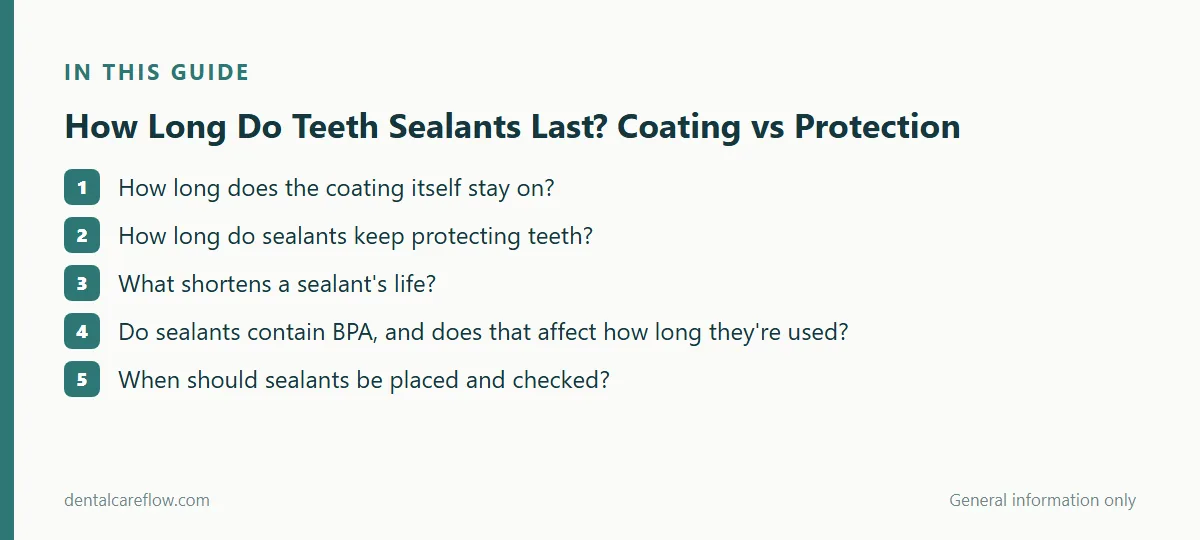
Sealants are thin coatings painted onto the chewing surfaces of back teeth. They are one of the most common preventive treatments for American children and teens, and many school-based programs place them for free or at low cost. This article separates two questions people often mix up: how long the coating stays on, and how long it keeps protecting the tooth.
How long does the coating itself stay on?
Cleveland Clinic describes sealants as liquid coatings made from medical-grade resins or glass ionomers, painted onto premolars and molars and hardened with a curing light. It says they last up to five years and should be replaced on a regular basis for best results. The ADA's MouthHealthy site says sealants often last several years before they need to be reapplied, and that your dentist checks their condition at regular visits and can reapply them as needed.
How long do sealants keep protecting teeth?
A 2016 CDC Vital Signs report summarized the evidence this way:
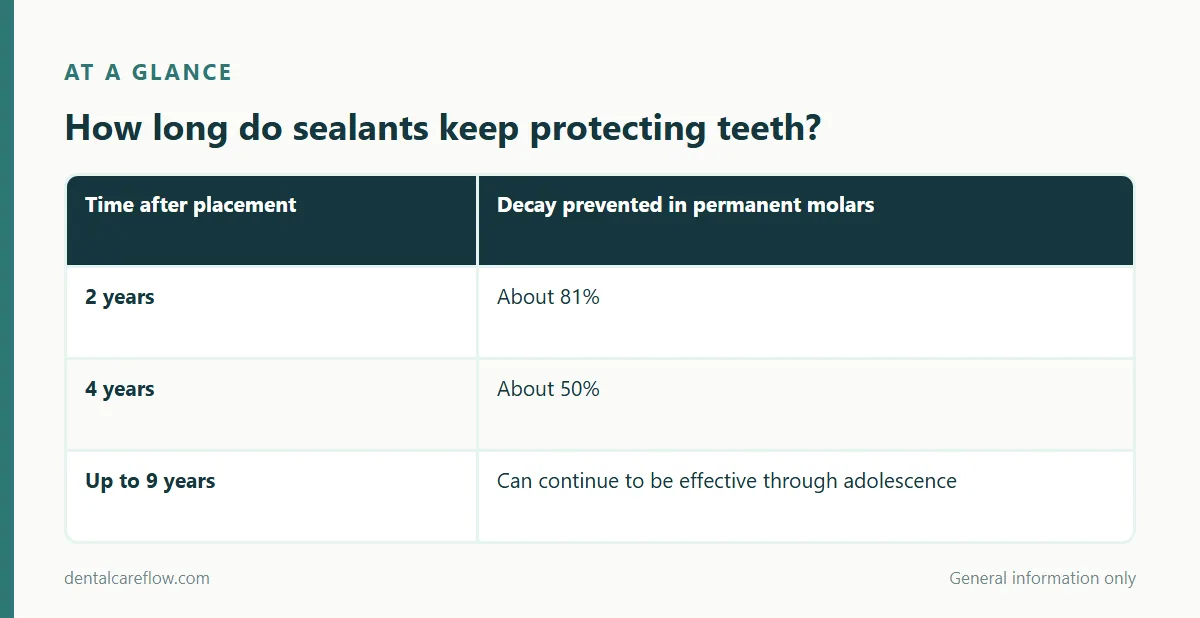
| Time after placement | Decay prevented in permanent molars |
|---|---|
| 2 years | About 81% |
| 4 years | About 50% |
| Up to 9 years | Can continue to be effective through adolescence |
The drop over time reflects sealants wearing or partly coming off, which is why checks at routine visits matter. Cleveland Clinic adds that children aged 6 to 11 without sealants are three times more likely to develop tooth decay.
What shortens a sealant's life?
- Heavy chewing forces and grinding gradually wear the coating.
- Chewing ice and hard candy can chip it.
- Imperfect placement. Cleveland Clinic notes that sealants placed incorrectly can trap bacteria and cause cavities.
- Skipping checkups, so small chips go unnoticed and aren't repaired.
Do sealants contain BPA, and does that affect how long they're used?
Some parents hesitate to reapply sealants because of concerns about BPA. The ADA's MouthHealthy site addresses this directly: there is a tiny amount of BPA in sealants, but not enough to cause harm, and everyday exposure from sources such as receipts, cosmetics and dust is greater. Clear sealants also let dentists keep an eye on the tooth underneath, and MouthHealthy notes sealants can even be placed over early decay to help stop further damage.
When should sealants be placed and checked?
Cleveland Clinic advises that children get sealants on permanent molars and premolars as soon as these teeth come in, to protect them through the cavity-prone years from about age 6 through 14. Adults without decay or fillings in their molars can benefit too. A simple timeline many families follow:
- When the first permanent molars come in: ask about sealing them.
- When later molars and premolars arrive: ask again, since each new tooth needs its own sealant.
- Every routine visit: the dentist checks the sealants and touches up worn spots.
- Late teens and adults: ask whether resealing still makes sense for your teeth.
Are sealants worth reapplying?
Cleveland Clinic calls sealants less costly than other treatments and notes they can reduce the need for more invasive dental work later. In the US, children enrolled in Medicaid have dental coverage under the EPSDT benefit, which Medicaid.gov says includes services to maintain dental health. The CDC report also found that only 38.7% of low-income children aged 6 to 11 had sealants, which is why many states run school sealant programs. Ask your child's school or local health department whether one operates near you.
Sealants can't be placed on teeth that already have decay, fillings or crowns, according to Cleveland Clinic. For comparing longer-term restorations, see our article on dental crown types.
Sources
- Cleveland Clinic, Dental Sealants
- ADA MouthHealthy, Sealants
- CDC, Vital Signs: Dental Sealant Use and Untreated Tooth Decay Among U.S. School-Aged Children (2016)
- Medicaid.gov, Dental Care
This article is general information and is not a substitute for advice from your own dentist. Ask your dentist whether sealants suit your or your child's teeth.
Ask about treatment and costs
Two quick questions. General information only, no diagnosis.