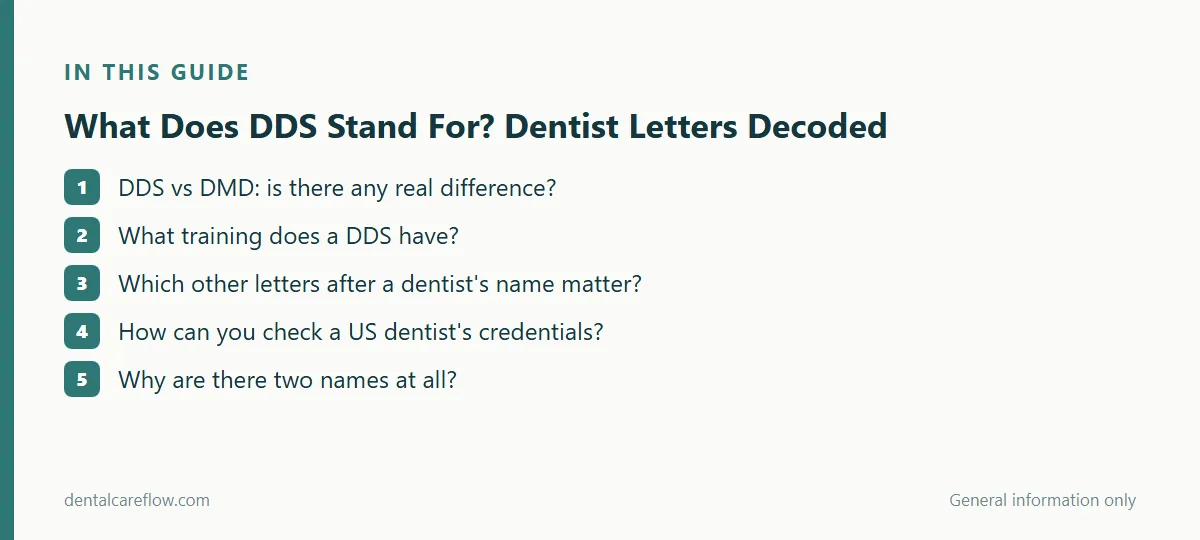
What Does DDS Stand For? Dentist Letters Decoded
What does DDS stand for? Doctor of Dental Surgery. See how it compares with DMD, what US training and licensing it requires, and which letters really matter.
Editorially reviewed. This article has not been reviewed by a clinician. How we work

On this page
What does DDS stand for? DDS stands for Doctor of Dental Surgery. It is one of two degree titles US dental schools award; the other is DMD. According to the American Dental Association's MouthHealthy site, both mean the same thing: your dentist graduated from an accredited dental school.
If you have seen "DDS" after one dentist's name and "DMD" after another's, you may have wondered whether one is better trained. It is a reasonable question, and the short answer is no. Below we explain where the letters come from, what training sits behind them in the US, and which other letters on a dentist's door or website are actually worth paying attention to.
DDS vs DMD: is there any real difference?
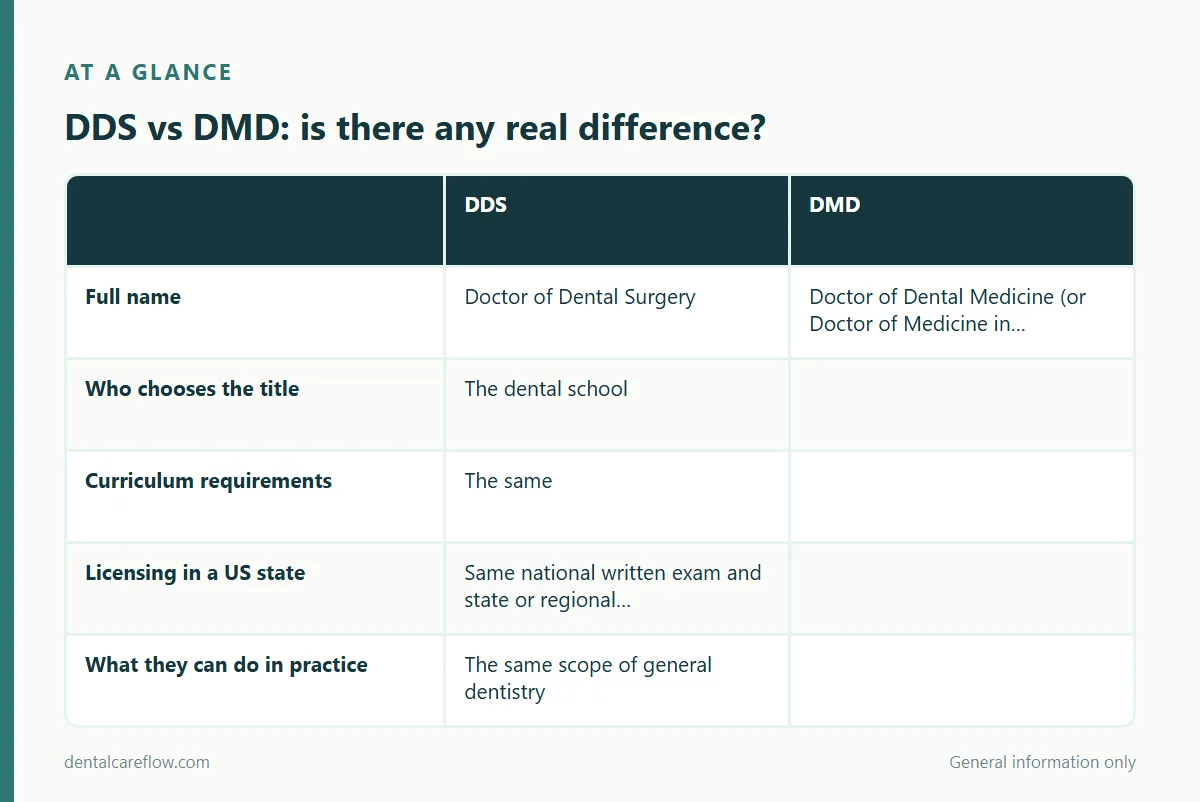
MouthHealthy explains that DDS (Doctor of Dental Surgery) and DMD (Doctor of Medicine in Dentistry, also written as Doctor of Dental Medicine) are equivalent. Each university decides which title to award, and both degrees use the same curriculum requirements. Cleveland Clinic adds that dentists with either degree receive the same amount of training and can do the same dental procedures.
| DDS | DMD | |
|---|---|---|
| Full name | Doctor of Dental Surgery | Doctor of Dental Medicine (or Doctor of Medicine in Dentistry) |
| Who chooses the title | The dental school | |
| Curriculum requirements | The same | |
| Licensing in a US state | Same national written exam and state or regional clinical exam | |
| What they can do in practice | The same scope of general dentistry |
So when you are choosing a family dentist in the US, DDS versus DMD should not be a deciding factor.
What training does a DDS have?
The letters represent a long path. Cleveland Clinic says a general dentist typically spends about eight years in school: four years of undergraduate study plus four years of dental school. MouthHealthy describes it as three or more years of undergraduate education plus four years of dental school, which it compares to medical school. The US Bureau of Labor Statistics notes that dental programs usually require at least a bachelor's degree and certain science courses for admission.
After graduation, a DDS cannot simply start working. In the United States:
- The ADA states that all US licensing jurisdictions require applicants to pass the Integrated National Board Dental Examination (INBDE).
- Most jurisdictions also require a clinical assessment, and requirements are set by each state board of dentistry.
- Dentists must be licensed in the state where they work (BLS).
- To keep a license, dentists complete continuing education throughout their careers (MouthHealthy).
Which other letters after a dentist's name matter?
DDS or DMD tells you someone is a dentist. What it does not tell you is whether they have extra specialty training. According to BLS, dental specialties typically require a two- to four-year residency after dental school, and oral and maxillofacial surgery takes four to six years. Common specialists include:
- Orthodontists for braces and bite alignment
- Periodontists for gum disease
- Endodontists for root canal treatment
- Oral and maxillofacial surgeons for complex extractions and surgery
- Prosthodontists for crowns, bridges and dentures
- Pediatric dentists for children
You may also see other letters alongside DDS or DMD. When in doubt, ask the office where the dentist trained and whether they completed a residency.
How can you check a US dentist's credentials?
Because each state licenses its own dentists, the most direct check is your state board of dentistry, which the ADA identifies as the body that sets licensure requirements. A short checklist:
- Confirm the dentist holds an active license in your state.
- Check whether any disciplinary actions are listed.
- If they call themselves a specialist, ask where they completed their residency.
- Ask which procedures they do in-house and which they refer out.
If you are comparing dentists trained abroad, our guide on whether Turkish dentists are qualified covers how foreign credentials are assessed. The ADA notes that most US states require graduates of international dental programs to complete additional education and receive a DDS or DMD before they can be licensed here.
Why are there two names at all?
The two titles reflect historical choices by individual universities rather than any difference in what is taught. MouthHealthy is clear that the choice belongs to each school and that the curriculum requirements are the same, so the letters are best read simply as "dentist."
Sources
- ADA MouthHealthy, DDS and DMD
- Cleveland Clinic, What Is a Dentist?
- US Bureau of Labor Statistics, Occupational Outlook Handbook: Dentists
- American Dental Association, Licensure for International Dentists
This article is general information and is not a substitute for advice from your own dentist.
Ask about treatment and costs
Two quick questions. General information only, no diagnosis.