Does Dental Amalgam Contain Nickel? Metals in Your Mouth
Does dental amalgam contain nickel? See what the FDA says amalgam is made of, which dental crowns and wires can contain nickel, and what to ask if allergic.
Editorially reviewed. This article has not been reviewed by a clinician. How we work

On this page
Does dental amalgam contain nickel? According to the FDA, standard dental amalgam does not list nickel as an ingredient. It is about 50% elemental mercury by weight, with the rest a powdered alloy of silver, tin and copper. Nickel does appear in some other dental metals, such as certain crowns and orthodontic wires.
The question usually comes from people with a known nickel allergy who want to know whether their "silver" fillings could be the problem. This article sorts out which dental materials the US sources say contain nickel and which do not, and what to tell your dentist if you have a metal allergy.
What is dental amalgam made of?
The FDA's page on dental amalgam fillings states that approximately half of dental amalgam is elemental mercury by weight, and the other half is a powdered alloy composed of silver, tin and copper. When the FDA advises people with metal sensitivities, it names those same four metals: mercury, silver, copper and tin. Nickel is not among them.
That does not mean every metal in your mouth is nickel-free. Your dental records should show what was placed, and your dentist can confirm the specific product used.
Which dental materials can contain nickel?
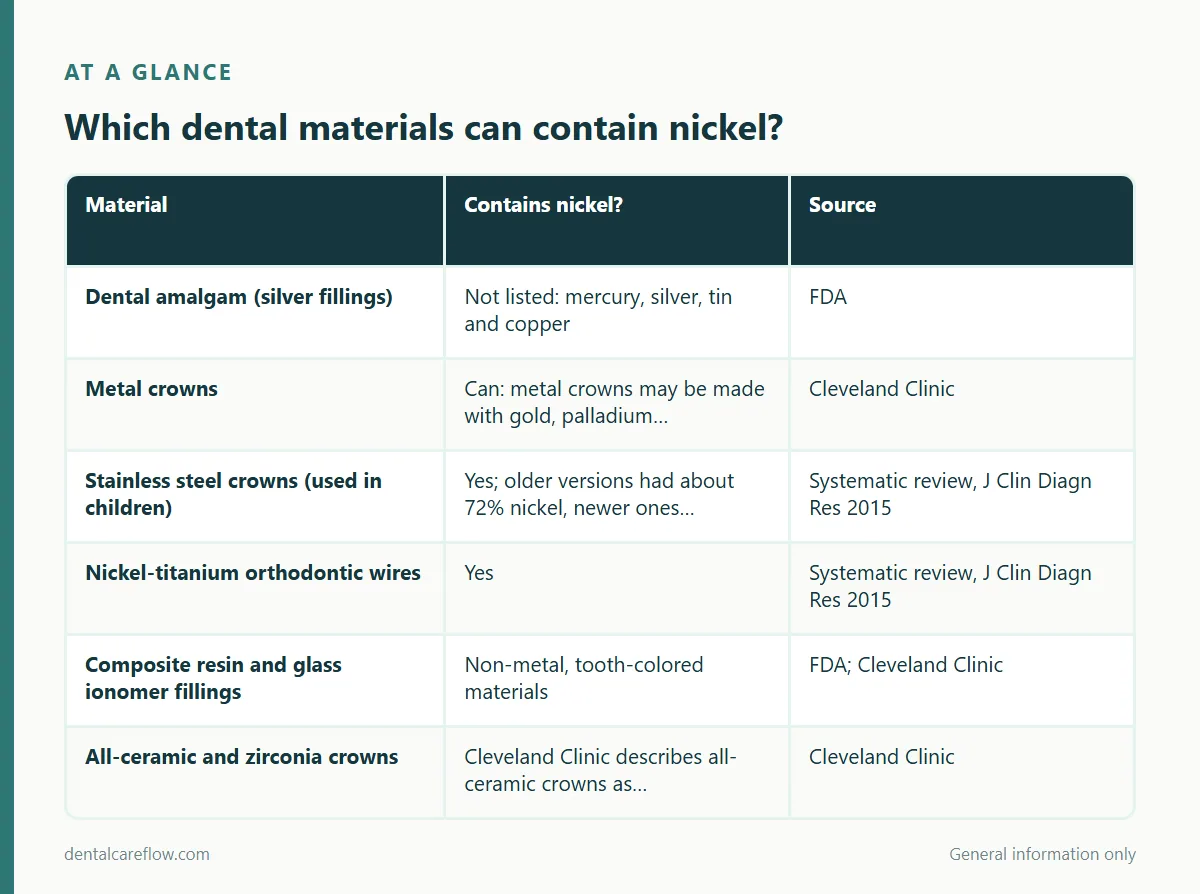
| Material | Contains nickel? | Source |
|---|---|---|
| Dental amalgam (silver fillings) | Not listed: mercury, silver, tin and copper | FDA |
| Metal crowns | Can: metal crowns may be made with gold, palladium, nickel or chromium | Cleveland Clinic |
| Stainless steel crowns (used in children) | Yes; older versions had about 72% nickel, newer ones about 9 to 12% | Systematic review, J Clin Diagn Res 2015 |
| Nickel-titanium orthodontic wires | Yes | Systematic review, J Clin Diagn Res 2015 |
| Composite resin and glass ionomer fillings | Non-metal, tooth-colored materials | FDA; Cleveland Clinic |
| All-ceramic and zirconia crowns | Cleveland Clinic describes all-ceramic crowns as suitable for people with metal allergies | Cleveland Clinic |
What does the FDA say about amalgam and metal allergies?
The FDA says you should not get amalgam fillings if you are allergic or sensitive to any of the metals in amalgam. It also lists groups for whom it encourages non-amalgam alternatives, such as composite resins and glass ionomer cements, when your dentist considers them appropriate:
- Pregnant women, women planning to become pregnant, and nursing women and their infants
- Children under six
- People with pre-existing neurological disease or impaired kidney function
- People with known allergy to mercury or other metals
Should you have existing amalgam fillings removed?
Not routinely. The FDA does not recommend that anyone remove or replace existing amalgam fillings in good condition unless a health care professional considers it medically necessary, for example because of documented hypersensitivity to the material. It is a decision to make with your dentist, not on your own.
What might a reaction to a dental metal look like?
A 2015 systematic review in the Journal of Clinical and Diagnostic Research found that the most common sign of a reaction to dental materials in the mouth is oral lichenoid lesions, and also reported burning, swelling of the cheek lining and inflamed gums. It notes most of the evidence comes from case reports. Where nickel hypersensitivity is confirmed during orthodontic treatment, the review advises switching nickel-titanium wires to stainless steel or titanium-molybdenum alloy.
A checklist if you have a nickel allergy
- Tell your dentist and orthodontist at every new treatment, and ask that it is noted in your chart.
- Bring any allergy test results from your doctor or allergist.
- Ask what metal, if any, is in a proposed crown, bridge or appliance.
- Ask about non-metal options such as composite, glass ionomer, all-ceramic or zirconia.
- Report any new burning, white patches or swelling near a dental restoration.
For more on crown materials, see our comparison of zirconia vs porcelain crowns.
Sources
- FDA, Dental Amalgam Fillings
- Cleveland Clinic, Dental Crowns
- Cleveland Clinic, Dental Fillings
- Syed M, Chopra R, Sachdev V. Journal of Clinical and Diagnostic Research, 2015, Allergic Reactions to Dental Materials: A Systematic Review
This article is general information and is not a substitute for advice from your own dentist or allergist.
Ask about treatment and costs
Two quick questions. General information only, no diagnosis.