What Is a DMD Degree? The Path to Becoming a US Dentist
What is a DMD degree? Follow the US path from college prerequisites to dental school, the INBDE, state licensing and optional specialty residencies.
Editorially reviewed. This article has not been reviewed by a clinician. How we work

On this page
What is a DMD degree? A DMD, or Doctor of Dental Medicine, is the professional doctorate that qualifies someone to become a dentist in the United States. It is awarded after four years of accredited dental school and is equivalent to the DDS degree.
This article looks at the DMD from the perspective of someone considering dental school, or a patient who wants to understand what years of training sit behind those three letters. We follow the path step by step, from college prerequisites to a state license, using US sources such as the American Dental Association (ADA) and the Bureau of Labor Statistics (BLS).
Is a DMD the same as a DDS?
Yes. ADA MouthHealthy explains that DMD (Doctor of Medicine in Dentistry or Doctor of Dental Medicine) and DDS (Doctor of Dental Surgery) mean the same thing, that each university chooses which degree to award, and that both use the same curriculum requirements. Cleveland Clinic adds that dentists with either title receive the same amount of training and can do the same procedures. A school that awards the DMD is simply using a different name for the same professional degree.
What does the path to a DMD look like?
Here is the typical US timeline, drawn from Cleveland Clinic, MouthHealthy, BLS and the ADA:
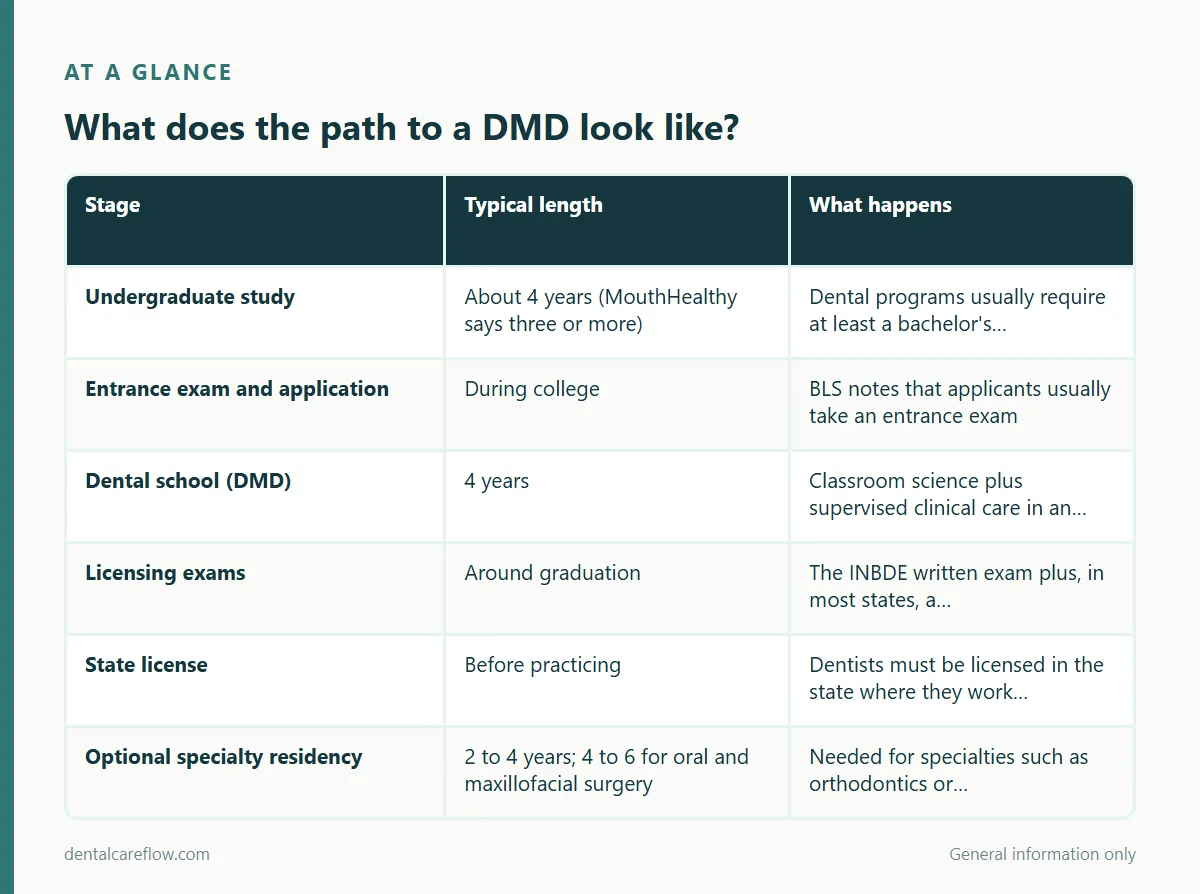
| Stage | Typical length | What happens |
|---|---|---|
| Undergraduate study | About 4 years (MouthHealthy says three or more) | Dental programs usually require at least a bachelor's degree and certain science courses (BLS) |
| Entrance exam and application | During college | BLS notes that applicants usually take an entrance exam |
| Dental school (DMD) | 4 years | Classroom science plus supervised clinical care in an accredited program |
| Licensing exams | Around graduation | The INBDE written exam plus, in most states, a clinical assessment (ADA) |
| State license | Before practicing | Dentists must be licensed in the state where they work (BLS) |
| Optional specialty residency | 2 to 4 years; 4 to 6 for oral and maxillofacial surgery | Needed for specialties such as orthodontics or periodontics (BLS) |
Cleveland Clinic sums this up as roughly eight years of school for a general dentist and 10 to 11 years for a specialist.
What does accreditation mean for a DMD program?
Accreditation is what makes the degree count toward a US license. The ADA states that applicants must graduate from a dental education program accredited by the Commission on Dental Accreditation (CODA) to meet the education requirement for licensure. Canadian programs accredited by the Commission on Dental Accreditation of Canada are recognized through a reciprocal agreement.
For internationally trained dentists, the route is different. The ADA explains that most states require graduates of international programs to complete additional predoctoral education and receive a DDS or DMD. One route the ADA describes is an advanced standing program, which place them into a US dental program beyond the first year.
Which exams come after the degree?
- INBDE: The ADA says all US licensing jurisdictions require the Integrated National Board Dental Examination. It launched in August 2020 and replaced the older NBDE Part I and Part II.
- Clinical assessment: Most jurisdictions require one, and many boards use third-party testing agencies. Which results are accepted varies by state.
- Continuing education: MouthHealthy notes that dentists must complete continuing education throughout their careers to keep their licenses.
What can a DMD graduate do, and what is the job outlook?
A licensed general dentist with a DMD can diagnose and treat problems with the teeth, gums and mouth. BLS lists typical duties such as removing decay, filling cavities, repairing or removing damaged teeth, giving anesthetics, prescribing medication and reading x-rays. General dentists do not need further training after dental school (BLS).
On the career side, BLS reports:
- Median annual pay for dentists of $176,110 in May 2025
- About 161,400 dentist jobs in 2025
- Employment projected to grow 6 percent from 2025 to 2035
- 78 percent of dentists employed in offices of dentists
Questions to ask if you are considering a DMD program
- Is the program CODA-accredited?
- Which clinical licensing exams do graduates usually take, and which states accept them?
- How much supervised patient care do students provide, and in what settings?
- Does the school offer residencies or links to specialty programs?
Patients interested in how training compares internationally can read our guide on how foreign dentists' qualifications are assessed.
Sources
- ADA MouthHealthy, DDS and DMD
- US Bureau of Labor Statistics, Occupational Outlook Handbook: Dentists
- American Dental Association, Licensure for International Dentists
- Cleveland Clinic, What Is a Dentist?
This article is general information and is not a substitute for advice from your own dentist or a dental school admissions office.
Ask about treatment and costs
Two quick questions. General information only, no diagnosis.