How to Clean All-on-4 Dental Implants: Daily Routine and Tools
How to clean All-on-4 dental implants: the brushes, floss threaders and water flosser tips for a fixed bridge, plus how often to see your dentist.
Editorially reviewed. This article has not been reviewed by a clinician. How we work

On this page
How to clean All-on-4 dental implants: brush the fixed bridge twice a day with a soft brush and nonabrasive toothpaste, then clean underneath it and around each implant with floss threaders or interproximal brushes, and keep regular professional cleanings.
A water flosser can help with this routine, but it should be an extra rather than a replacement for those tools.
Cleveland Clinic describes All-on-4 as a specific type of fixed implant denture: it attaches permanently, and you can't remove it at home, though your dentist can take it off for maintenance. That makes daily cleaning different from both natural teeth and removable dentures. Here is a practical routine, the tools involved and what professional visits add.
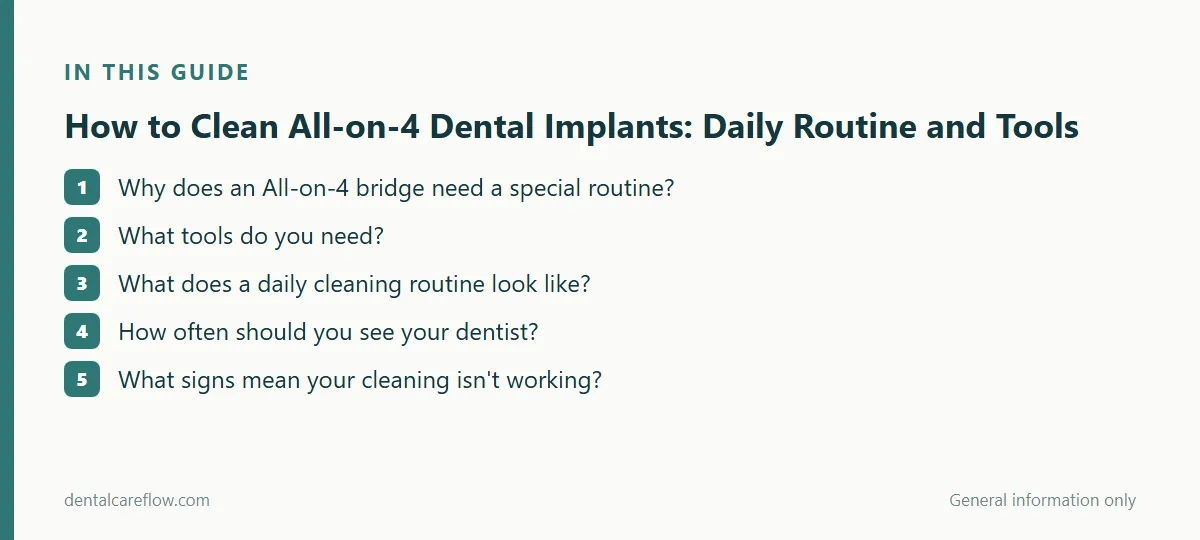
Why does an All-on-4 bridge need a special routine?
With removable dentures, you take the teeth out and clean them in your hand. A fixed full-arch bridge stays in, and the space between its underside and your gums is where food and plaque collect. Cleveland Clinic notes that you brush a fixed implant denture just like natural teeth and clean underneath it using floss threaders, interproximal brushes and other special cleaning tools. The American Academy of Periodontology adds that implants need the same daily brushing and flossing routines recommended for natural teeth.
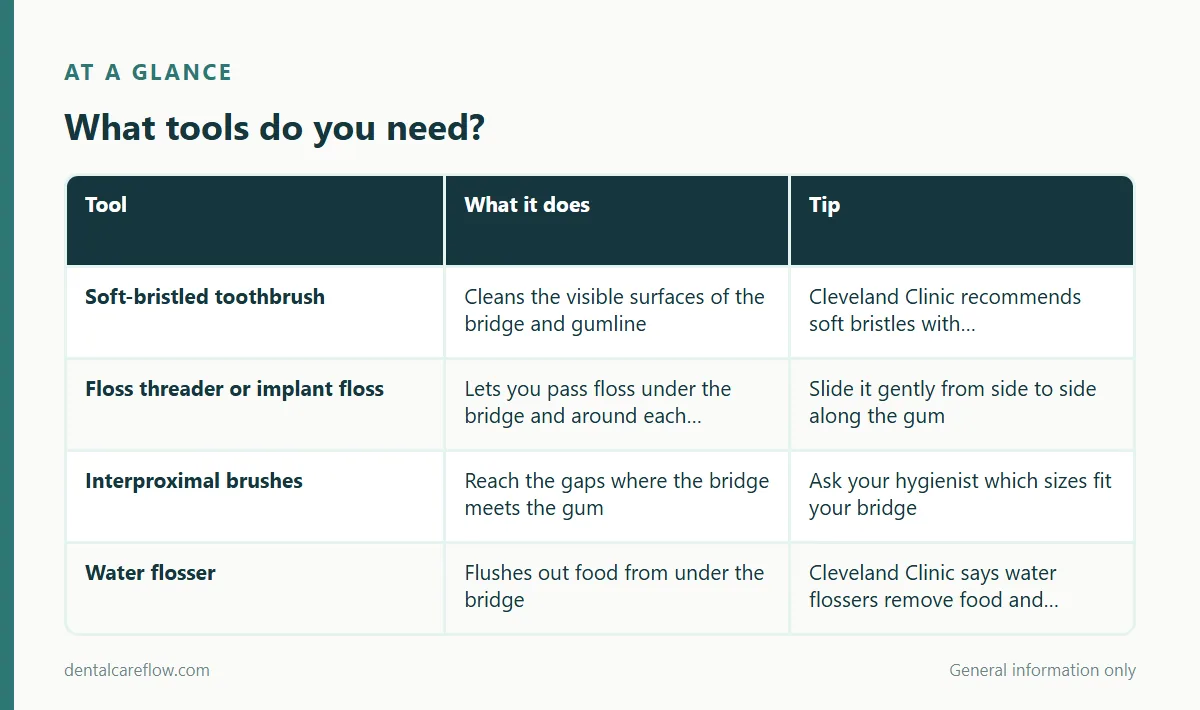
What tools do you need?
| Tool | What it does | Tip |
|---|---|---|
| Soft-bristled toothbrush | Cleans the visible surfaces of the bridge and gumline | Cleveland Clinic recommends soft bristles with nonabrasive toothpaste |
| Floss threader or implant floss | Lets you pass floss under the bridge and around each implant | Slide it gently from side to side along the gum |
| Interproximal brushes | Reach the gaps where the bridge meets the gum | Ask your hygienist which sizes fit your bridge |
| Water flosser | Flushes out food from under the bridge | Cleveland Clinic says water flossers remove food and debris well but can't remove biofilm, so use it as an extra |
What does a daily cleaning routine look like?
- Morning: brush all surfaces of the bridge, angling the brush toward the gumline. Cleveland Clinic suggests placing the brush at a 45-degree angle toward the gums.
- After meals: rinse with water or use a water flosser to clear food from under the bridge.
- Evening: brush again, then thread floss under the bridge and around each implant post. Follow with interproximal brushes in any gaps.
- Check your work: run your tongue under the edge of the bridge; any fuzzy or gritty feeling means plaque is still there.
Cleveland Clinic advises cleaning implant-supported dentures at least twice daily and brushing and flossing thoroughly around the implants.
How often should you see your dentist?
Cleveland Clinic recommends regular visits for exams and cleanings, noting that many people do well with six-month visits while people prone to gum problems may need more frequent appointments. With a fixed bridge, these visits matter because your dentist can remove it for maintenance when necessary. Our dental checkup schedule after implants explains what to expect over the first years.
What signs mean your cleaning isn't working?
- Bleeding or swollen gums around the implants
- Persistent bad breath or a bad taste
- Pus near an implant or tenderness that won't settle
- The bridge feeling loose or your bite changing
Cleveland Clinic lists a loose implant, bleeding or swollen gums, fever and pus around the implant among reasons to contact your dentist. For more on spotting problems early, see our guide to implant infection signs and prevention.
How long does an All-on-4 restoration last with good cleaning?
Cleveland Clinic says that with proper care and maintenance, dental implants can last a lifetime, while the denture portion on top typically needs replacing every 15 to 20 years. Good daily cleaning protects both the implants and the gums that hold them.
Sources
- Cleveland Clinic, Implant-Supported Dentures
- Cleveland Clinic, Oral Hygiene
- Cleveland Clinic, Dental Implants
- American Academy of Periodontology, Full Mouth Dental Implants
This article is general information and is not a substitute for advice from your own dentist or hygienist. Ask them to show you the cleaning tools that fit your bridge.
Ask about treatment and costs
Two quick questions. General information only, no diagnosis.