How to Fix a Cracked Tooth: Treatment by Type of Crack
How to fix a cracked tooth: match each type of crack to the usual repair, from bonding and crowns to root canals, plus what to do before your appointment.
Editorially reviewed. This article has not been reviewed by a clinician. How we work
On this page
How to fix a cracked tooth depends on the type and depth of the crack. A dentist may smooth or bond a minor crack, cover a weakened tooth with a crown, perform a root canal if the pulp is affected, or remove a tooth that is split below the gum line. A cracked tooth cannot heal by itself.
That last point surprises many people. Cleveland Clinic states plainly that a cracked tooth can't heal, though treatment might save it, and the American Association of Endodontists (AAE) notes that, unlike a broken bone, a cracked tooth does not mend. So the real question is not whether to fix it but how, and how quickly. This guide matches the type of crack to the usual repair.
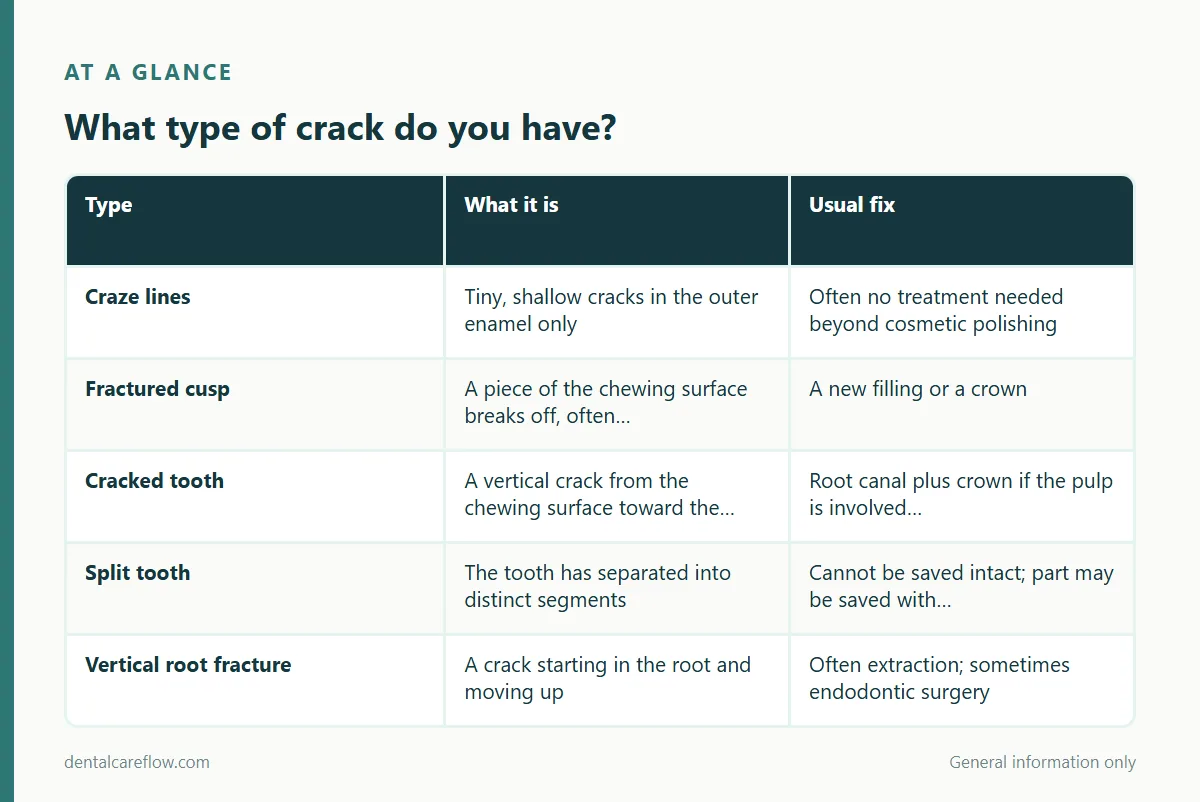
What type of crack do you have?
Dentists sort cracks into a handful of categories. The AAE and Cleveland Clinic describe five:
| Type | What it is | Usual fix |
|---|---|---|
| Craze lines | Tiny, shallow cracks in the outer enamel only | Often no treatment needed beyond cosmetic polishing |
| Fractured cusp | A piece of the chewing surface breaks off, often around a filling | A new filling or a crown |
| Cracked tooth | A vertical crack from the chewing surface toward the root, not yet separated | Root canal plus crown if the pulp is involved; extraction if it extends below the gum line |
| Split tooth | The tooth has separated into distinct segments | Cannot be saved intact; part may be saved with endodontic treatment |
| Vertical root fracture | A crack starting in the root and moving up | Often extraction; sometimes endodontic surgery |
What are the signs of a cracked tooth?
Cleveland Clinic notes that cracked teeth don't always cause symptoms. When they do, the AAE and Cleveland Clinic describe:
- Erratic pain when chewing, sometimes when you release the bite
- Sensitivity to heat, cold or sweets
- Pain that comes and goes, making it hard to pinpoint which tooth
- Swelling of the gum near the tooth
How does a dentist find the crack?
The AAE notes that pain from a crack can come and go, which can make the affected tooth hard to locate. Cleveland Clinic lists the tools dentists use, including a bite test, a close visual exam, passing a light through the tooth (transillumination), staining dye, a periodontal probe, dental x-rays and sometimes a cone beam CT scan.
Which treatments fix a cracked tooth?
Depending on what the exam shows, Cleveland Clinic lists these options:
- Bonding: tooth-colored resin fills a minor crack.
- Contouring and polishing: smooths small rough edges.
- Veneer: covers a crack on a front tooth.
- Crown: caps the tooth to hold it together. The AAE notes a crown offers maximum protection but cannot ensure success in every case.
- Root canal: needed when the pulp is infected or damaged, usually followed by a crown.
- Extraction: when the tooth cannot be saved, followed by a replacement such as a bridge or implant.
The AAE adds that once treated, most cracked teeth continue to function for years, but some cracks keep progressing despite treatment. That is why early diagnosis matters.
What can you do at home before your appointment?
There is no safe way to fix a cracked tooth at home, and Cleveland Clinic advises against trying. Until you are seen:
- Rinse with warm water or salt water (MouthHealthy and Cleveland Clinic).
- Hold a cold compress against your face to limit swelling.
- Chewing on the other side may be more comfortable until the tooth is checked.
- The AAE suggests biting on clean, moist gauze if breathing through your mouth or drinking cold fluids hurts, and not putting pain ointments or aspirin on the area.
Cleveland Clinic considers a badly cracked tooth a dental emergency because an untreated crack can lead to an abscess that spreads. Call your dentist promptly, and go to the ER if you develop spreading facial swelling or trouble breathing.
How can you lower the risk of another crack?
- Avoid chewing ice, unpopped popcorn kernels, hard candy and pens.
- Ask about a night guard if you clench or grind.
- Wear a mouthguard for contact sports.
- Do not use your teeth to open packaging.
If your dentist recommends a crown, our guide to zirconia vs porcelain crowns explains the common materials.
Sources
- American Association of Endodontists, Cracked Teeth
- Cleveland Clinic, Cracked Tooth (Fractured Tooth)
- ADA MouthHealthy, Dental Emergencies
This article is general information and is not a substitute for advice from your own dentist.
Ask about treatment and costs
Two quick questions. General information only, no diagnosis.