Which Procedure Treats Tooth Decay by Sealing the Tooth?
Which procedure treats tooth decay by sealing the tooth? Learn how dental sealants stop early decay, when a filling is needed instead, and who benefits.
Editorially reviewed. This article has not been reviewed by a clinician. How we work

On this page
Which procedure treats tooth decay by sealing the tooth? For early decay in the grooves of back teeth, the answer is a dental sealant: a thin coating painted on the chewing surface that, according to the ADA, can stop early decay from progressing. Once decay has made a cavity, the treatment is a filling.
The question often comes up in health classes, quizzes and dental assistant study guides, and the textbook answer is usually "sealant." In real life, though, the choice depends on how far the decay has gone. This article explains both procedures, how each one "seals" the tooth, and how to tell which one your dentist is likely to recommend.
How does a sealant treat decay?
A sealant is a protective barrier. The ADA describes sealants as materials applied to the chewing surfaces of teeth that flow into the pits and fissures and form a physical barrier on the tooth surface. Bacteria and food can no longer settle into those grooves.
Sealants are mainly preventive, but they also treat very early decay. The ADA's evidence summary says sealants are effective in preventing and arresting pit-and-fissure decay, and that they can slow the progression of early lesions that have not yet formed a cavity. ADA MouthHealthy adds that sealants can be placed over early decay to prevent further damage, and clear sealants let the dentist keep an eye on the tooth.
How is a sealant applied?
MouthHealthy describes a quick process:
- The tooth is cleaned and dried.
- An acidic gel is applied to roughen the surface so the sealant bonds well.
- The gel is rinsed off and the tooth dried again.
- The sealant is painted onto the grooves.
- A blue curing light hardens it.
The steps MouthHealthy describes do not include drilling or numbing, and sealants do not replace brushing and flossing.
How does a filling treat decay?
When decay has broken through the enamel and formed a hole, a coating on top is not enough. Cleveland Clinic explains that during a filling the dentist numbs the tooth with local anesthesia, removes the damaged or decayed tissue, fills the space with filling material, hardens it with a curing light if it is composite resin, then polishes and checks your bite. Cleveland Clinic notes that fillings reduce your risk of further decay, and that leaving decayed tissue behind can cause the cavity to grow larger.
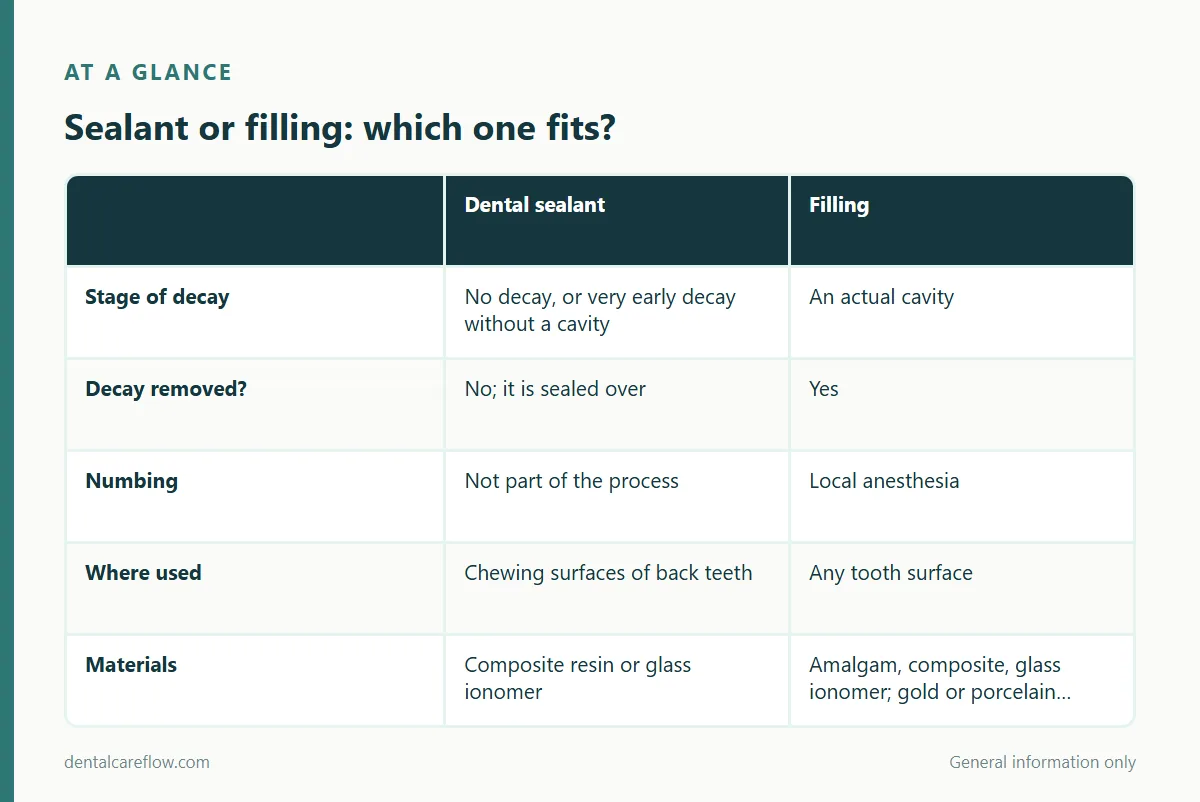
Sealant or filling: which one fits?
| Dental sealant | Filling | |
|---|---|---|
| Stage of decay | No decay, or very early decay without a cavity | An actual cavity |
| Decay removed? | No; it is sealed over | Yes |
| Numbing | Not part of the process | Local anesthesia |
| Where used | Chewing surfaces of back teeth | Any tooth surface |
| Materials | Composite resin or glass ionomer | Amalgam, composite, glass ionomer; gold or porcelain for indirect fillings |
Material details come from the ADA (sealants) and Cleveland Clinic (fillings).
How well do sealants work?
The CDC reports that sealants prevent 80% of cavities over two years in the back teeth, and that children without sealants have almost three times as many first-molar cavities as children with them. Despite that, the CDC notes that only about 42% of children aged 6 to 11 and 48% of adolescents aged 12 to 19 have sealants on permanent teeth. The ADA's guideline also found that sealed surfaces had a 73% lower risk of new decay than surfaces that received only fluoride varnish.
Who should get sealants?
- Children: MouthHealthy notes the first permanent molars usually come in around age 6 and the second molars around age 12, and earlier sealing is better.
- Teens and young adults: The CDC points out that adults aged 20 to 34 have more untreated cavities in their back teeth than any other age group, so young adults may benefit too.
- Other adults: MouthHealthy says adults can get sealants and a dentist can advise whether they are a good fit.
On coverage, MouthHealthy suggests contacting your dental benefits provider, since some plans cover sealants. Medicaid.gov notes that Medicaid covers dental services for all child enrollees. For a look at how other common treatments are priced, see our dental treatment price breakdown.
Sources
- American Dental Association, Dental Sealants
- ADA MouthHealthy, Sealants
- CDC, Dental Sealant Facts
- Cleveland Clinic, Dental Fillings
- Medicaid.gov, Dental Care
This article is general information and is not a substitute for advice from your own dentist.
Ask about treatment and costs
Two quick questions. General information only, no diagnosis.