What Are Veneers Made Of? Porcelain, Composite and More
What are veneers made of? Compare porcelain, composite, no-prep and snap-on veneers by placement, looks, lifespan and how much enamel each one needs.
Editorially reviewed. This article has not been reviewed by a clinician. How we work

On this page
What are veneers made of? Most are made of either porcelain, a ceramic custom-made in a dental lab, or composite resin, the same tooth-colored material used for bonding. No-prep and removable snap-on veneers are variations on these, and each material affects appearance, durability and how much enamel is removed.
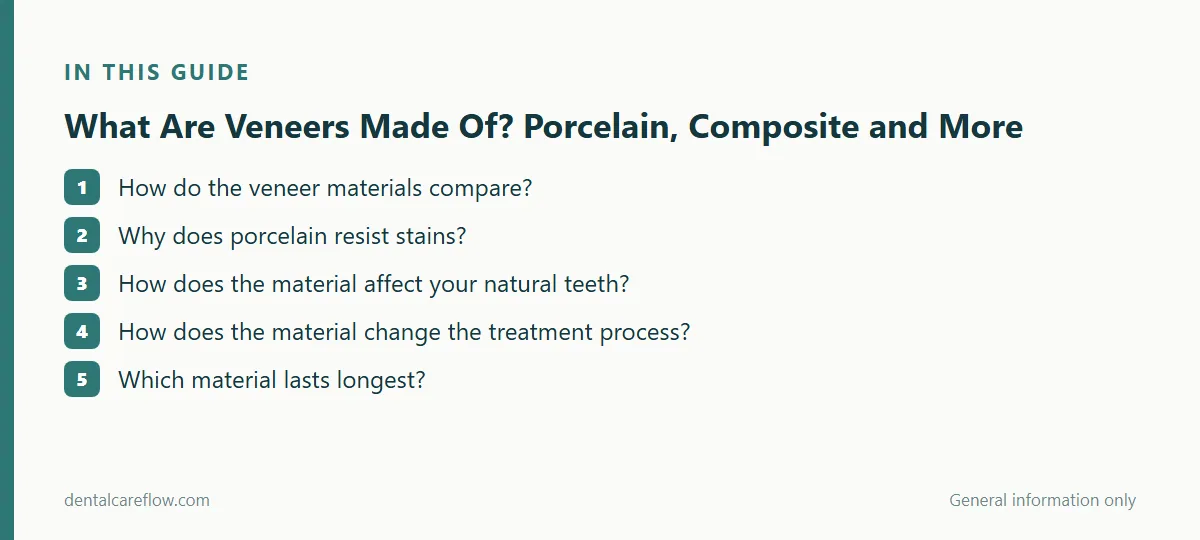
The material is the biggest single decision in a veneer treatment plan. It shapes how the veneers look, how they are placed, how they age and what repairs look like later. This article compares the materials side by side and explains why the choice matters for your own teeth.
How do the veneer materials compare?
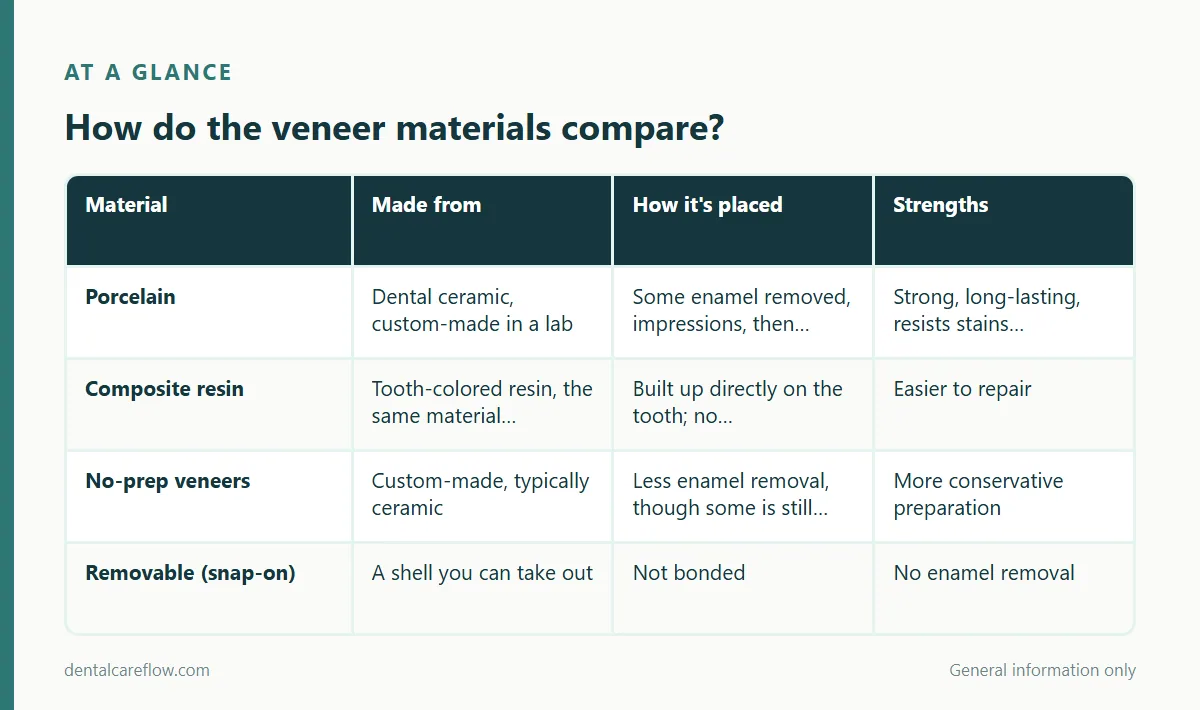
| Material | Made from | How it's placed | Strengths | Trade-offs |
|---|---|---|---|---|
| Porcelain | Dental ceramic, custom-made in a lab | Some enamel removed, impressions, then bonded at a second visit | Strong, long-lasting, resists stains better than enamel | Usually costs more; not reversible |
| Composite resin | Tooth-colored resin, the same material used for bonding | Built up directly on the tooth; no impressions needed | Easier to repair | Less resistant to staining and wear |
| No-prep veneers | Custom-made, typically ceramic | Less enamel removal, though some is still needed | More conservative preparation | Not suitable for everyone |
| Removable (snap-on) | A shell you can take out | Not bonded | No enamel removal | Can make eating difficult; limited research |
The descriptions above come from Cleveland Clinic and the ADA's MouthHealthy site.
Why does porcelain resist stains?
Cleveland Clinic notes that veneers resist staining better than natural tooth enamel and blend in with your natural teeth. MouthHealthy, for its part, describes composite as less resistant to stains than porcelain. Even porcelain veneers can be affected over time by dark drinks like coffee, tea and red wine, especially at the edges, so both sources advise limiting them.
How does the material affect your natural teeth?
Cleveland Clinic explains that porcelain veneers require removing some enamel, while no-prep versions need less. MouthHealthy states that treatment is not reversible because enamel is removed to place a veneer. Composite veneers are often more conservative, but they still involve bonding to the tooth surface. Before committing to any material, ask your dentist how much tooth structure will be changed.
How does the material change the treatment process?
Cleveland Clinic describes two quite different processes. Composite veneers are built up from resin directly on your teeth, without impressions, so they are typically completed in a single appointment. Traditional porcelain veneers start with a preparation visit, where small amounts of enamel are removed and impressions are taken, followed by a second visit to bond the finished veneers. Because the lab can take a few weeks, your dentist may fit temporary veneers in between. Cleveland Clinic also lists possible downsides that apply across materials: teeth can become more sensitive to heat and cold, and a veneer can occasionally fall off or become dislodged.
Which material lasts longest?
Cleveland Clinic puts the average veneer lifespan at 10 to 15 years with proper care and maintenance. MouthHealthy says porcelain is the stronger, longer-lasting option and that any veneer may chip, crack, wear down or loosen over time, needing re-bonding, repair or replacement. Composite's advantage is that small chips can often be repaired directly.
What should you ask when choosing a material?
- Which material suits my bite, and do I clench or grind? MouthHealthy notes veneers may not be a good choice for people who clench, grind or have a deep overbite.
- How much enamel will be removed for each option?
- How will each material look next to my untreated teeth?
- What does repair or replacement involve for each material?
- How does the price compare, given that veneers are cosmetic and usually not covered by insurance?
Do material choices change aftercare?
Only slightly. For any veneer, Cleveland Clinic recommends a soft brush, non-abrasive fluoride toothpaste and avoiding whitening products, which can scratch veneers. MouthHealthy reminds patients that cavities can still form under or around a veneer, so flossing and checkups still matter. Composite wearers may want to be stricter with staining foods.
For a deeper look at the two main materials, see our guide to porcelain vs composite veneers, and our complete guide to dental veneers for the bigger picture.
Sources
- Cleveland Clinic, Dental Veneers
- ADA MouthHealthy, Veneers
This article is general information and is not a substitute for advice from your own dentist.
Ask about treatment and costs
Two quick questions. General information only, no diagnosis.