Why No Dairy After Dental Implant Surgery? What's Behind the Rule
Why no dairy after dental implant surgery? See which antibiotics react with milk, which reasons are weak, and what to eat instead while your implant heals.
Editorially reviewed. This article has not been reviewed by a clinician. How we work

On this page
Why no dairy after dental implant surgery? The rule is not universal. The clearest reason is that some antibiotics, notably tetracycline, work poorly when taken with milk, yogurt or cheese. Other reasons you may read online have weaker support, so your surgeon's written instructions should decide what you eat.
Many American patients leave implant surgery with a printed sheet that says "no dairy for 24 to 48 hours" while a friend's sheet from a different office says nothing about it. This article explains where the advice comes from, which parts have solid backing, and how to eat well while you heal if you are asked to skip dairy for a while.
Where does the no-dairy advice come from?
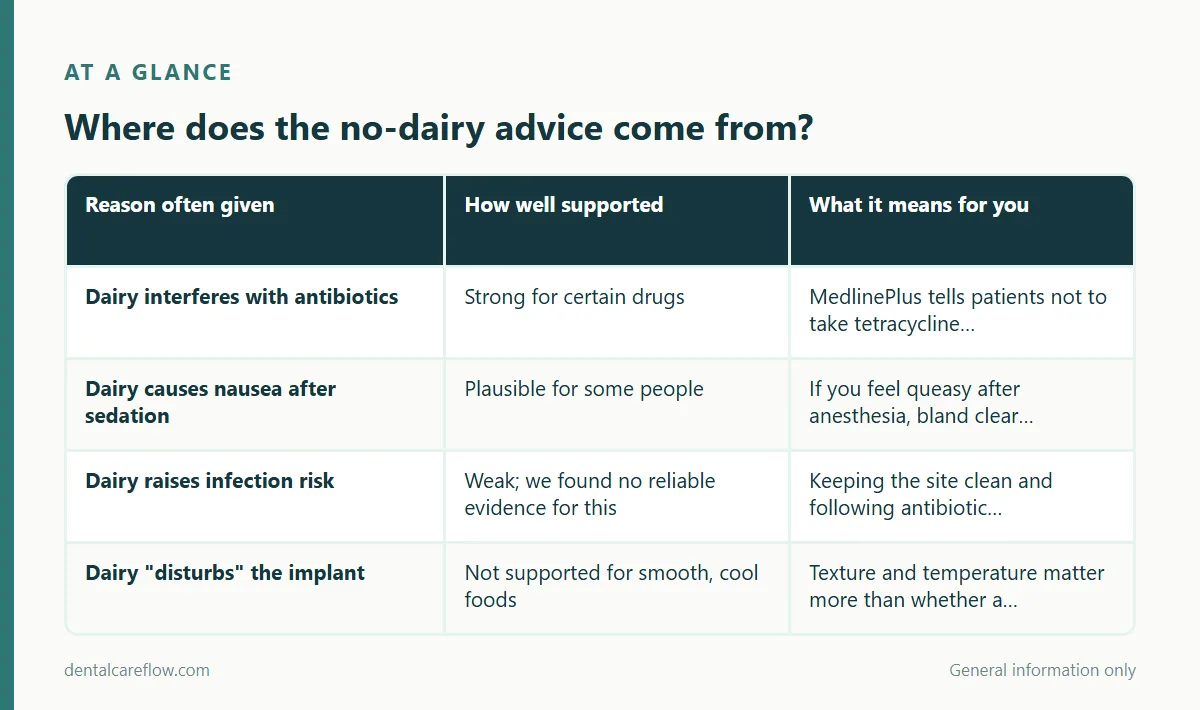
Patients usually hear one or more of these explanations:
| Reason often given | How well supported | What it means for you |
|---|---|---|
| Dairy interferes with antibiotics | Strong for certain drugs | MedlinePlus tells patients not to take tetracycline with dairy products such as milk, yogurt, cheese and ice cream |
| Dairy causes nausea after sedation | Plausible for some people | If you feel queasy after anesthesia, bland clear liquids may sit better at first |
| Dairy raises infection risk | Weak; we found no reliable evidence for this | Keeping the site clean and following antibiotic directions matters more |
| Dairy "disturbs" the implant | Not supported for smooth, cool foods | Texture and temperature matter more than whether a food contains dairy |
Does dairy really affect antibiotics after implant surgery?
It depends entirely on which antibiotic you were prescribed. MedlinePlus, the National Library of Medicine's drug guide, gives quite different directions for common antibiotics:
- Tetracycline: do not take it with food, especially dairy products such as milk, yogurt, cheese and ice cream, and take it at least 1 hour before or 2 hours after meals or snacks.
- Doxycycline: a tetracycline-class drug, yet MedlinePlus says you may take it with food or milk if it upsets your stomach, while spacing it from calcium supplements and antacids.
- Amoxicillin: MedlinePlus says it may be taken with food to prevent stomach upset and gives no dairy warning.
So a blanket dairy ban is sometimes a simple way for an office to keep patients from making timing mistakes with certain drugs. Read the pharmacy label on your own prescription and ask the pharmacist if anything is unclear.
How long should you avoid dairy after an implant?
Only as long as your surgeon or pharmacist tells you. If the reason is an antibiotic, the limit applies around doses for the length of the course, not necessarily to every meal. If the reason is nausea after sedation, it usually only matters on the day of surgery. Cleveland Clinic notes that slight discomfort and swelling after implant surgery are normal, the first round of healing takes about a week, and most people feel like themselves again within about a week.
What can you eat instead in the first few days?
If you have been asked to skip dairy, you can still get protein and calories from soft foods that need little chewing:
- Scrambled eggs or soft omelets, once warm (not hot) foods are allowed
- Smooth soups and broths, cooled to lukewarm
- Mashed potatoes made with broth or plant-based milk
- Applesauce, mashed banana and blended fruit
- Soft-cooked pasta, rice or oatmeal
- Hummus, flaked fish or tofu
For a stage-by-stage plan, see our guide to eating after dental implants safely.
What should you ask your surgeon before leaving the office?
- Is the dairy restriction tied to my antibiotic, to sedation, or to something else?
- How many hours or days does it apply?
- Can I take my antibiotic with food, and should I separate it from calcium supplements or antacids?
- Which foods and drink temperatures are safe for the first 24 hours?
- Which symptoms should make me call you?
Cleveland Clinic lists a loose implant, bleeding or swollen gums, fever, pus around the implant and swollen lymph nodes in the neck as reasons to contact your dentist. Our implant aftercare do's and don'ts covers the rest of the first-week routine.
Sources
- MedlinePlus, Tetracycline
- MedlinePlus, Doxycycline
- MedlinePlus, Amoxicillin
- Cleveland Clinic, Dental Implants
This article is general information and is not a substitute for advice from your own dentist, oral surgeon or pharmacist. Always follow the written instructions you were given.
Ask about treatment and costs
Two quick questions. General information only, no diagnosis.