Are Crowns Covered by Insurance? What US Plans Usually Pay
Are crowns covered by insurance? Learn how US dental plans, Medicaid and Medicare treat crowns, why material matters and how to get a pretreatment estimate.
Editorially reviewed. This article has not been reviewed by a clinician. How we work

On this page
Are crowns covered by insurance? Usually partly. Most US dental plans list crowns as a "major" service and pay a smaller share than for fillings, after your deductible and up to the annual maximum. Medical insurance and Original Medicare rarely pay for crowns except in narrow medical situations.
Whether your own crown is covered, and how much you will owe, comes down to which kind of coverage you have and why the crown is needed. Below is a coverage-by-coverage look, followed by the steps that help you avoid a surprise bill.
How do dental plans classify a crown?
MetLife's consumer guide explains that dental plans typically group care into three levels: preventive (cleanings, exams, X-rays), basic (fillings, extractions, root canals, gum treatment) and major (crowns, bridges, inlays, dentures). Major services are usually paid at a lower percentage than basic care. Delta Dental of Kansas adds that the plan's coinsurance amount for each category decides how much it pays for a procedure, with you paying the rest.
Two other plan rules affect crowns more than most treatments:
- The annual maximum. Once your plan has paid its yearly cap, you pay the remainder until the next benefit period. A crown, especially combined with a root canal, can use up much of that cap.
- Waiting periods. HealthCare.gov warns that separate dental plans can have waiting periods before they cover adult services, and you still pay premiums during that time. New policies often apply waits to major work.
Which types of coverage pay for crowns?
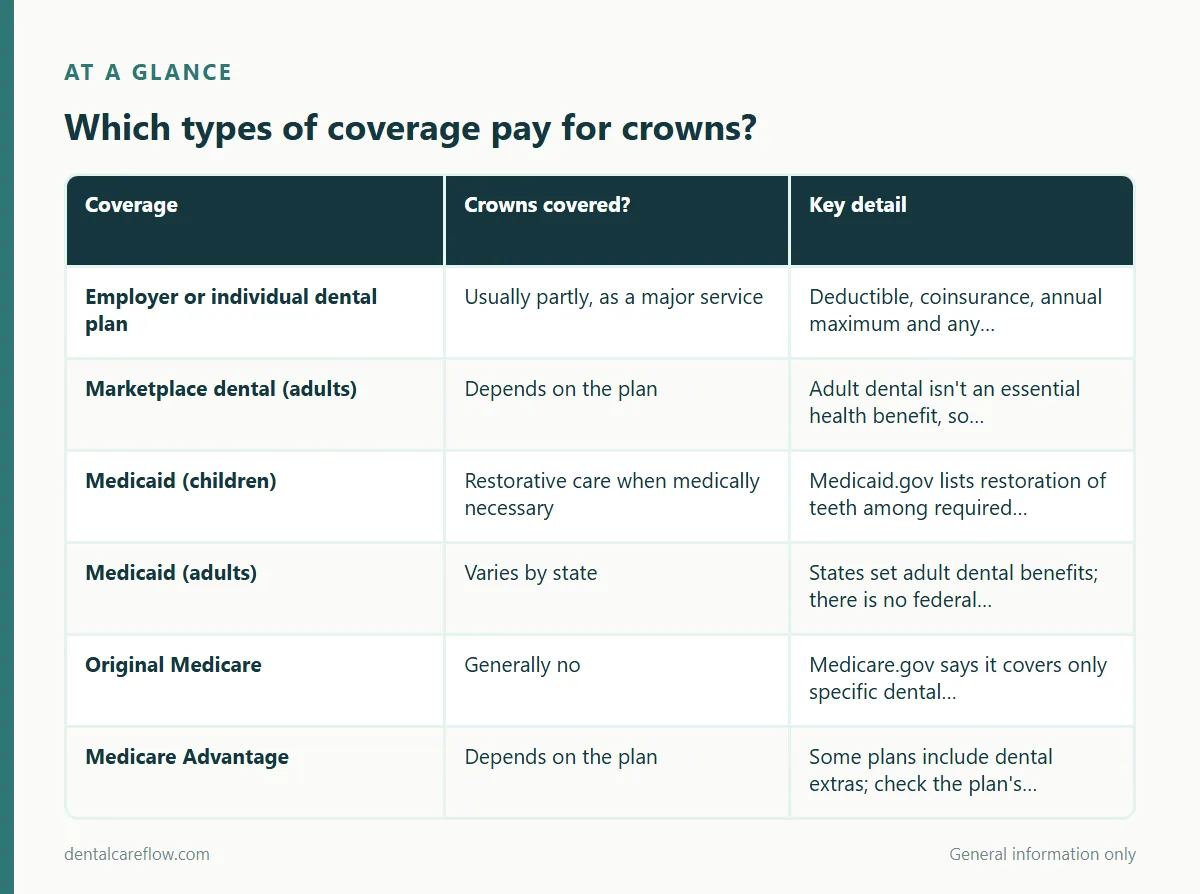
| Coverage | Crowns covered? | Key detail |
|---|---|---|
| Employer or individual dental plan | Usually partly, as a major service | Deductible, coinsurance, annual maximum and any waiting period apply |
| Marketplace dental (adults) | Depends on the plan | Adult dental isn't an essential health benefit, so plans vary widely |
| Medicaid (children) | Restorative care when medically necessary | Medicaid.gov lists restoration of teeth among required children's services under EPSDT |
| Medicaid (adults) | Varies by state | States set adult dental benefits; there is no federal minimum |
| Original Medicare | Generally no | Medicare.gov says it covers only specific dental services tied to certain medical treatments or hospital stays |
| Medicare Advantage | Depends on the plan | Some plans include dental extras; check the plan's evidence of coverage |
Does the reason for the crown change coverage?
Often, yes. Cleveland Clinic lists the common reasons for a crown: strengthening a weak or cracked tooth, restoring a worn or broken tooth, holding a bridge, covering a tooth after a root canal, covering an implant, or covering a heavily stained tooth. Plans generally treat crowns that restore a damaged tooth as restorative work. A crown placed mainly to improve appearance may be considered cosmetic and excluded. If a crown sits on an implant, coverage depends on whether your plan covers implants at all; MetLife notes that implants are often not covered by standard dental insurance.
Does crown material affect what insurance pays?
It can. Cleveland Clinic describes metal, porcelain-fused-to-metal, pressed ceramic, all-ceramic (including zirconia), same-day milled and all-resin crowns. Some plans pay based on a standard crown and leave you to cover the difference for a more expensive material, particularly on back teeth. Ask how your plan handles this before choosing. Our comparison of zirconia and porcelain crowns explains the trade-offs between the two most popular tooth-colored options.
How can you find out what you will owe?
- Ask for a pretreatment estimate. MetLife notes that a pretreatment estimate submitted through your dentist gives the most accurate fee and payment information. Many insurers call this a predetermination.
- Check your remaining annual maximum. If you have had other work this year, less may be left.
- Confirm any waiting period for major services on a new plan.
- Ask about material. Find out whether the plan pays the same for the crown your dentist recommends.
- Plan the timing. If you need several crowns, ask your dentist whether treatment can safely be split across two benefit periods.
What if your plan won't cover the crown?
Ask the office for its self-pay fee and whether a payment plan is available. The National Institute of Dental and Craniofacial Research lists dental school clinics and community health centers with income-based fees as lower-cost options.
Sources
- Cleveland Clinic, Dental Crowns: Types, Procedure and Care
- MetLife, What Does Dental Insurance Cover?
- Delta Dental of Kansas, What is an annual maximum?
- HealthCare.gov, Dental coverage in the Health Insurance Marketplace
- Medicaid.gov, Dental Care
- Medicare.gov, Dental services
- NIDCR, Finding Dental Care
This article is general information and is not a substitute for advice from your own dentist or your insurer. Coverage depends on your specific plan.
Ask about treatment and costs
Two quick questions. General information only, no diagnosis.