What Is Good Dental Insurance? A US Plan Checklist
What is good dental insurance in the US? Compare annual maximums, deductibles, waiting periods and networks, and see where Americans get dental coverage.
Editorially reviewed. This article has not been reviewed by a clinician. How we work

On this page
What is good dental insurance? In the US, it is a plan whose annual maximum, deductible, waiting periods and dentist network fit the care you actually expect to need this year, at a premium you can carry, rather than the plan with the lowest monthly price.
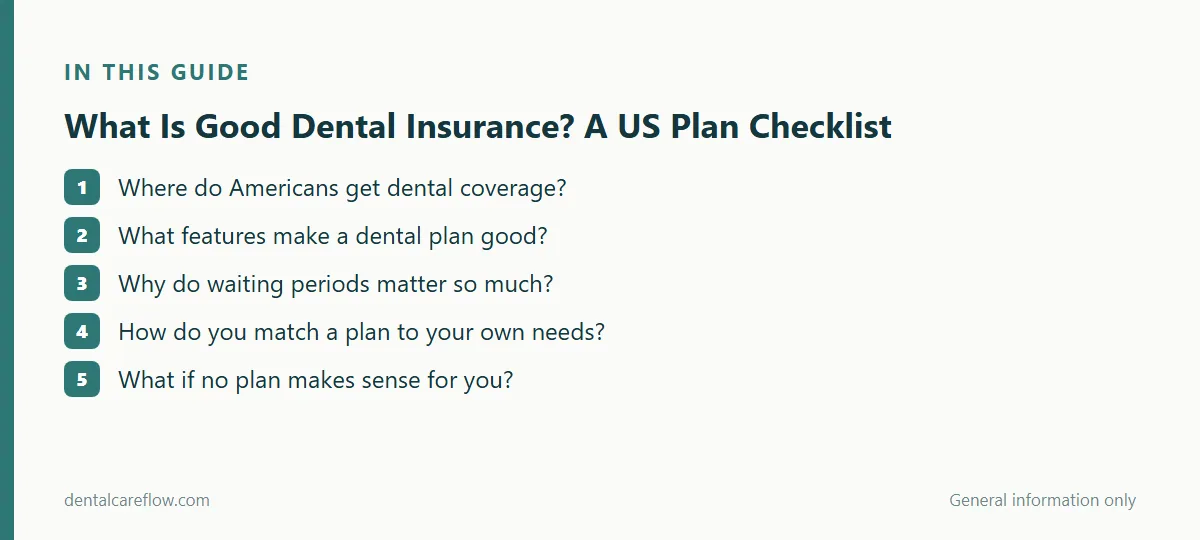
Dental coverage in America works very differently from medical coverage. Most plans cap what they pay each year, sort treatments into tiers, and leave you responsible for everything past the cap. That makes the fine print more important than the brand name on the card. This guide walks through where Americans get dental coverage and the features worth comparing before you sign up.
Where do Americans get dental coverage?
According to the ADA Health Policy Institute, 64% of adults aged 19 to 64 have private dental benefits, 15% have public dental benefits and 21% have none. For adults 65 and older, the HPI reports that 54% have no dental benefits, a figure that does not account for Medicare Advantage plans. The main routes are:
- Employer plans. The most common source of private dental benefits for working-age adults.
- The Health Insurance Marketplace. HealthCare.gov explains that you can choose a health plan that includes dental or buy a separate dental plan, but you can't buy a Marketplace dental plan unless you are buying a health plan at the same time.
- Medicaid and CHIP. Medicaid.gov states that dental services are covered for children under the EPSDT benefit, while states decide what dental benefits adult enrollees receive, and there are no minimum federal requirements for adults.
- Medicare. Medicare.gov says that in most cases Original Medicare doesn't cover dental services such as cleanings, fillings, extractions, dentures or implants. Medicare Advantage plans may offer some dental services as extra benefits.
What features make a dental plan good?
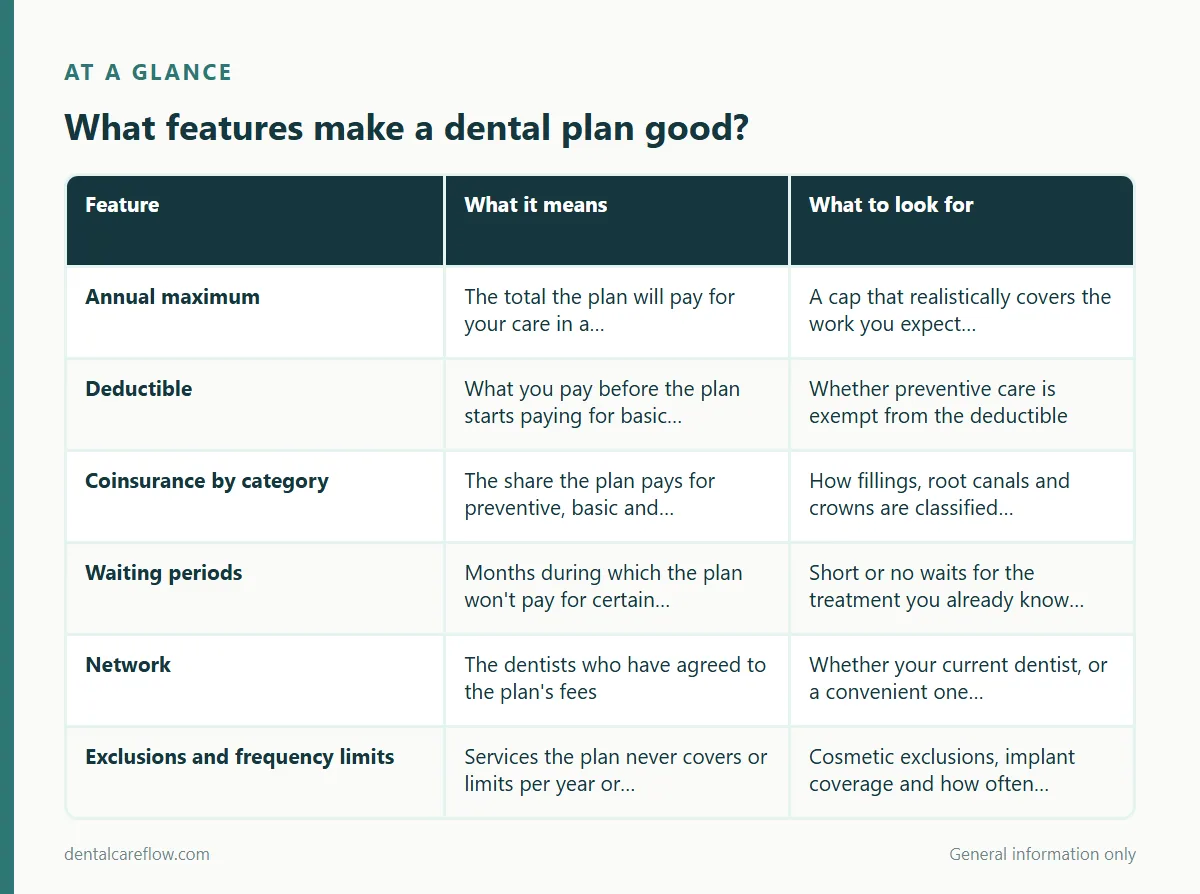
Use this checklist when you compare plans side by side. Each item can change what you pay far more than a small difference in premium.
| Feature | What it means | What to look for |
|---|---|---|
| Annual maximum | The total the plan will pay for your care in a 12-month benefit period; after that, you pay | A cap that realistically covers the work you expect, especially if crowns or root canals are likely |
| Deductible | What you pay before the plan starts paying for basic and major services | Whether preventive care is exempt from the deductible |
| Coinsurance by category | The share the plan pays for preventive, basic and major work | How fillings, root canals and crowns are classified, and the percentage paid for each |
| Waiting periods | Months during which the plan won't pay for certain services even though you pay premiums | Short or no waits for the treatment you already know you need |
| Network | The dentists who have agreed to the plan's fees | Whether your current dentist, or a convenient one, participates |
| Exclusions and frequency limits | Services the plan never covers or limits per year or per tooth | Cosmetic exclusions, implant coverage and how often cleanings and X-rays are paid |
Delta Dental of Kansas describes the annual maximum as the total the plan pays in a benefit period and notes that it is different from an out-of-pocket maximum. Delta Dental of Arkansas explains that a deductible usually applies to basic and major services but not to preventive care, and it resets each benefit period.
Why do waiting periods matter so much?
HealthCare.gov warns that separate dental plans can have waiting periods before they cover adult services. During that time you still owe monthly premiums, but the plan doesn't pay for the waiting-period services. If you already know you need a crown or root canal, a plan with a long wait for major work may cost you money before it pays anything. Ask the insurer for waiting period details in writing before enrolling.
How do you match a plan to your own needs?
- List the care you expect. Checkups and cleanings only, or known fillings, a crown or gum treatment? Your dentist can give you a written treatment plan.
- Check the network first. If you want to keep your dentist, call the office and ask which plans they participate in.
- Read the category table. Find where your expected treatments sit and what share the plan pays.
- Compare total cost, not premium. Add a year of premiums to your likely out-of-pocket share, then compare plans on that total.
- Look at the annual maximum last. If your expected care exceeds it, consider splitting treatment across benefit periods with your dentist's agreement.
What if no plan makes sense for you?
Insurance is not the only route to affordable care. The National Institute of Dental and Craniofacial Research lists dental school clinics, dental hygiene school clinics and federally funded community health centers that charge based on income. For a sense of how individual treatment fees add up, see our dental treatment price breakdown guide.
A good dental plan is simply one that pays meaningfully for the care you need. Take a written treatment plan from your dentist to every comparison and the right choice usually becomes clear.
Sources
- ADA Health Policy Institute, Coverage, Access and Outcomes
- HealthCare.gov, Dental coverage in the Health Insurance Marketplace
- Medicaid.gov, Dental Care
- Medicare.gov, Dental services
- Delta Dental of Kansas, What is an annual maximum?
- Delta Dental of Arkansas, Dental Insurance Terms Explained: Deductible
- NIDCR, Finding Dental Care
This article is general information and is not a substitute for advice from your own dentist or a licensed insurance professional. Plan terms vary, so always check your plan documents.
Ask about treatment and costs
Two quick questions. General information only, no diagnosis.