Can I Go to the ER for a Toothache? A Decision Guide
Can I go to the ER for a toothache? Learn which symptoms need the ER, which need an urgent dentist, what the ER will do and lower-cost US alternatives.
Editorially reviewed. This article has not been reviewed by a clinician. How we work

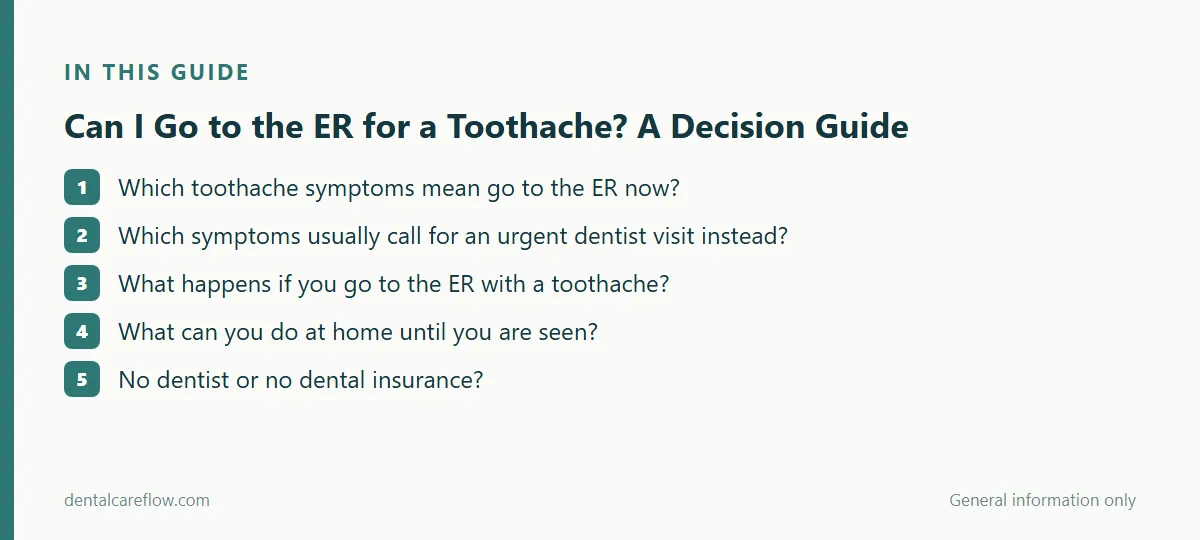
On this page
Can I go to the ER for a toothache? Yes, you can, and you should if you have spreading facial swelling, trouble breathing or swallowing, uncontrolled bleeding, or a facial injury. For an ordinary toothache, though, a dentist is usually the better first call because most ERs cannot fix the tooth itself.
Tooth pain has a way of peaking at night and on weekends, which is exactly when your dentist's office is closed. This guide is a practical decision aid for people in the US: which symptoms belong in the emergency department, which can wait for an urgent dental appointment, and what you can expect from each option.
Which toothache symptoms mean go to the ER now?
The ADA's guidance on what constitutes a dental emergency describes these as potentially life threatening and needing immediate treatment:
- Bleeding that will not stop
- Swelling inside or outside the mouth from a spreading infection that could affect your airway
- Trauma to the facial bones that could affect your airway
MedlinePlus adds that swelling of the upper or lower jaw from a tooth abscess is a very serious symptom, and that an untreated abscess can spread and become life threatening. If you have any of these, go to the ER or call 911. Do not wait for a dental appointment.
Which symptoms usually call for an urgent dentist visit instead?
The ADA classes several painful problems as urgent dental care, meaning they need prompt attention, ideally from a dentist rather than a hospital:
- Severe tooth pain from an inflamed nerve
- Pain around a partly erupted wisdom tooth
- A localized abscess with pain and swelling
- A broken tooth that hurts or cuts your cheek or tongue
- A knocked-out or displaced tooth
- A lost or broken temporary crown or filling that is causing pain
MedlinePlus suggests contacting a provider if a toothache is severe, lasts longer than a day or two, or comes with fever, earache or pain when opening your mouth wide. ADA MouthHealthy notes that most dentists set aside time for emergency patients, so call the office, describe your symptoms, and ask whether they can see you the same day.
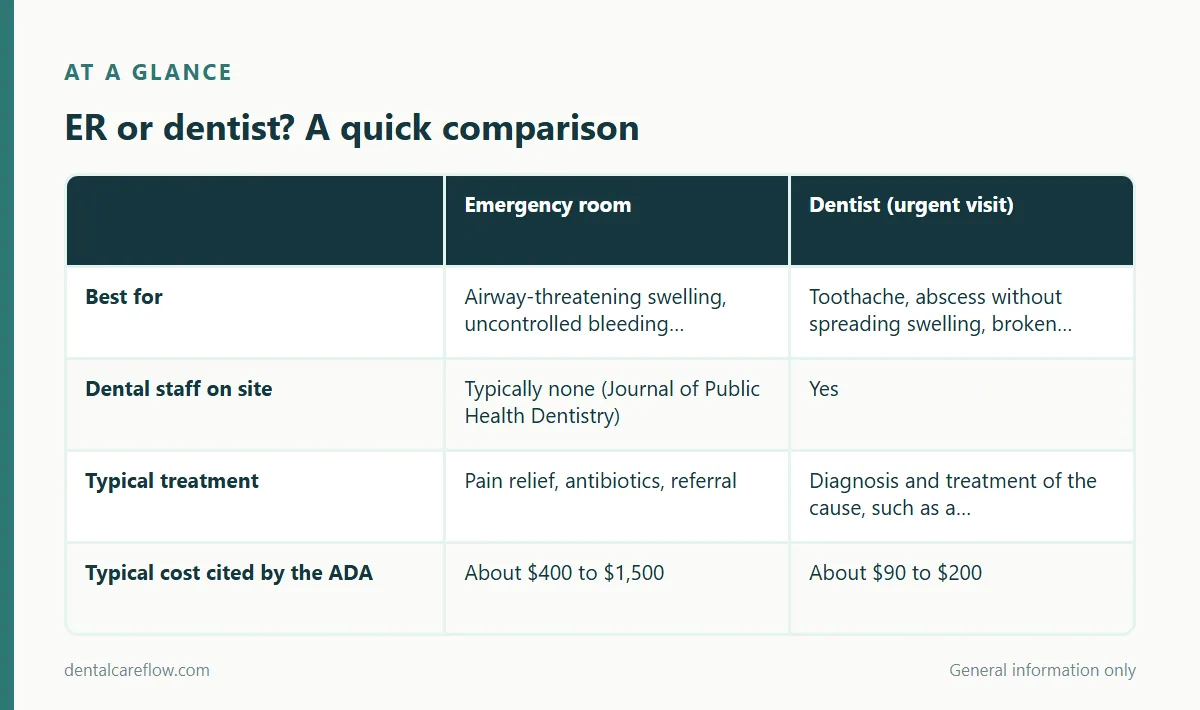
ER or dentist? A quick comparison
| Emergency room | Dentist (urgent visit) | |
|---|---|---|
| Best for | Airway-threatening swelling, uncontrolled bleeding, facial trauma | Toothache, abscess without spreading swelling, broken tooth |
| Dental staff on site | Typically none (Journal of Public Health Dentistry) | Yes |
| Typical treatment | Pain relief, antibiotics, referral | Diagnosis and treatment of the cause, such as a filling, root canal or extraction (MedlinePlus) |
| Typical cost cited by the ADA | About $400 to $1,500 | About $90 to $200 |
What happens if you go to the ER with a toothache?
Expect an assessment of your pain, swelling and temperature, and possibly a prescription. A study of US emergency department visits from 2018 to 2022 found that 63% of visits for non-traumatic dental conditions included an antibiotic and that opioid use fell from 33% of visits in 2018 to 25% in 2022. The authors note that emergency departments typically have no oral health providers on staff, so you will usually be told to follow up with a dentist.
The ADA's own guidance favors non-opioid pain relief: it states that in most cases antibiotics are not recommended for toothaches, and that NSAIDs, alone or combined with acetaminophen, are preferred over opioids as first-line treatment for acute dental pain. Ask whoever treats you what is appropriate for your health history.
What can you do at home until you are seen?
- Rinse your mouth with warm water and floss gently to remove trapped food (MouthHealthy).
- Do not put aspirin directly on the tooth or gum (MouthHealthy and MedlinePlus).
- MedlinePlus notes over-the-counter pain medicine can help if you cannot see a dentist right away.
- Watch for warning signs: fever, swelling that spreads, or trouble swallowing mean go to the ER.
No dentist or no dental insurance?
The ADA notes that uninsured and Medicaid patients use emergency departments for dental care more often than insured patients. NIDCR lists lower-cost US options, including federally funded health centers that charge based on income, dental school clinics, state and local health department programs, and calling 2-1-1. Medicaid.gov notes that dental services are covered for all child enrollees, while adult dental benefits are set by each state. Medicare.gov says Original Medicare does not cover most dental services. Finding a regular dentist before the next flare-up is the best way to stay out of the ER.
If tooth pain follows recent implant surgery, see our guide to post-implant infection signs.
Sources
- American Dental Association, What Constitutes a Dental Emergency?
- American Dental Association, New Study Finds Patients Commonly Prescribed Opioids and Antibiotics for Dental Conditions at EDs
- American Dental Association, Emergency Department Referrals
- MedlinePlus, Toothaches
- MedlinePlus, Tooth abscess
- ADA MouthHealthy, Dental Emergencies
- Journal of Public Health Dentistry (via PubMed Central), Pharmacologic Management of Non-Traumatic Dental Conditions in US Emergency Departments, 2018–2022
- NIDCR, Finding Low-Cost Dental Care
- Medicaid.gov, Dental Care
- Medicare.gov, Dental services coverage
This article is general information and is not a substitute for advice from your own dentist or doctor. In a medical emergency, call 911.
Ask about treatment and costs
Two quick questions. General information only, no diagnosis.