Is Supplemental Dental Insurance Worth It? A Scenario Guide
Is supplemental dental insurance worth it? See when extra coverage pays off for Medicare, Marketplace and employer plan members, with a quick break-even test.
Editorially reviewed. This article has not been reviewed by a clinician. How we work

On this page
Is supplemental dental insurance worth it? It can be when your main coverage leaves dental out, as Original Medicare and many adult health plans do, and you expect regular care. It is often not worth it if the premiums, waiting periods and annual cap would swallow most of what the plan pays back.
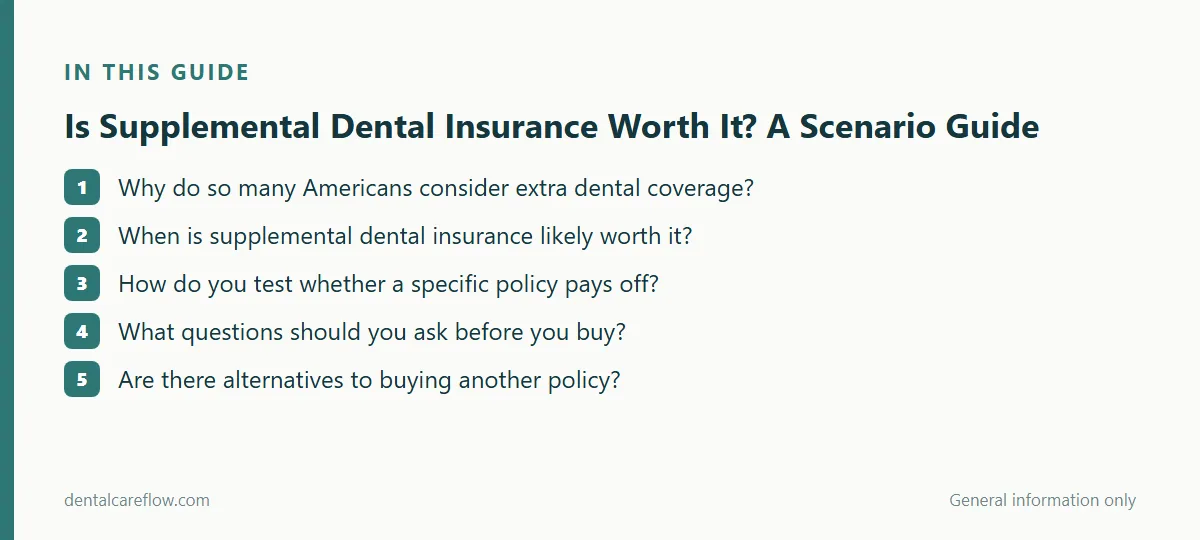
"Supplemental" usually means a dental policy you buy on top of the health coverage you already have. It might be a stand-alone plan from the Health Insurance Marketplace, a separate individual policy, or extra dental coverage bundled into a Medicare Advantage plan. Whether it pays off depends less on the product and more on your situation, so this guide works through it by scenario.
Why do so many Americans consider extra dental coverage?
Because the big public and medical programs leave large gaps for adults:
- Original Medicare. Medicare.gov states that in most cases Medicare doesn't cover dental services such as routine cleanings, fillings, extractions, dentures or implants, and you pay all costs for services it doesn't cover.
- Marketplace health plans. HealthCare.gov notes that dental coverage is an essential health benefit for children but not for adults, so health plans aren't required to offer adult dental coverage.
- Adult Medicaid. Medicaid.gov explains that states decide which dental benefits adults receive and that there are no minimum requirements for adult dental coverage.
The ADA Health Policy Institute reports that 54% of adults 65 and older have no dental benefits, a figure that excludes Medicare Advantage plans. That gap is the main reason supplemental dental policies are sold so heavily to retirees.
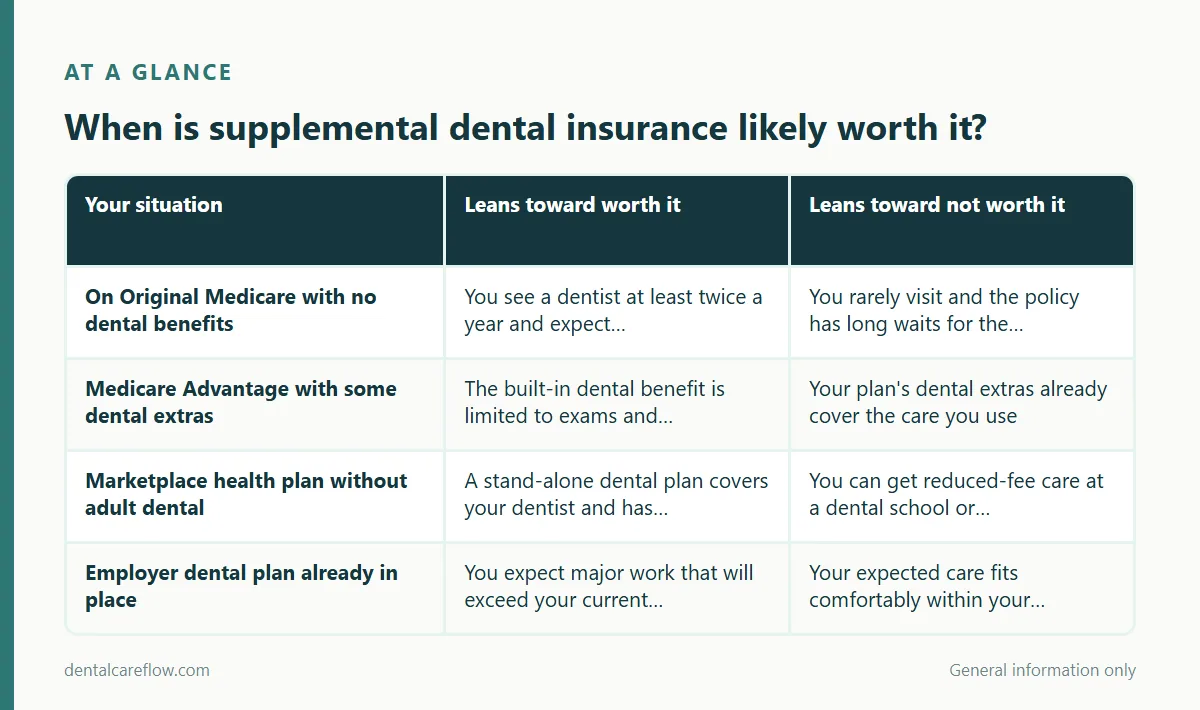
When is supplemental dental insurance likely worth it?
| Your situation | Leans toward worth it | Leans toward not worth it |
|---|---|---|
| On Original Medicare with no dental benefits | You see a dentist at least twice a year and expect fillings or other basic work | You rarely visit and the policy has long waits for the work you need |
| Medicare Advantage with some dental extras | The built-in dental benefit is limited to exams and cleanings and you need more | Your plan's dental extras already cover the care you use |
| Marketplace health plan without adult dental | A stand-alone dental plan covers your dentist and has short waits | You can get reduced-fee care at a dental school or health center instead |
| Employer dental plan already in place | You expect major work that will exceed your current plan's annual maximum and the second plan coordinates benefits | Your expected care fits comfortably within your existing plan |
How do you test whether a specific policy pays off?
You can do a quick break-even check with three numbers from the policy documents and one from your dentist.
- Annual premium. Multiply the monthly premium by 12.
- Expected benefit. Ask your dentist for a written treatment plan with fees, then apply the plan's coinsurance for each category after the deductible.
- Annual maximum. Delta Dental of Kansas explains that once the plan has paid its annual maximum, you cover further costs until the next benefit period. Cap the expected benefit at that amount.
- Waiting periods. HealthCare.gov warns that separate dental plans can have waiting periods for adult services during which you still pay premiums. Remove any benefit you can't use during the first year.
If the realistic first-year benefit is close to or below the annual premium, the policy is mostly a budgeting tool, not a saving. If it is clearly higher, and the plan's network includes a dentist you will actually use, the case is stronger.
What questions should you ask before you buy?
- Which services have waiting periods, and how long are they?
- What is the annual maximum, and do cleanings and exams count toward it?
- Does the deductible apply to preventive care?
- How are crowns, root canals and dentures classified?
- Does the plan cover implants at all?
- Is my current dentist in network, and what happens if I go out of network?
- Can I cancel at any time? HealthCare.gov notes you can cancel a separate Marketplace dental plan at any time and keep your health plan.
Are there alternatives to buying another policy?
Yes. The National Institute of Dental and Craniofacial Research points to dental school clinics, dental hygiene school clinics and federally funded community health centers that charge based on income, as well as state and local health departments and the 2-1-1 helpline. If you are pricing a large treatment such as implants, our dental implant cost guide for the USA explains what drives the bill.
Supplemental dental insurance is worth it when the numbers work for your mouth, not the average customer's. A written treatment plan and the policy's benefit summary are all you need to find out.
Sources
- Medicare.gov, Dental services
- Medicare.gov, Compare Original Medicare and Medicare Advantage
- HealthCare.gov, Dental coverage in the Health Insurance Marketplace
- Medicaid.gov, Dental Care
- ADA Health Policy Institute, Coverage, Access and Outcomes
- Delta Dental of Kansas, What is an annual maximum?
- NIDCR, Finding Dental Care
This article is general information and is not a substitute for advice from your own dentist or a licensed insurance professional. Policy terms vary, so always read the plan documents.
Ask about treatment and costs
Two quick questions. General information only, no diagnosis.