Is a Chipped Tooth an Emergency? A Three-Level Guide
Is a chipped tooth an emergency? Use this three-level guide to decide between the ER, a same-day dentist call or a routine visit, plus first-aid steps.
Editorially reviewed. This article has not been reviewed by a clinician. How we work
On this page
Is a chipped tooth an emergency? Usually not. Cleveland Clinic says a small chip that does not hurt can wait for a regular appointment. It becomes urgent if the tooth is badly broken or cracked, painful, bleeding, or part of a larger injury to the face or jaw.
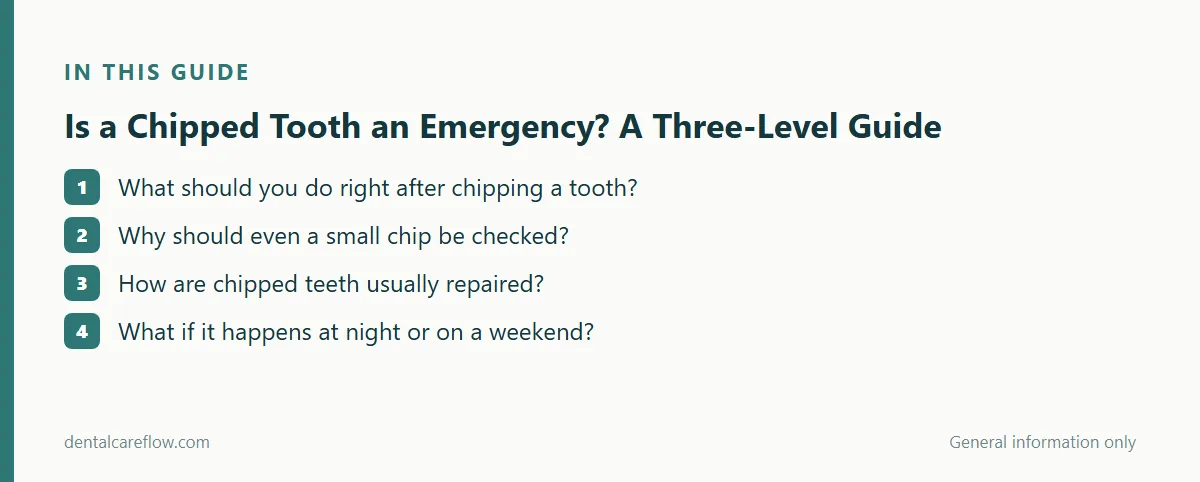
Chips happen on a crunchy snack, a fall, or a basketball court, and the first reaction is often panic. The useful thing is to sort the situation quickly. Below is a simple three-level guide, based on Cleveland Clinic, the ADA and the American Association of Endodontists, so you know whether to call 911, call your dentist today, or book a normal visit.
A three-level guide to a chipped tooth
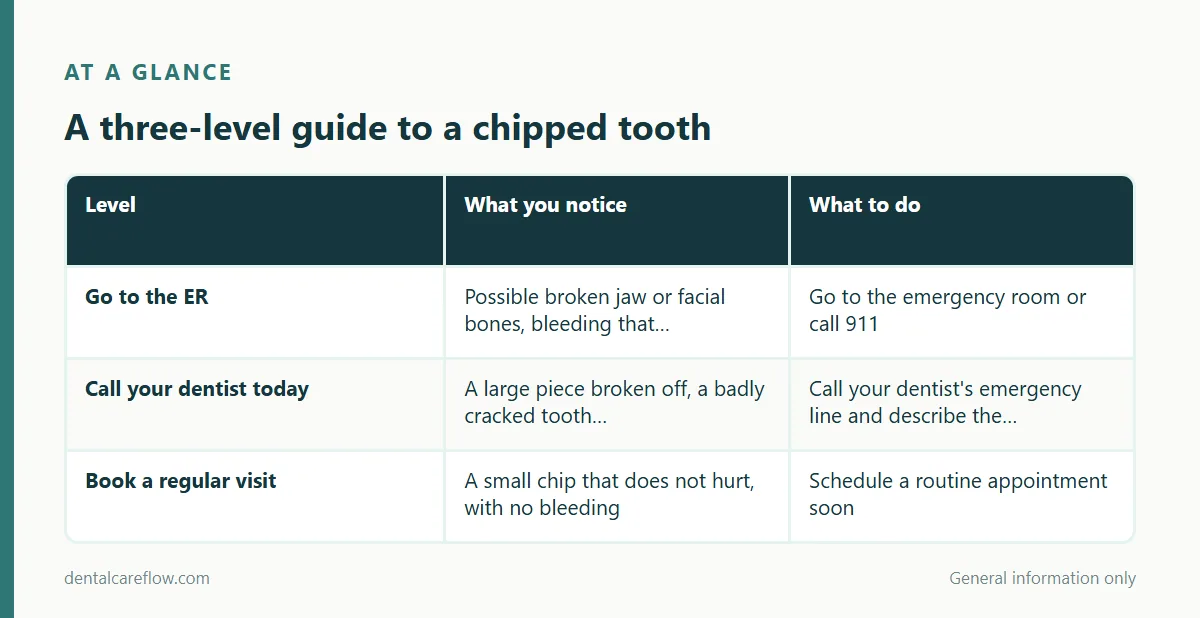
| Level | What you notice | What to do |
|---|---|---|
| Go to the ER | Possible broken jaw or facial bones, bleeding that will not stop, or swelling that could affect your breathing | Go to the emergency room or call 911 |
| Call your dentist today | A large piece broken off, a badly cracked tooth, significant pain, or a tooth that is loose or pushed out of place | Call your dentist's emergency line and describe the injury |
| Book a regular visit | A small chip that does not hurt, with no bleeding | Schedule a routine appointment soon |
The ER criteria reflect the ADA's list of true dental emergencies: uncontrolled bleeding, airway-threatening swelling, and trauma to the facial bones. Cleveland Clinic lists a small chip or crack that is not painful among problems that can wait for regular hours, and a badly cracked tooth among those that need prompt care.
What should you do right after chipping a tooth?
Cleveland Clinic and ADA MouthHealthy give similar first-aid steps:
- Save the piece. Rinse any broken fragments and bring them to your dentist. The AAE notes that chipped teeth can often be repaired by reattaching the fragment.
- Rinse your mouth with warm water.
- Control bleeding with gauze for about 10 minutes.
- Use a cold compress on the outside of your face to ease pain and swelling.
- Protect your tongue and cheek. If a sharp edge is irritating your mouth, Cleveland Clinic suggests covering it with orthodontic wax.
Why should even a small chip be checked?
A chip that looks minor may hide a crack underneath. The AAE explains that a crack can gradually spread, and Cleveland Clinic notes that cracked teeth don't always cause symptoms and that an untreated crack can lead to an abscess. A dentist can check whether the damage stops at the enamel or goes deeper. Signs that a chip is more than cosmetic include:
- Pain when you bite or release your bite
- Sensitivity to hot, cold or sweets
- Swelling near the tooth
- Pain that comes and goes, even when you are not chewing
How are chipped teeth usually repaired?
Repairs depend on size and location. The AAE says chipped teeth can often be fixed by reattaching the fragment or bonding a tooth-colored filling or crown. Cleveland Clinic also lists contouring and polishing for small rough edges and veneers for front teeth. For larger breaks, a crown or, if the pulp is affected, a root canal may be needed.
For a closer look at one common fix, see our article on how composite bonding is done.
What if it happens at night or on a weekend?
MouthHealthy notes that most dentists set aside time for emergency patients, and Cleveland Clinic suggests calling first because many dentists have an after-hours number. If you have no dentist, Cleveland Clinic says urgent care or the nearest ER is an option, but the ER can prescribe pain relief or antibiotics and does not do fillings or crowns, so you will still need a dental visit.
For a small chip that does not hurt, waiting until Monday is usually fine. Keep the area clean and avoid biting hard foods with that tooth.
Coverage reminder for US patients
Medicare.gov notes that Original Medicare does not cover most dental services, and Medicaid.gov explains that adult dental benefits vary by state while children enrolled in Medicaid have dental coverage. If you have a private dental plan, ask the office whether the repair counts as restorative or cosmetic under your plan before treatment.
Sources
- Cleveland Clinic, What Is a Dental Emergency and Where To Go for Care
- Cleveland Clinic, Cracked Tooth (Fractured Tooth)
- American Association of Endodontists, Cracked Teeth
- American Dental Association, What Constitutes a Dental Emergency?
- ADA MouthHealthy, Dental Emergencies
- Medicare.gov, Dental services coverage
- Medicaid.gov, Dental Care
This article is general information and is not a substitute for advice from your own dentist. In a medical emergency, call 911.
Ask about treatment and costs
Two quick questions. General information only, no diagnosis.