How to Fix a Chipped Tooth: Repair Options Explained
How to fix a chipped tooth: what to do right away, when bonding, a veneer or a crown is used, and the questions to ask your dentist before treatment.
Editorially reviewed. This article has not been reviewed by a clinician. How we work

On this page
How to fix a chipped tooth depends on the size and location of the chip: small chips can often be polished smooth or repaired with bonding, larger ones may need a veneer or crown, and a chip that exposes the nerve usually needs a root canal first.
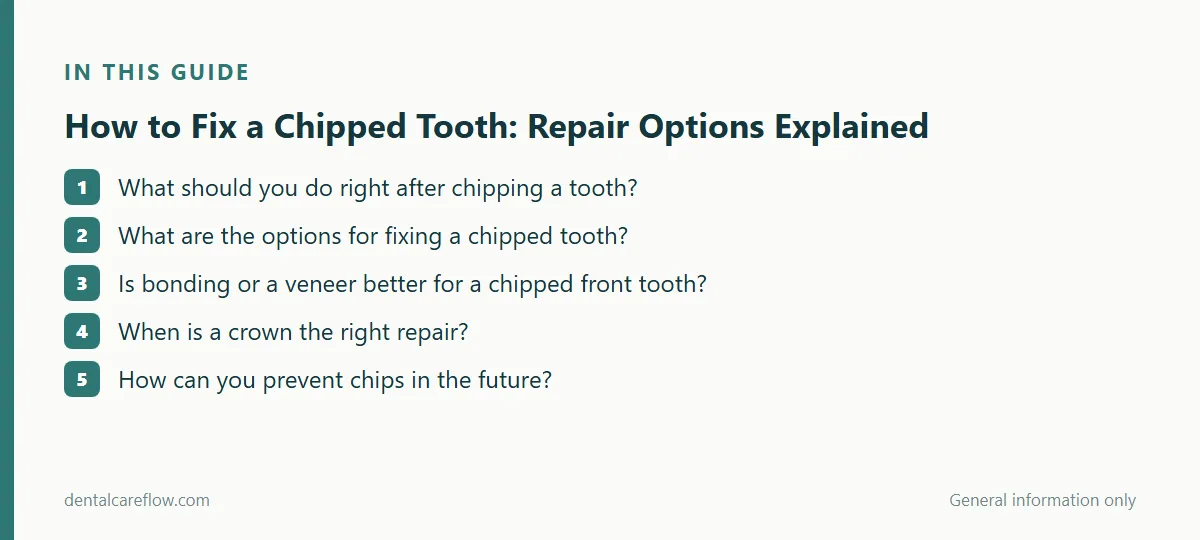
A chipped tooth is one where a piece of the outer enamel has broken off. Cleveland Clinic distinguishes this from a cracked tooth, where the break runs through the whole tooth. Chips are common and usually not an emergency, but they can't be repaired at home, and a large chip left untreated can let bacteria reach the inner tooth. This guide explains what to do right away, the repair options a dentist may suggest, and the questions worth asking at your appointment.
What should you do right after chipping a tooth?
Until you can see a dentist, Cleveland Clinic suggests a few simple steps:
- Save the fragment if you find it. Keep it in milk and bring it to your appointment.
- Protect the sharp edge with dental wax or a mouth guard. Sugar-free gum can work as a stopgap.
- Keep brushing and flossing, especially around the chip, so food doesn't collect there.
- Manage discomfort with an over-the-counter pain reliever such as ibuprofen and an ice pack on the cheek.
- Eat soft foods and avoid biting with the injured tooth.
- Book a dental visit as soon as you can.
Signs that the chip may have reached the nerve include tooth pain and sensitivity to chewing or to hot and cold foods and drinks. In that case, try to be seen sooner rather than later.
What are the options for fixing a chipped tooth?
Your dentist will choose an approach based on how much tooth is missing, where the tooth is and whether the inner tissue is affected. The main options described by Cleveland Clinic are:
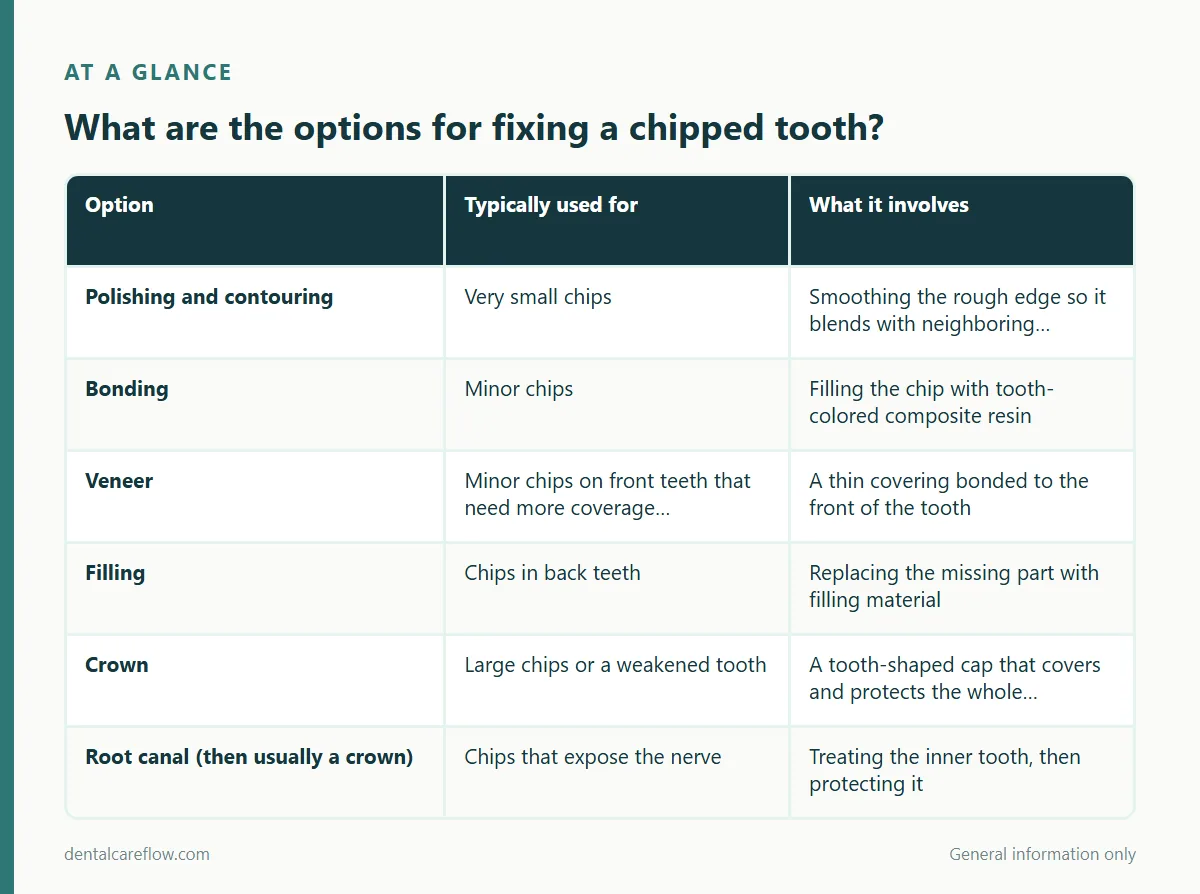
| Option | Typically used for | What it involves |
|---|---|---|
| Polishing and contouring | Very small chips | Smoothing the rough edge so it blends with neighboring teeth |
| Bonding | Minor chips | Filling the chip with tooth-colored composite resin |
| Veneer | Minor chips on front teeth that need more coverage than bonding | A thin covering bonded to the front of the tooth |
| Filling | Chips in back teeth | Replacing the missing part with filling material |
| Crown | Large chips or a weakened tooth | A tooth-shaped cap that covers and protects the whole visible tooth |
| Root canal (then usually a crown) | Chips that expose the nerve | Treating the inner tooth, then protecting it |
Is bonding or a veneer better for a chipped front tooth?
Both can restore the look of a chipped front tooth, but they work differently. Bonding is sculpted directly onto the tooth in the chair. The American Dental Association's MouthHealthy site describes two kinds of veneer: composite veneers, which are bonded and shaped directly on the tooth, and porcelain veneers, which are made in a lab after a small amount of enamel is removed. MouthHealthy notes that veneer treatment is not reversible because enamel is removed, and that a veneer can chip, wear or loosen over time and may need to be repaired or replaced.
For a closer look at the two veneer materials, see our comparison of porcelain and composite veneers.
When is a crown the right repair?
When a large piece of tooth has broken away, or the remaining tooth is weak, a filling or bonding may not be strong enough. Cleveland Clinic describes crowns as tooth-shaped caps that protect a tooth that is weak or has had major damage. If the chip has exposed the nerve, a root canal may be needed first, and a crown is often placed afterward to protect the treated tooth. Our guide to dental crown types explains the materials dentists commonly use.
Questions to ask your dentist
- Has the chip reached the dentin or the nerve?
- Which repair do you recommend for this tooth, and why?
- Is the repair reversible, and how much natural tooth will be removed?
- How long can I expect this repair to last, and what can shorten its life?
- How many visits will it take, and what will it cost with and without my insurance?
- Do I grind my teeth, and would a night guard protect the repair?
How can you prevent chips in the future?
Cleveland Clinic lists common causes as facial injuries, biting hard foods or objects, using teeth as tools and grinding. Its prevention advice includes:
- Wear a mouth guard for contact sports and a night guard if you grind your teeth.
- Don't chew ice, hard candy or non-food objects, or use your teeth to open packages.
- Limit sugary and acidic foods and drinks, and treat acid reflux (GERD) if you have it.
- Brush, floss and keep up with regular dental checkups.
Sources
- Cleveland Clinic, Chipped Tooth: Causes, Symptoms & Repair
- American Dental Association, MouthHealthy, Veneers
This article is general information and is not a substitute for advice from your own dentist.
Ask about treatment and costs
Two quick questions. General information only, no diagnosis.