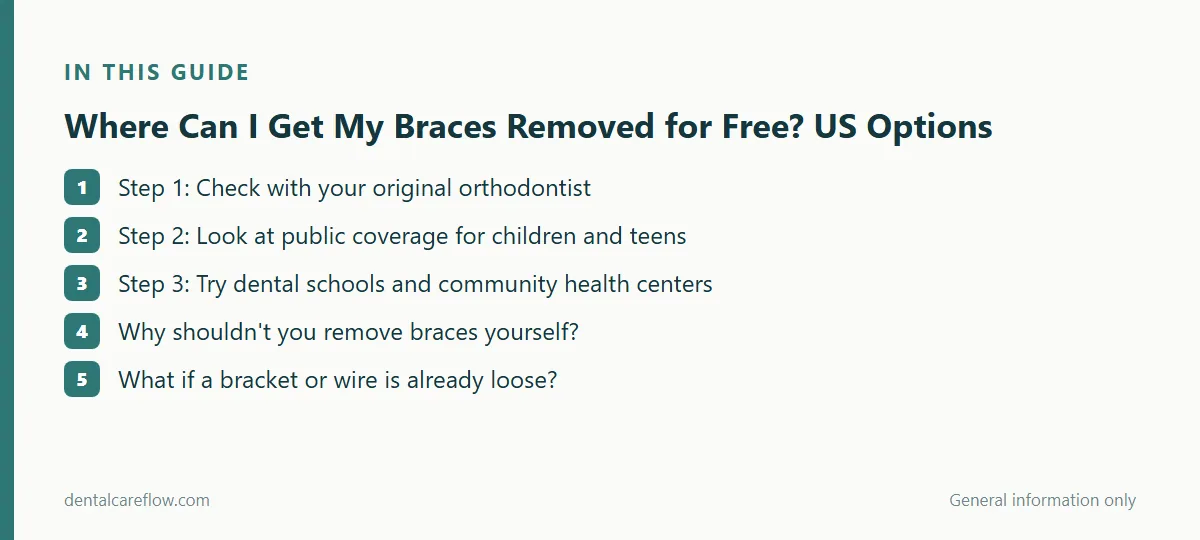
Where Can I Get My Braces Removed for Free? US Options
Where can I get my braces removed for free? Check your orthodontist first, then Medicaid or CHIP, dental schools, health centers and 2-1-1 programs.
Editorially reviewed. This article has not been reviewed by a clinician. How we work
On this page
Where can I get my braces removed for free? First ask the orthodontist who placed them whether removal was included in your fee. Other US options include Medicaid or CHIP for children, dental school clinics, community health centers and local programs found through 2-1-1.
People end up searching for this for many reasons: they moved, their orthodontist closed or retired, they lost insurance partway through, or their braces have been on far longer than planned. Whatever the reason, there are safer and cheaper options than pulling brackets off yourself. Here is a practical checklist.
Step 1: Check with your original orthodontist
Before paying anyone else, call the office that put your braces on and ask:
- Was removal and a retainer included in the treatment fee I already paid or financed?
- If I still owe a balance, can we set up a payment plan so removal can go ahead?
- If I have moved, can you send my records to a new orthodontist?
- Is my treatment actually finished, or would removing braces now undo progress?
That last question matters. The American Association of Orthodontists (AAO) explains that braces work by applying steady pressure that gradually moves teeth, that most people wear them for 12 to 24 months, and that after removal you will wear a retainer to keep teeth in their new positions. Taking braces off without a retainer plan can waste the work already done.
Step 2: Look at public coverage for children and teens
Medicaid.gov explains that Medicaid covers dental services for all child enrollees under the EPSDT benefit, and that when a dental treatment need is identified, states must cover it if it is medically necessary. Separate CHIP programs are also required to include dental coverage. If your child's braces were placed under Medicaid or CHIP, contact the plan or your state Medicaid office about completing treatment, including removal, with a participating provider.
Adult coverage is different. Medicaid.gov says states decide which dental benefits to offer adults, and Medicare.gov states that Original Medicare does not cover most dental services.
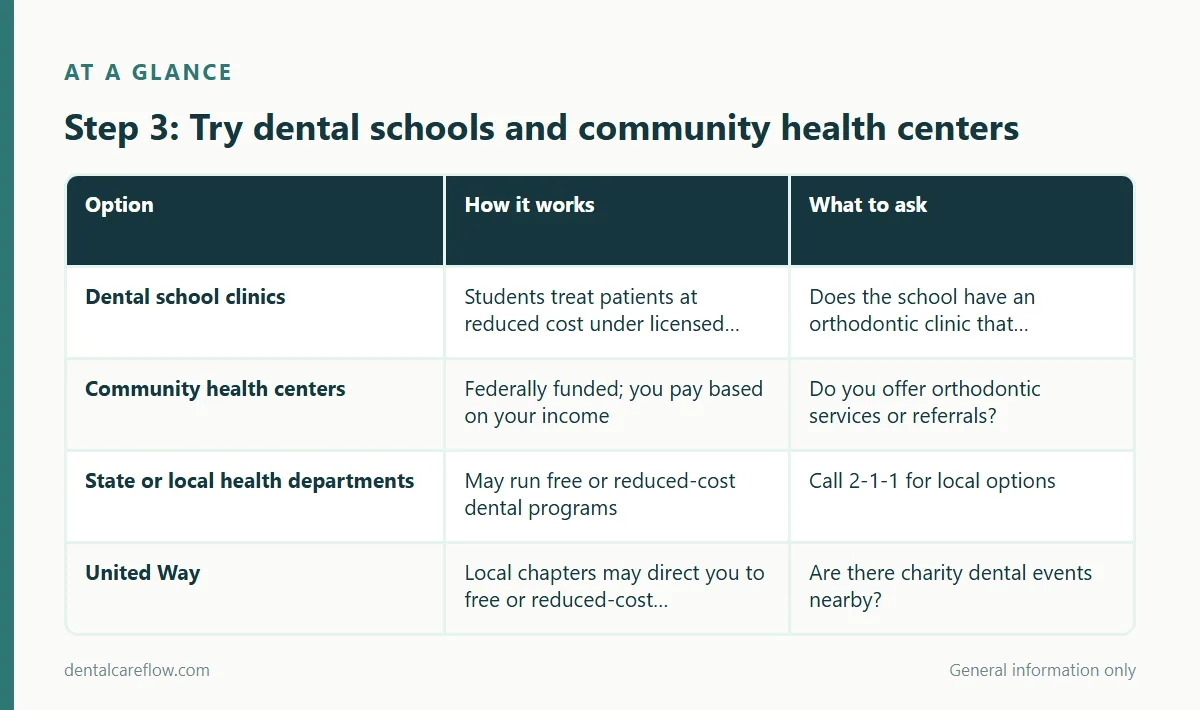
Step 3: Try dental schools and community health centers
NIDCR lists these lower-cost options in the US:
| Option | How it works | What to ask |
|---|---|---|
| Dental school clinics | Students treat patients at reduced cost under licensed dentists' supervision | Does the school have an orthodontic clinic that removes braces placed elsewhere? |
| Community health centers | Federally funded; you pay based on your income | Do you offer orthodontic services or referrals? |
| State or local health departments | May run free or reduced-cost dental programs | Call 2-1-1 for local options |
| United Way | Local chapters may direct you to free or reduced-cost dental services | Are there charity dental events nearby? |
Fees and services vary widely, so call ahead and ask whether they will remove braces placed by another provider and whether a retainer is included.
Why shouldn't you remove braces yourself?
Orthodontists attach brackets with a medical-grade adhesive. The AAO contrasts this with the weaker glue in non-medical "fashion braces," and notes that even those may need a dentist to remove the appliance or the adhesive it leaves behind. If fake braces can require professional removal, real ones bonded with stronger adhesive are not a do-it-yourself job.
Removing braces at home also leaves you without the retainer the AAO describes as the step that keeps teeth in their new positions.
What if a bracket or wire is already loose?
Contact an orthodontist or dentist promptly. ADA guidance on urgent dental care includes snipping or adjusting an orthodontic wire or appliance that is piercing or ulcerating the inside of the mouth. That is a reason for a prompt visit, not for removing the whole appliance yourself.
A quick decision path
- Call your original orthodontist and ask about removal and records.
- If your child is on Medicaid or CHIP, call the plan.
- Call the nearest dental school and community health center.
- Dial 2-1-1 for local free or reduced-cost programs.
- Budget for a retainer, which the AAO describes as part of finishing treatment.
If you are tempted by bargain treatment elsewhere, it is worth reading cheap dental treatment risks explained.
Sources
- American Association of Orthodontists, How Do Braces Work?
- American Association of Orthodontists, The Dangers of Fashion Braces
- Medicaid.gov, Dental Care
- Medicare.gov, Dental services coverage
- NIDCR, Finding Low-Cost Dental Care
- American Dental Association, What Constitutes a Dental Emergency?
This article is general information and is not a substitute for advice from your own dentist or orthodontist.
Ask about treatment and costs
Two quick questions. General information only, no diagnosis.