
How Do Crowns Work on Teeth? What a Crown Actually Does
How do crowns work on teeth? See the jobs a crown does, how it stays on, what happens to the tooth underneath and how crown materials compare.
Editorially reviewed. This article has not been reviewed by a clinician. How we work

On this page
- What problems does a crown solve?
- Why does covering the whole tooth make it stronger?
- How does a crown stay on?
- Can the tooth under a crown still have problems?
- How do different crown materials change how it works?
- What does a crown feel like once it is on?
- Is a crown covered by US insurance or Medicare?
- Sources
How do crowns work on teeth? A dental crown is a tooth-shaped cap cemented over the entire visible part of a tooth. By covering and holding the tooth together, it restores its shape and size, protects weak or cracked tooth structure from breaking further, and can improve how the tooth looks.
People often hear "you need a crown" without a clear sense of what the crown is actually doing. This article focuses on the why: the jobs a crown performs, how it stays on, what remains underneath, and how different materials change the way it works. If you want the appointment-by-appointment process, see our separate guide on how a crown is put on a tooth.
What problems does a crown solve?
ADA MouthHealthy and Cleveland Clinic describe a crown's main jobs:
- Holding a weak tooth together. MouthHealthy explains that a crown can strengthen a tooth with a large filling when there isn't enough tooth left to hold the filling.
- Protecting a cracked tooth from breaking further (Cleveland Clinic).
- Restoring a worn or broken tooth to a normal shape.
- Anchoring a bridge. Crowns on neighboring teeth can hold a bridge in place.
- Covering a tooth after root canal treatment or covering a dental implant.
- Improving appearance of a badly discolored or misshapen tooth.
Why does covering the whole tooth make it stronger?
A filling repairs a tooth from the inside, which works when enough healthy tooth remains around it. MouthHealthy explains that when there isn't enough tooth left to hold a large filling, a crown can strengthen the tooth instead. A crown works from the outside: Cleveland Clinic explains that it fits over the entire tooth, so the dentist first removes a small amount of enamel to make room for the cap. Covering the whole tooth is what lets it protect weak or cracked tooth structure.
That is also the key difference from a veneer. MouthHealthy notes that veneers cover only the front surface, while crowns cover the entire tooth structure.
How does a crown stay on?
The crown is shaped in a lab or milled in the office to fit the prepared tooth closely, then bonded with dental cement, according to Cleveland Clinic. Sometimes the dentist first builds up the tooth with filling material so there is enough structure to support the crown. If a crown comes loose, has sharp edges, or you notice a bad taste around it, Cleveland Clinic advises calling your dentist.
Can the tooth under a crown still have problems?
Yes. The natural tooth is still there under the cap. Some crowned teeth have had root canal treatment first, and Cleveland Clinic lists covering a root canal-treated tooth as a common reason for a crown. Either way, the tooth underneath can still develop problems. Cleveland Clinic lists decay as a risk if the crown does not fit well, which is why brushing, flossing and regular checkups still matter.
How do different crown materials change how it works?
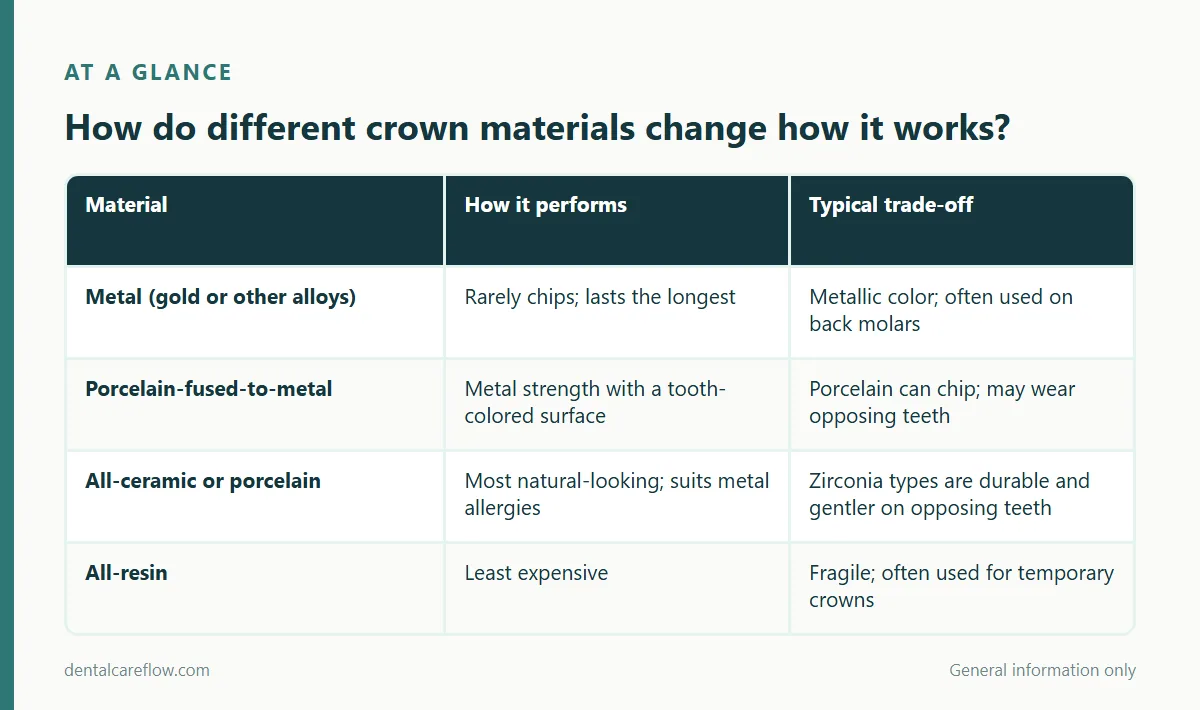
| Material | How it performs | Typical trade-off |
|---|---|---|
| Metal (gold or other alloys) | Rarely chips; lasts the longest | Metallic color; often used on back molars |
| Porcelain-fused-to-metal | Metal strength with a tooth-colored surface | Porcelain can chip; may wear opposing teeth |
| All-ceramic or porcelain | Most natural-looking; suits metal allergies | Zirconia types are durable and gentler on opposing teeth |
| All-resin | Least expensive | Fragile; often used for temporary crowns |
This summary follows Cleveland Clinic. For a deeper material comparison, see zirconia vs porcelain crowns.
What does a crown feel like once it is on?
Cleveland Clinic says most people resume normal activities right away. Sensitivity to heat and cold is normal for a couple of weeks, and gum soreness usually fades within a few days. Cleveland Clinic suggests calling your dentist if the crown feels loose, cracks or chips, or has sharp edges.
Is a crown covered by US insurance or Medicare?
Coverage depends on your plan and the reason for the crown. Medicare.gov notes Original Medicare does not cover most dental services. For Medicaid, Medicaid.gov explains that dental services are covered for children and that adult benefits vary by state. Ask your dentist's office for a pre-treatment estimate.
Sources
- Cleveland Clinic, Dental Crowns
- ADA MouthHealthy, Crowns
- ADA MouthHealthy, Veneers
- Medicare.gov, Dental services coverage
- Medicaid.gov, Dental Care
This article is general information and is not a substitute for advice from your own dentist.
Ask about treatment and costs
Two quick questions. General information only, no diagnosis.