
What Does a Bridge Look Like? Parts and Types Explained
What does a bridge look like? Learn the parts of a dental bridge, how traditional, cantilever, Maryland and implant bridges differ, and how materials show.
Editorially reviewed. This article has not been reviewed by a clinician. How we work

On this page
What does a bridge look like? A dental bridge looks like a short row of connected teeth: one or more artificial teeth fill the gap, held by crowns, metal wings or implants on either side.
If you are missing a tooth and your dentist mentions a bridge, it helps to picture the piece itself and how it will sit in your mouth. Bridges come in a few designs, and each one looks a little different on its own even if the result in your smile is similar. This guide walks through the parts of a bridge, the main types, what you will see in the mirror, and how materials change the look.
What are the parts of a dental bridge?
Cleveland Clinic explains that a bridge has two main parts:
- Pontics: the artificial teeth that fill the gap left by missing teeth.
- Abutments: the supports that hold the bridge in place. These can be your natural teeth, usually covered with crowns, or small connector posts on dental implants.
Held in your hand, a traditional three-unit bridge looks like three teeth joined side by side. The two outer pieces are hollow crowns that fit over prepared teeth, and the middle piece is a false tooth with no root of its own that sits over the gap. The ADA's MouthHealthy site describes the idea simply: a bridge "bridges" the gap where one or more teeth used to be. It is also called a fixed partial denture.
What do the different types of bridges look like?
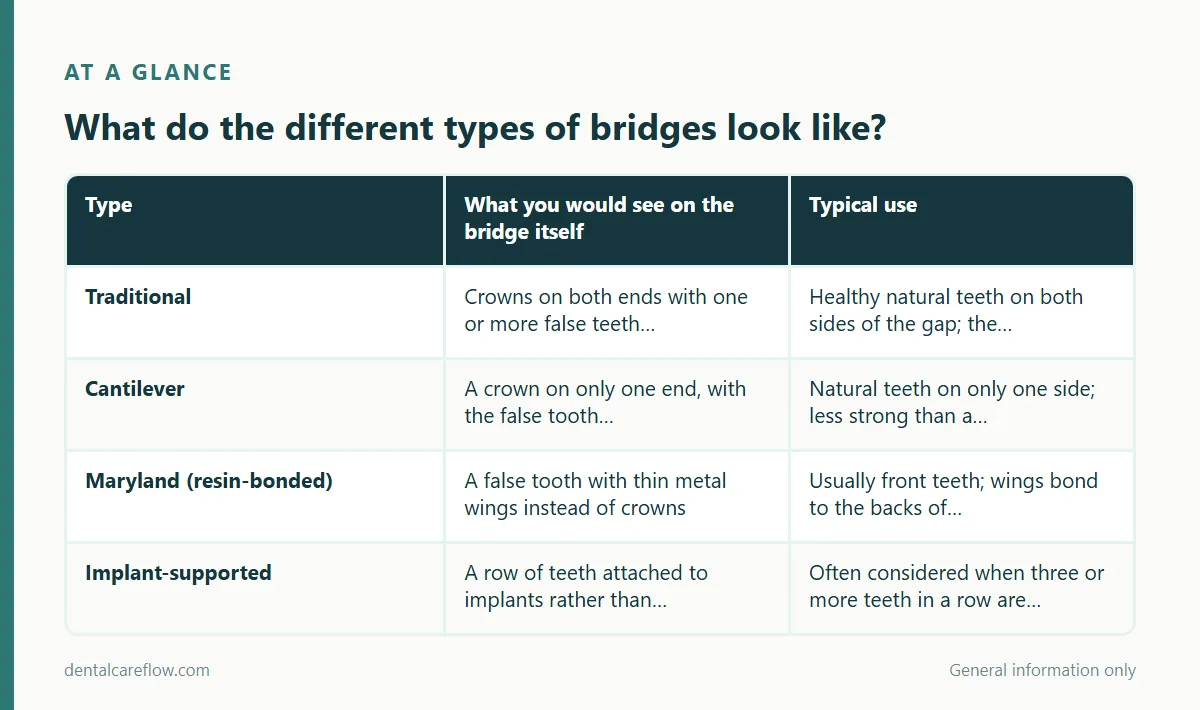
| Type | What you would see on the bridge itself | Typical use |
|---|---|---|
| Traditional | Crowns on both ends with one or more false teeth between them | Healthy natural teeth on both sides of the gap; the most common type |
| Cantilever | A crown on only one end, with the false tooth extending from it | Natural teeth on only one side; less strong than a traditional bridge |
| Maryland (resin-bonded) | A false tooth with thin metal wings instead of crowns | Usually front teeth; wings bond to the backs of neighboring teeth |
| Implant-supported | A row of teeth attached to implants rather than natural teeth | Often considered when three or more teeth in a row are missing |
All four descriptions come from Cleveland Clinic. A Maryland bridge looks the most minimal out of the mouth: essentially one tooth with flat tabs on each side. Cleveland Clinic notes it cannot handle the chewing forces on back teeth, which is why it is typically used at the front.
What does a bridge look like in your mouth?
From the front, a well-made bridge should look like a continuous row of teeth. Cleveland Clinic says dentists can match a bridge's shade to your natural teeth. The false tooth sits over the gum where the missing tooth used to be, shaped to resemble the tooth it replaces.
A few details may differ from natural teeth:
- The teeth in a bridge are joined, so floss cannot pass between them the usual way. Cleveland Clinic recommends floss threaders or interproximal brushes to clean under the bridge.
- On a Maryland bridge, the metal wings sit on the tongue side of the neighboring teeth.
- Metal parts can show depending on the material, as explained below.
How do materials change the look of a bridge?
The ADA says bridges can be made of gold, alloys, porcelain, or a combination. Because the ends of a traditional bridge are crowns, the appearance follows the same patterns as crowns. MedlinePlus notes that metal crowns do not look natural in color, while ceramic or porcelain crowns match the color of other teeth. With porcelain fused to metal, the porcelain can fracture, and Cleveland Clinic warns that a chipped porcelain layer may expose the metal underneath.
Cleveland Clinic also notes that metal crowns, the most wear-resistant type, are mainly suited to out-of-sight molars because of their color. Ask your dentist which material fits the location of your gap and how much of it will show when you smile.
How is a bridge fitted, and how long does it last?
For traditional and cantilever bridges, Cleveland Clinic describes this process: the dentist numbs the area and reshapes the abutment teeth, which permanently removes some enamel, then takes impressions. You wear a temporary bridge while the final one is made, usually in two to four weeks, and the final bridge is cemented at a second visit. Implant-supported bridges first need implants placed and about three to six months of healing before the bridge is attached with cement or small screws.
A bridge typically lasts five to 15 years, and some last longer with good care. Dentists call bridges permanent because only a dentist can remove them, but they still need replacement over time. If you are deciding between options, our implants vs bridges comparison lays out the trade-offs, and our guide to implants for multiple missing teeth covers longer gaps.
Frequently asked questions
Does a bridge look fake?
It should not. Dentists can shade-match bridges to your natural teeth, and tooth-colored materials are designed to blend in. Metal parts are more noticeable.
Can you take a dental bridge out?
A fixed bridge can only be removed by a dentist, according to the ADA. Removable partial dentures are a different appliance.
What is under the false tooth?
Your gum. The false tooth (pontic) has no root and sits over the gap, which is why Cleveland Clinic recommends cleaning under the bridge with floss threaders or interproximal brushes.
What can go wrong with a bridge?
Cleveland Clinic lists decay or damage to the supporting teeth, fractures of weak abutment teeth, and gum inflammation or cavities from plaque buildup.
Sources
- Cleveland Clinic, Dental Bridges
- American Dental Association (MouthHealthy), Bridges
- MedlinePlus, Dental crowns
- Cleveland Clinic, Dental Crowns
This article is general information and does not replace advice from your own dentist.
Ask about treatment and costs
Two quick questions. General information only, no diagnosis.