
How Much Is a Gold Tooth? Cost Factors and US Coverage
How much is a gold tooth? Learn what shapes the bill for a gold crown, inlay or grill, how US coverage rules apply, and how to compare written quotes.
Editorially reviewed. This article has not been reviewed by a clinician. How we work

On this page
How much is a gold tooth? There is no single price, because the bill depends on whether you need a full gold-alloy crown, a partial restoration, or a purely cosmetic piece, plus the prep work and your coverage.
In a dental office, a "gold tooth" almost always means a crown made from a gold alloy: a tooth-shaped cap cemented over a damaged tooth. Outside the office, the phrase can also mean a decorative grill. Those are very different products with very different rules, so it helps to know which one you are pricing before you ask for a quote. This guide explains what you are actually paying for, how US coverage rules treat gold work, and how to compare written estimates fairly.
What is a "gold tooth" in dentistry?
MedlinePlus describes a crown as a tooth-shaped cap that replaces your tooth above the gum line, used to support a weak tooth or improve how it looks. Metal crowns, the group gold belongs to, withstand chewing and grinding well, rarely chip, and last the longest of the crown types it lists. Their drawback is visual: metal crowns do not look natural in color.
Cleveland Clinic groups gold with other metals such as palladium, nickel and chromium, and notes that metal crowns suit out-of-sight molars because the metallic color is the main drawback. A dental "gold" crown is not pure gold. Cleveland Clinic's page on fillings explains that gold restorations contain gold mixed with other metals such as silver, tin, copper or palladium, which add strength.
Gold is also used for smaller lab-made restorations. Cleveland Clinic lists gold among indirect filling materials used for inlays and onlays, which suit teeth with too much damage for a regular filling but not enough to need a full crown.
What drives the price of a gold tooth?
Because no official US price list exists for private dental care, your quote is built from several parts. Ask the office to show each one separately.
- The alloy itself. Dental gold is a blend of metals, and the mix varies. Ask which alloy the lab will use and whether the metal is part of the crown fee or listed as its own charge.
- Type of restoration. A full crown, an onlay and an inlay use different amounts of metal and lab time.
- Lab work and visits. Most crowns need two visits: one to shape the tooth, take an impression or scan and place a temporary, and one to cement the final crown. Cleveland Clinic notes that lab fabrication usually takes two to three weeks.
- Prep work. The dentist may need to remove decay or old fillings and build the tooth up before the crown goes on. Some teeth need other treatment first.
- Number of teeth. Each tooth is usually billed as its own restoration.
- Reason for treatment. A crown restoring a broken tooth and a gold cap placed only for looks are not the same thing on a claim form, so ask your plan how it handles each.
Gold crown vs. cosmetic gold: how do they compare?
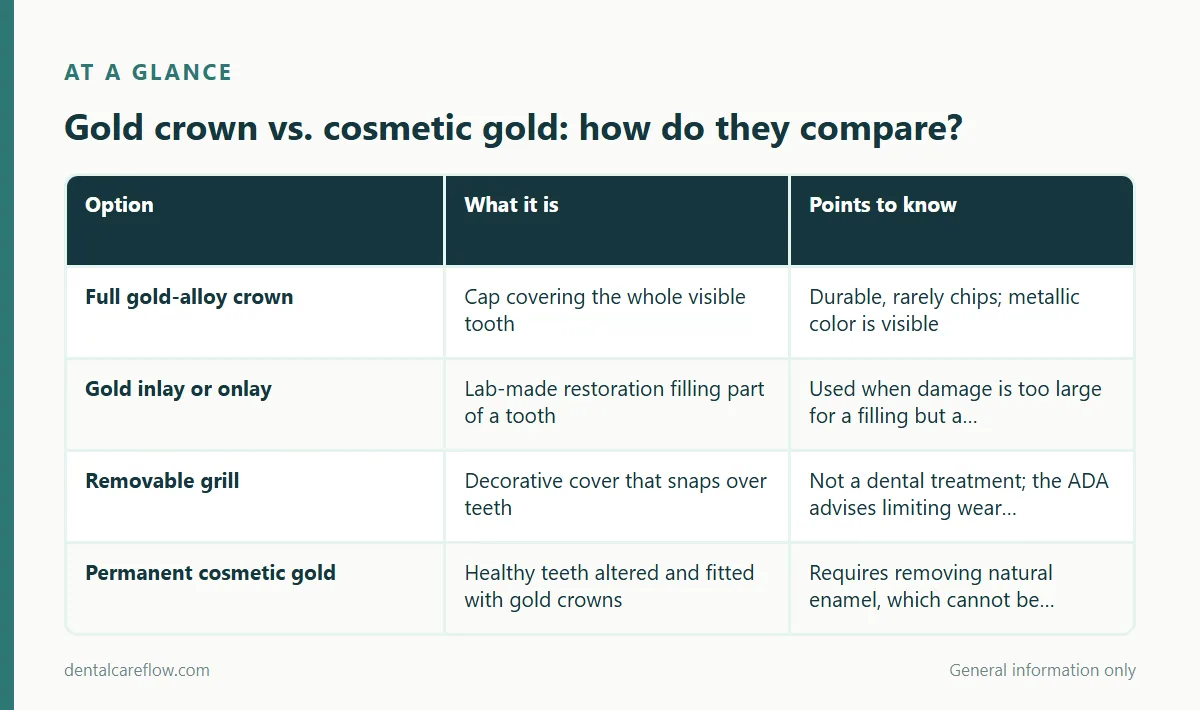
| Option | What it is | Points to know |
|---|---|---|
| Full gold-alloy crown | Cap covering the whole visible tooth | Durable, rarely chips; metallic color is visible |
| Gold inlay or onlay | Lab-made restoration filling part of a tooth | Used when damage is too large for a filling but a crown is not needed |
| Removable grill | Decorative cover that snaps over teeth | Not a dental treatment; the ADA advises limiting wear time |
| Permanent cosmetic gold | Healthy teeth altered and fitted with gold crowns | Requires removing natural enamel, which cannot be reversed |
The ADA's MouthHealthy site notes that most grills are removable, but some wearers have had their teeth altered with gold crowns so the look is permanent. Placing any crown requires removing some natural enamel, according to Cleveland Clinic, so that choice cannot be undone.
Are grills a cheaper way to get a gold look?
A grill is a jewelry item, not a restoration, and its price is set by a jeweler rather than a dental fee schedule. The ADA points out some trade-offs to weigh. Some grills are made from non-precious (base) metals that may cause irritation or allergic reactions. Food and debris can be trapped between the grill and teeth, letting bacteria produce acids, and there are no studies showing that long-term wear is safe. Gluing a grill onto your teeth can damage teeth and tissues.
If you choose a removable grill, the ADA suggests limiting wear time, taking it out to eat, cleaning it daily, and talking with a dentist first about what the grill is made of.
Will insurance, Medicaid or Medicare pay for a gold tooth?
Coverage depends on why the tooth needs work, not on the color of the metal.
- Private dental plans each set their own rules. Before treatment, ask the office to send a pre-treatment estimate to your plan, and check in writing whether the crown is covered, how the material affects payment, and whether work done for appearance alone is excluded.
- Medicaid must cover dental services for children, and "restoration of teeth" is among the minimum services listed by Medicaid.gov. For adults, states choose what dental benefits to offer, and there are no minimum federal requirements.
- Original Medicare does not cover most dental services, including fillings, extractions, dentures and implants, according to Medicare.gov. Limited exceptions apply when dental care is directly tied to certain covered medical treatments.
How do you compare gold tooth quotes?
Ask for every estimate in writing and check that each one includes the same items:
- The restoration type (full crown, onlay or inlay) and the specific alloy, including its precious-metal content.
- Whether the metal is billed separately or included.
- Prep work such as a build-up, plus the temporary crown.
- Number of visits and any follow-up adjustment.
- What your plan is expected to pay, and what happens if the crown loosens or the temporary falls out.
For a broader look at materials, see our guide to dental crown types. If the tooth also needs a filling first, our explainer on filling costs with insurance walks through deductibles and annual maximums.
Frequently asked questions
Is a gold crown made of pure gold?
No. Dental gold is an alloy that mixes gold with metals such as silver, tin, copper or palladium for strength.
How long does a gold crown last?
Cleveland Clinic says crowns typically last five to 15 years with good care, sometimes much longer, and that metal crowns last the longest for wear.
Can I get a gold crown on a front tooth?
It is possible, but the metal color is visible. Cleveland Clinic notes metal crowns are most often used on out-of-sight molars; your dentist can explain the trade-offs for your tooth.
Are grills safe to wear?
The ADA says there are no studies showing long-term wear is safe and recommends limiting wear time and removing grills to eat. Speak with a dentist before buying one.
Sources
- MedlinePlus, Dental crowns
- Cleveland Clinic, Dental Crowns
- Cleveland Clinic, Dental Fillings
- American Dental Association (MouthHealthy), Grills
- Medicaid.gov, Dental Care
- Medicare.gov, Dental services
This article is general information and does not replace advice from your own dentist.
Ask about treatment and costs
Two quick questions. General information only, no diagnosis.