How Much Do Root Canals Cost? A Tooth-by-Tooth Breakdown
How much do root canals cost? See why molars cost more than front teeth, what else is on the bill, how insurance pays and how it compares with extraction.
Editorially reviewed. This article has not been reviewed by a clinician. How we work

On this page
How much do root canals cost? It depends mostly on which tooth is treated, how complex its canals are, who does the work and the crown that usually follows. Front teeth generally cost less than molars, and many US dental plans pay part of the fee as a basic service.
Because fees vary so much by tooth and by local market, a single national number would mislead more than it helps. Instead, this guide breaks the bill into its parts so you can read a treatment estimate with confidence and compare it with the alternatives.
Why does the tooth matter so much?
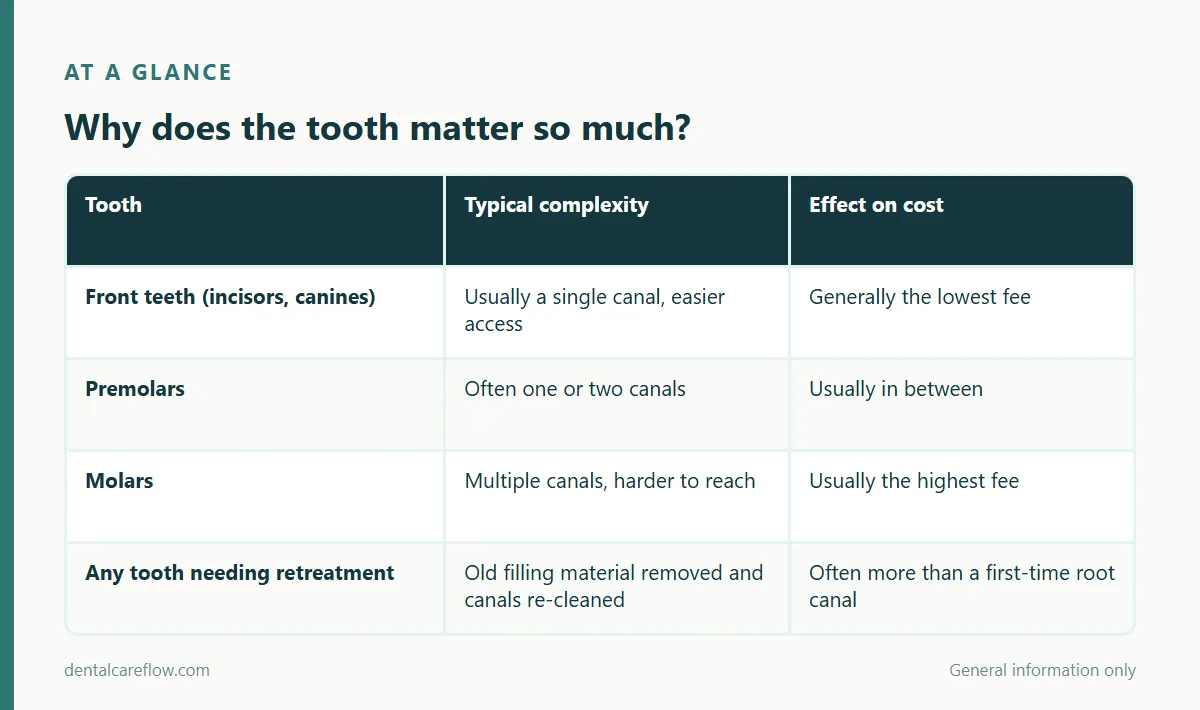
The American Association of Endodontists (AAE) explains that root canals on front teeth (incisors and canines) are generally less expensive, while molars usually cost more because they have multiple canals and are harder to reach. Curved, narrow or extra canals, retreatment of a previously treated tooth and severe infection can all call for more advanced techniques and more time.
| Tooth | Typical complexity | Effect on cost |
|---|---|---|
| Front teeth (incisors, canines) | Usually a single canal, easier access | Generally the lowest fee |
| Premolars | Often one or two canals | Usually in between |
| Molars | Multiple canals, harder to reach | Usually the highest fee |
| Any tooth needing retreatment | Old filling material removed and canals re-cleaned | Often more than a first-time root canal |
What else is on a root canal bill?
The root canal itself is only one line. Ask whether your estimate includes:
- Exam and X-rays to diagnose the tooth.
- The root canal procedure. Cleveland Clinic says most root canals take about 60 to 90 minutes, and the initial treatment may need more than one visit.
- A temporary filling between appointments.
- The final restoration. Cleveland Clinic notes that you will likely have two more appointments, one to prepare the tooth for a crown and one to place it, and that you shouldn't bite on the tooth until the crown is in place. The AAE lists the type of restoration as a cost factor in its own right.
Does it cost more to see an endodontist?
Cleveland Clinic explains that a general dentist or an endodontist, a specialist in this treatment, may perform a root canal. Specialist fees can differ from a general dentist's, and complex molars or retreatments are often referred to an endodontist. The AAE also notes that fees tend to be higher in urban areas and regions with a higher cost of living.
How does dental insurance handle root canals?
The AAE says many dental plans cover root canal treatment because it is a predictable way to treat infection and keep a natural tooth, with the patient typically paying deductibles or co-pays. Some plans require pre-authorization before treatment begins. MetLife's consumer guide places root canals in the "basic" category of most plans, while crowns usually fall under "major" services paid at a lower percentage. That means the root canal and its crown can be reimbursed at different rates, and together they may use a large part of your annual maximum.
If you have Original Medicare, Medicare.gov explains that dental services are not covered in most cases. Adults on Medicaid should check their state's dental benefits, since Medicaid.gov notes there are no federal minimums for adult dental coverage.
Is pulling the tooth cheaper than a root canal?
It can look that way at first. The AAE points out that a missing tooth usually needs an implant or bridge, which typically costs more and takes more appointments, and that saving the natural tooth is generally the more cost-effective choice over time. Cleveland Clinic adds that most root canals are successful and can last many years, often a lifetime. For a sense of replacement costs, see our implants vs bridges cost comparison.
Questions to ask before you book
- Is this a first-time root canal or a retreatment?
- Will you do it, or refer me to an endodontist?
- Does the estimate include the crown and buildup, or are those separate?
- Does my plan need pre-authorization, and how much of my annual maximum will this use?
- If I'm paying myself, can I have a written good faith estimate?
If you're weighing treatment abroad, our root canal cost guide for Turkey covers that side of the comparison.
Sources
- American Association of Endodontists, How Much Does a Root Canal Cost?
- Cleveland Clinic, Root Canal
- MetLife, What Does Dental Insurance Cover?
- Medicare.gov, Dental services
- Medicaid.gov, Dental Care
This article is general information and is not a substitute for advice from your own dentist. Ask your provider for a written estimate based on your tooth and treatment plan.
Ask about treatment and costs
Two quick questions. General information only, no diagnosis.