How to Fix a Broken Tooth at Home: First Aid Until the Dentist
How to fix a broken tooth at home? You can't truly repair it, but these first aid steps protect the tooth until you see a dentist. Know when it's urgent.
Editorially reviewed. This article has not been reviewed by a clinician. How we work
On this page
- Why a broken tooth can't be fixed at home
- First aid steps for a broken or chipped tooth
- Managing pain until your appointment
- If the whole tooth is knocked out
- Lost fillings and crowns: a related problem
- When a broken tooth is an emergency
- Lowering the chance of another break
- Frequently asked questions
- Sources
If you're searching for how to fix a broken tooth at home, the honest answer is that you can't truly repair it yourself. What you can do at home is first aid: protect the tooth, ease pain and swelling, and get to a dentist as soon as possible.
A broken tooth needs professional treatment because the damage often goes deeper than what you can see in a mirror. The good news is that the first steps you take in the minutes and hours after the break really do matter, especially if a tooth has been knocked out entirely. The guidance below comes from the American Dental Association (ADA), MedlinePlus from the National Library of Medicine, and Cleveland Clinic.
Why a broken tooth can't be fixed at home
Every authoritative source we checked ends its first aid advice the same way: see your dentist. MedlinePlus says to contact a dentist right away if a tooth is broken or knocked out, and to bring the tooth or piece with you if you can find it. The ADA's MouthHealthy site advises seeing your dentist as soon as possible after a cracked tooth.
Products sold at pharmacies, such as orthodontic wax or temporary dental cement, are meant to protect your mouth for a short time. They aren't a repair. Even a small chip that doesn't hurt should still be fixed, MedlinePlus notes, to avoid sharp edges. For the options your dentist may use, see our guide on how to fix a chipped tooth.
First aid steps for a broken or chipped tooth
Cleveland Clinic and the ADA describe similar steps:
- Save the pieces. Cleveland Clinic advises keeping any broken pieces and rinsing them.
- Rinse your mouth with warm water to clean the area.
- Control bleeding. Press a piece of gauze on the spot for about 10 minutes, or until the bleeding stops.
- Reduce swelling. Hold a cold compress on the outside of your cheek, lip or mouth near the tooth.
- Cover sharp edges. Cleveland Clinic suggests orthodontic wax, sold in the oral health aisle of most pharmacies, to cover a sharp chipped edge.
- Call your dentist. Describe what happened in as much detail as you can. The ADA notes that most dentists reserve time in their daily schedules for emergency patients.
Managing pain until your appointment
Cleveland Clinic lists over-the-counter pain relievers such as acetaminophen, naproxen or ibuprofen as options for dental pain. Check the label and any health conditions or medications that might make one of these unsuitable for you.
One warning appears in nearly every source: don't put aspirin, or any painkiller, directly on the tooth or gums. Cleveland Clinic explains that aspirin can burn the gum tissue, and both the ADA and MedlinePlus give the same advice.
If the whole tooth is knocked out
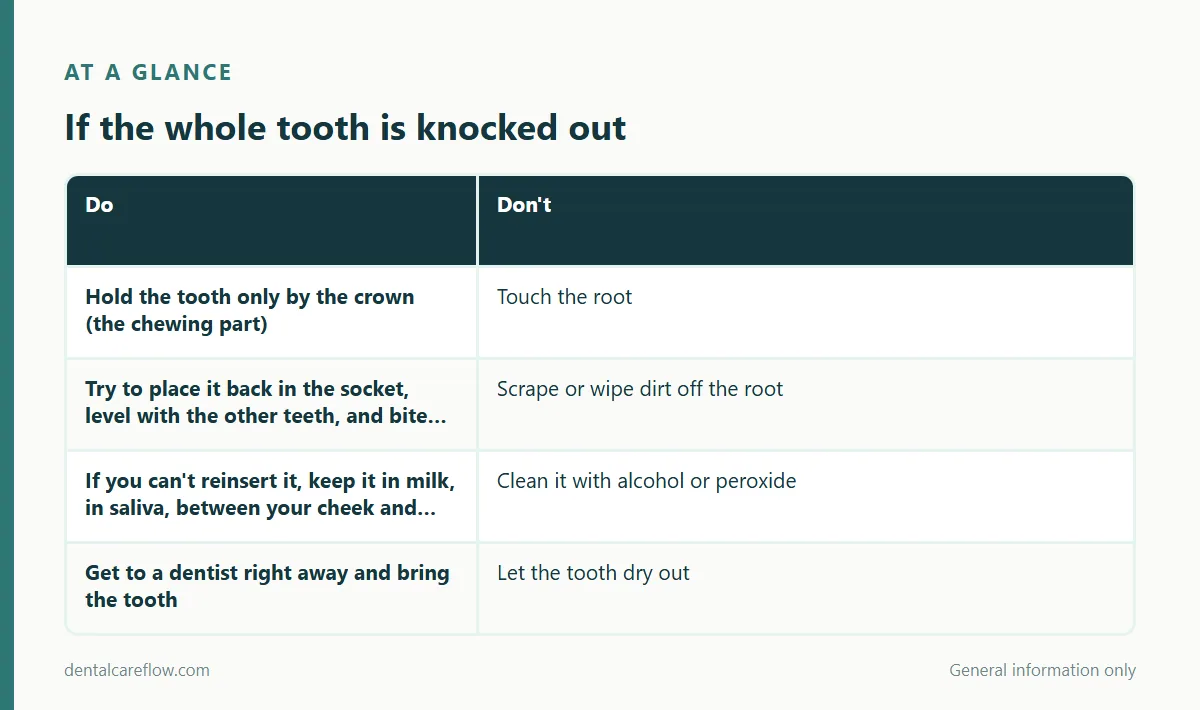
A knocked-out adult tooth is the most time-sensitive situation. MedlinePlus says to see a dentist as soon as possible, because waiting reduces the chance the tooth can be saved. Here is what the sources advise:
| Do | Don't |
|---|---|
| Hold the tooth only by the crown (the chewing part) | Touch the root |
| Try to place it back in the socket, level with the other teeth, and bite gently on gauze | Scrape or wipe dirt off the root |
| If you can't reinsert it, keep it in milk, in saliva, between your cheek and gum, or in an ADA-accepted tooth preservation product | Clean it with alcohol or peroxide |
| Get to a dentist right away and bring the tooth | Let the tooth dry out |
MedlinePlus notes that only permanent teeth are typically put back in. Baby teeth are not, so if a child loses a baby tooth in an accident, call the dentist for guidance rather than trying to push it back in.
Lost fillings and crowns: a related problem
Sometimes what feels like a broken tooth is a filling or crown that has come out. Cleveland Clinic offers short-term tips:
- Lost filling: place sugarless gum in the cavity (sugary gum can hurt) or use over-the-counter dental cement, then see your dentist soon.
- Loose crown or bridge: bring it to your dentist. If possible, it can be put back temporarily after coating the inside with over-the-counter dental cement, toothpaste or denture adhesive.
- Never use super glue to reattach anything in your mouth.
When a broken tooth is an emergency
Your dentist is usually the first call. Cleveland Clinic says most dental emergencies, including a broken or knocked-out tooth, are treated in a dental office, and many dentists have an after-hours number. If you don't have a dentist, Cleveland Clinic suggests an urgent care center or the nearest emergency room.
Go to an emergency room right away if you have:
- A possible broken jaw. MedlinePlus says that if you can't close your upper and lower teeth together, your jaw may be broken and you need immediate care.
- Broken facial bones or other serious injuries, according to Cleveland Clinic.
- Bleeding that won't stop, or a bitten tongue or lip that keeps bleeding, as the ADA notes.
Keep in mind that an ER can help with pain, bleeding and infection, but Cleveland Clinic points out that it doesn't do fillings or crowns, so you'll still need to see a dentist afterward.
Lowering the chance of another break
MedlinePlus lists practical prevention steps: wear a mouth guard for contact sports, always wear a seatbelt, and avoid chewing very hard foods such as bones, stale bread, tough bagels and unpopped popcorn kernels.
Frequently asked questions
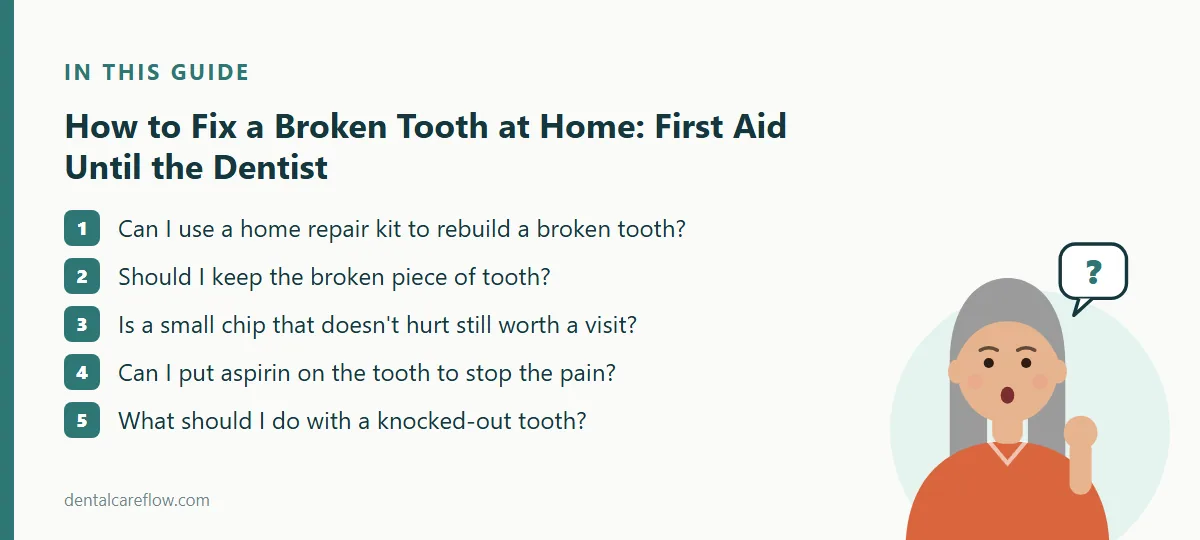
Can I use a home repair kit to rebuild a broken tooth?
The sources we reviewed describe pharmacy products like orthodontic wax and dental cement only as short-term protection. None present them as a repair, and all advise seeing a dentist.
Should I keep the broken piece of tooth?
Yes. Cleveland Clinic advises saving and rinsing broken pieces, and MedlinePlus says to bring the tooth with you to the dentist if you can find it.
Is a small chip that doesn't hurt still worth a visit?
MedlinePlus says a minor chip without discomfort may not need an emergency visit, but it should still be fixed to avoid sharp edges that can cut your lips or tongue.
Can I put aspirin on the tooth to stop the pain?
No. The ADA, MedlinePlus and Cleveland Clinic all warn against placing aspirin on the tooth or gums, as it can burn the tissue.
What should I do with a knocked-out tooth?
Hold it by the crown, try to place it back in the socket, or keep it moist in milk or saliva, and get to a dentist right away.
Sources
- MedlinePlus, Broken or knocked out tooth
- American Dental Association (MouthHealthy), Dental Emergency - What if I break a Tooth
- Cleveland Clinic, What Is a Dental Emergency and Where To Go for Care
This article is general information and doesn't replace advice from your own dentist.
Ask about treatment and costs
Two quick questions. General information only, no diagnosis.