
Can Dentists Remove Teeth? Dentist vs Oral Surgeon
Can dentists remove teeth? Yes, general dentists do many extractions. Learn when you are referred to an oral surgeon, what happens, and US coverage rules.
Editorially reviewed. This article has not been reviewed by a clinician. How we work

On this page
Can dentists remove teeth? Yes. General dentists perform many tooth extractions themselves, and they refer more complex cases to specialists such as oral and maxillofacial surgeons or periodontists.
If a tooth is badly damaged, you may wonder whether your regular dentist can take it out or whether you need a surgeon or a hospital. In most cases the first stop is your own dentist, who can assess the tooth, do routine extractions in the office, and send you on when a case needs more. This guide covers who removes teeth, why a referral happens, what the visit involves, and how US coverage rules treat extractions.
Who removes teeth in the United States?
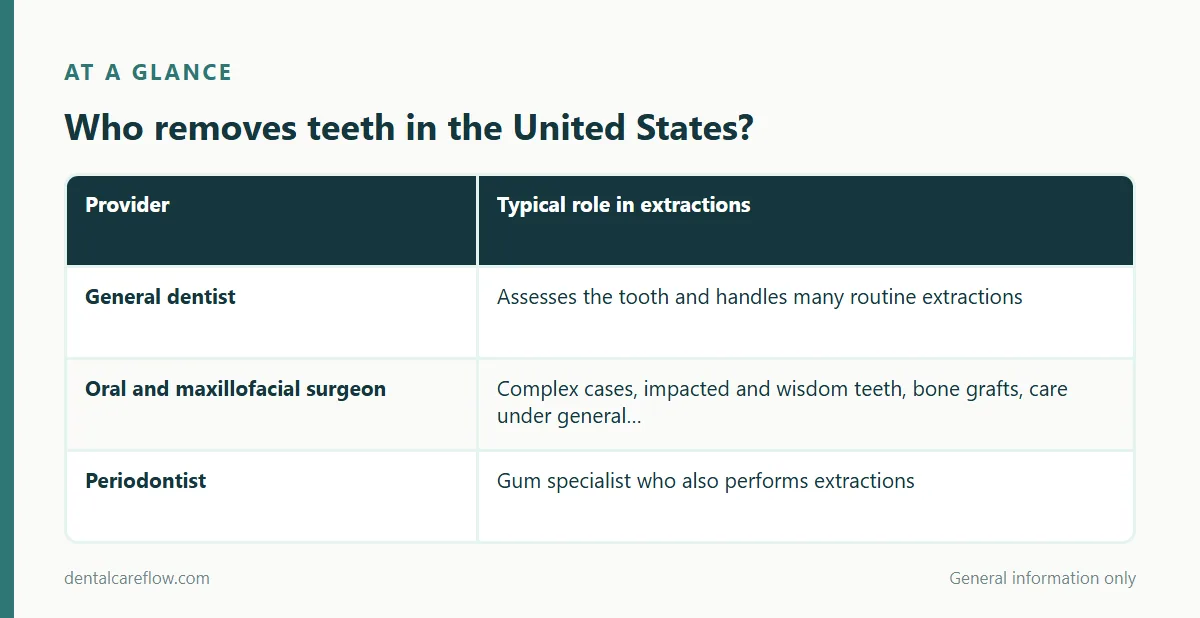
Cleveland Clinic states that dentists and some dental specialists, such as oral and maxillofacial surgeons and periodontists, perform tooth extractions. It adds that while general dentists do plenty of extractions, more complex cases are usually referred out to specialists.
Oral surgeons are dental specialists with advanced training in oral surgery. Cleveland Clinic explains that oral surgeons and maxillofacial surgeons share the same educational pathway and credentials; maxillofacial surgeons also treat the face, jaws and neck. Their work includes wisdom tooth removal, extractions of decayed or damaged teeth, and bone grafts that add volume to the jawbone.
| Provider | Typical role in extractions |
|---|---|
| General dentist | Assesses the tooth and handles many routine extractions |
| Oral and maxillofacial surgeon | Complex cases, impacted and wisdom teeth, bone grafts, care under general anesthesia |
| Periodontist | Gum specialist who also performs extractions |
Curious about the titles? Our article Is a dentist a doctor? explains what DDS and DMD mean.
Why would a tooth need to come out?
According to Cleveland Clinic, removal may be necessary when a tooth is damaged past the point of repair. Common reasons include:
- A fractured tooth
- Advanced gum disease
- An impacted tooth that cannot erupt normally
- Crowded teeth
- Severe tooth decay
An extraction is one option among several. Many damaged teeth can be saved with a filling, crown or other treatment, so ask your dentist what alternatives exist for your tooth before agreeing to removal.
When does a dentist refer you to an oral surgeon?
Cleveland Clinic lists conditions that may lead a dentist to recommend oral surgery, including abscessed teeth, broken teeth, jawbone loss, extensive decay, impacted teeth, and loose or missing teeth. For wisdom teeth specifically, if your dentist recommends removal, you will likely be referred to an oral surgeon for a consultation.
The setting can change too. Oral surgeons usually work in a clinic setting such as an outpatient surgery center, or in a hospital if general anesthesia is needed. A referral does not mean something has gone wrong; it means the case fits a specialist's equipment and training.
What happens during an extraction?
Cleveland Clinic describes these steps:
- Your dentist gives local anesthesia to numb the tooth and surrounding gum. Sedation is an option if you have dental anxiety.
- The tooth is loosened and removed. Badly decayed teeth, or teeth broken at the gum line, may need small gum incisions or to be removed in sections.
- The socket is cleaned and disinfected.
- A bone graft may be placed to help prevent jawbone loss.
- Stitches may be used, though they are not always needed.
Removing one tooth usually takes 30 to 60 minutes. Most people return to routine activities within 48 to 72 hours, though a large tooth such as a molar can take up to four months for the jaw to fully heal. Possible complications include delayed healing, dry socket, infection, sinus damage and nerve injury. Cleveland Clinic warns that drinking through a straw can disrupt the blood clot and cause dry socket.
Call your dentist after an extraction if you develop a fever of 100.4°F (38°C) or higher, pus around the site, or severe pain that does not improve with medication. If you are considering an implant afterward, see our guide to extraction and same-day implants.
Does insurance cover a tooth extraction?
- Original Medicare does not cover routine dental services such as tooth extractions, according to Medicare.gov. An exception exists for certain medically related care, for example an extraction to treat a mouth infection before cancer treatment. For covered Part B dental services, you pay 20% of the Medicare-approved amount after the Part B deductible.
- Medicaid covers dental services for all child enrollees, including relief of pain and infections. Adult dental benefits vary by state, with no federal minimum.
- Private dental plans set their own rules. Ask the office for a pre-treatment estimate, especially if you are being referred to a specialist who may be outside your network.
Frequently asked questions
Can a general dentist remove wisdom teeth?
General dentists perform many extractions, but Cleveland Clinic says that when wisdom tooth removal is recommended, you will likely be referred to an oral surgeon for a consultation.
Is it safe to pull a tooth at home?
No. Extraction involves anesthesia, cleaning the socket and managing bleeding and infection risk. See a dentist, and seek urgent care if you have facial swelling, fever or severe pain.
Can I keep my extracted tooth?
Usually, yes. CDC infection control guidance says extracted teeth can be returned to patients on request.
How long is the recovery?
Most people return to routine activities within two to three days, while full jaw healing after a large tooth can take up to four months.
Sources
- Cleveland Clinic, Tooth Extraction
- Cleveland Clinic, Oral Surgery
- Medicare.gov, Dental services
- Medicaid.gov, Dental Care
- Centers for Disease Control and Prevention, Dental Infection Control: Handling Extracted Teeth
This article is general information and does not replace advice from your own dentist.
Ask about treatment and costs
Two quick questions. General information only, no diagnosis.