Dental Care · Free tool
Teeth Shade Guide: How Whitening Shades Are Ordered
Dentists often describe tooth color with codes such as A1, A2 or B1 from the classic 16-tab shade guide.
- 2 min
- Private, in your browser
- 3 sources
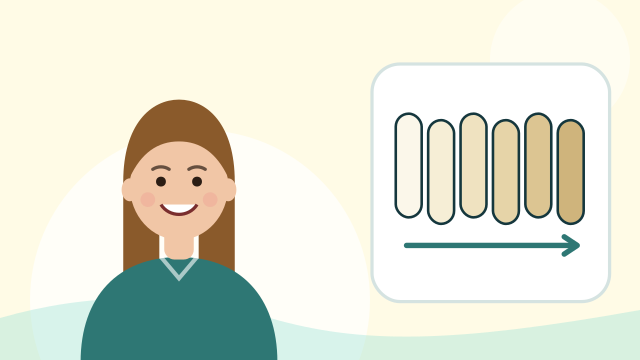
Lightest → darkest (value order)
- B11
- A12
- B23
- D24
- A25
- C16
- C27
- D48
- A39
- D310
- B311
- A3.512
- B413
- C314
- A415
- C416
Illustrative colours only — screens cannot show real tooth colour. Never choose a shade from a screen.
How to use this tool
-
Get your shade codes
Ask your dentist which code they recorded for your current shade and any goal shade they suggested, for example A3 now and A1 as a goal.
-
Choose Current and Goal shade
Pick both codes from the Current shade and Goal shade lists. The result updates as you choose, or press Compare shades.
-
See the steps apart
Both tabs are marked on the lightest-to-darkest strip, with each position out of 16 and how many steps separate them in the value order.
-
Confirm your shade in person
Swatch colors are illustrations only and screens distort color. Only an in-person shade match by your dentist tells you your real tooth shade.
At a glance
-
16 shades
Natural tooth shades in the VITA Classical shade guide, grouped into four hue families, A to D
Source: dentalcare.com (continuing education) -
B1 to C4
Value order from the lightest tab, B1, to the darkest, C4, in the dentalcare.com shade course
Source: dentalcare.com (continuing education) -
Uneven steps
A spectrophotometer study found the distances between steps vary greatly in value and color
Source: James Cook University ResearchOnline -
Not on crowns
The ADA says whitening will not work on caps, veneers, crowns or fillings
Source: MouthHealthy (ADA)
How this tool works
Pick two codes, for example your current shade and a goal mentioned by your dentist, to see where they sit in the light-to-dark order and how many steps apart they are.
The letters are hue families (A reddish-brown, B reddish-yellow, C gray, D reddish-gray) and the numbers are chroma (color intensity) steps within a family. For whitening, the 16 tabs are commonly re-ordered by value (lightness): B1, A1, B2, D2, A2, C1, C2, D4, A3, D3, B3, A3.5, B4, C3, A4, C4.
Steps apart = the difference between the two codes’ positions in that order. Colors on screen are approximate illustrations, so the tool always shows the code and position in text.
Method (version 1.0.0)
- Steps apart
|position(current) − position(goal)| in the 16-tab value order
Limitations
- Screens cannot reproduce real tooth color; never choose a shade from a screen.
- A spectrophotometer study found the steps in this value order are not evenly spaced, so “steps” are a rough guide only.
- Whitening does not change crowns, veneers or fillings, and not all discoloration responds to it (ADA).
When to seek professional advice
Talk to your dentist before whitening; whiteners may not correct all types of discoloration (ADA). Sensitivity is common and usually temporary.
Teeth Shade Guide: a short guide
What do teeth shade codes like A1, A2 and B1 mean?
Shade codes such as A1, A2 or B1 come from the VITA Classical shade guide, a set of 16 tabs that dentists hold next to your teeth to describe their color. The letter is the hue family. According to the dentalcare.com continuing education course on this guide, A tabs have a reddish-brown hue, B tabs a reddish-yellow hue, C tabs a grayish hue and D tabs a reddish-gray hue.
The number marks a gradation of chroma, or color intensity, within that letter family. In the B family, for example, the course describes four gradations: B1, B2, B3 and B4. The A family also includes an in-between tab, A3.5. Within a family, a higher number is a stronger gradation of the same hue, but the numbers alone do not tell you how a B tab compares with an A tab. For that you need the value order.
Teeth whitening shades chart: lightest to darkest
Value is how light or dark a shade looks, regardless of its hue. The dentalcare.com course lists the 16 tabs in order of increasing darkness, and a value-ordered guide like this is often used to describe color change during whitening. The position of a code in this list is what the tool uses to count steps between two shades.
Notice that the order mixes the families. B1 is the lightest tab, yet C1 sits in sixth place, behind A2, and D4 comes before A3. That is why going from A3 to A2 is four places lighter in this order, not one, even though the numbers differ by one.
- Lightest group: B1 (1), A1 (2), B2 (3), D2 (4).
- Light to middle: A2 (5), C1 (6), C2 (7), D4 (8).
- Middle to dark: A3 (9), D3 (10), B3 (11), A3.5 (12).
- Darkest group: B4 (13), C3 (14), A4 (15), C4 (16).
Why shade steps are only a rough guide
Counting steps is a handy way to talk about a change, but the steps are not equal. A study published through James Cook University measured the Vitapan Classical guide and the Vita Bleachedguide 3D-Master with a spectrophotometer. It found that the manufacturer's value order for the classical guide is flawed and that the distances between each step vary greatly in value and color, while the Bleachedguide's steps were more evenly distributed.
The authors recommended the Bleachedguide 3D-Master or an electronic color-measuring device for clinical studies. For you, the practical point is simple: two shades three steps apart in this tool may look closer or further apart in real life than another pair three steps apart. Use the number to understand what your dentist said, not to predict a result.
How dentists match tooth shade in person
A shade match is done in the chair with physical tabs next to your real teeth. The dentalcare.com course describes choosing the closest hue family first, then the chroma within that family, and then checking value using tabs arranged in order of darkness. For value, it suggests standing slightly away from the chair and squinting, and notes that black-and-white images may be used to check the value chosen.
The course also advises resetting the eyes by looking at a neutral gray surface if the process takes longer than 5–7 seconds. A phone or computer screen adds its own brightness, color settings and lighting, so the swatches in this tool are an illustrative ramp, not reproductions of real tabs. Never pick a shade, or judge your own teeth, from a screen.
What teeth whitening can and cannot change
MouthHealthy (ADA) describes four whitening options: stain removal toothpastes, in-office bleaching (also called chairside bleaching, which usually requires one visit), at-home bleaching with a custom-made tray from your dentist, and over-the-counter bleaching products. Stain removal toothpastes do not change the color of teeth, because they can only remove stains on the surface.
How well teeth respond depends on the type of discoloration. The ADA says yellow teeth will probably bleach well, brown teeth may not respond as well, and teeth with gray tones may not bleach at all. Whitening will not work on caps, veneers, crowns or fillings, which matters if you plan to match new dental work to your natural teeth. Some people get tooth sensitivity, which in most cases is temporary. The ADA advises talking to your dentist before you start.
Frequently asked questions
What is the whitest tooth shade on the shade guide?
B1 is the lightest of the 16 tabs in the classic VITA shade guide, according to the value order in the dentalcare.com shade selection course. A1 is second and B2 third. Whether a very light shade suits you is a conversation to have with your dentist.
Is A1 or B1 whiter?
B1 is lighter than A1 in the value order of the classic 16-tab guide: B1 is position 1 and A1 is position 2. They also differ in hue, since B tabs are reddish-yellow and A tabs are reddish-brown. The difference between neighboring tabs is not the same size across the guide.
What does A2 tooth shade mean?
A2 is a tab in the A family, which has a reddish-brown hue, at the second chroma gradation of that family. In the lightest-to-darkest value order it sits at position 5 of 16, after B1, A1, B2 and D2. Your dentist chooses it by holding physical tabs next to your teeth.
What does A3 shade mean on teeth?
A3 is a reddish-brown A-family tab with more color intensity than A1 and A2. In the value order used for whitening it is position 9 of 16, in the middle of the guide. Moving from A3 to A1 is seven positions lighter in that order, though the steps are not evenly spaced.
What are the A, B, C and D shade groups?
They are the four hue families of the VITA Classical shade guide. A tabs have a reddish-brown hue, B tabs reddish-yellow, C tabs grayish and D tabs reddish-gray, according to the dentalcare.com course. The number after the letter shows the chroma gradation within that family.
How many shades whiter can teeth get with whitening?
There is no fixed number of shades, and this tool cannot predict a result. The ADA says yellow teeth will probably bleach well, brown teeth may not respond as well, and teeth with gray tones may not bleach at all. Steps in the shade order are also uneven, so ask your dentist what is realistic for your teeth.
Can I find my tooth shade from a photo or my screen?
No. Screens and cameras change color with their own brightness, settings and lighting, so a picture cannot show your real tooth shade. The swatches here are illustrations only. A reliable shade comes from your dentist matching physical tabs to your teeth in person.
Does whitening change the color of crowns or veneers?
No. The ADA says whitening will not work on caps, veneers, crowns or fillings. If you have dental work on visible teeth, talk to your dentist before whitening, because your natural teeth may change color while the dental work stays the same.
Do whitening toothpastes change your tooth shade?
Not in the way bleaching does. MouthHealthy (ADA) says stain removal toothpastes do not change the color of teeth because they can only remove stains on the surface. Changing the shade itself involves bleaching, either at the dental office, at home with a tray from your dentist, or with over-the-counter products.
Why do dentists squint when matching tooth shade?
Squinting reduces the amount of light reaching the eye, which helps when judging value, meaning how light or dark a tooth looks. The dentalcare.com shade course suggests standing slightly away from the chair and squinting for this step. It also suggests resetting the eyes on a neutral gray surface if matching takes longer than 5–7 seconds.
Is tooth sensitivity after whitening normal?
The ADA says some people who use teeth whiteners may experience tooth sensitivity, and in most cases it is temporary. You can delay treatment and try again later. If sensitivity worries you or does not ease, talk to your dentist.
Sources
- Shade Selection Using the VITA Classical Shade Guide (CE690), dentalcare.com (continuing education). Accessed 2026-10-24.
- Use of shade guides Vitapan Classical and Vita Bleachedguide 3D-Master for color measurement in tooth-bleaching, James Cook University ResearchOnline. Accessed 2026-10-24.
- Teeth Whitening, MouthHealthy (ADA). Accessed 2026-10-24.
Editorially reviewed October 24, 2026. This tool has not been reviewed by a dentist or physician. It gives general information and arithmetic, not a diagnosis or treatment advice. Algorithm version 1.0.0. Found a mistake? Tell us and we will fix it. Read our editorial policy.
