What Is Teeth Bonding? A US Patient's Guide
What is teeth bonding? Learn what composite bonding fixes, what happens at the appointment, how long it lasts and how US insurance and Medicare treat it.
Editorially reviewed. This article has not been reviewed by a clinician. How we work

On this page
What is teeth bonding? It is a cosmetic repair in which a dentist applies tooth-colored composite resin to a tooth, shapes it, and hardens it with a curing light. It is used for chips, small gaps and discoloration, and is usually finished in a single office visit.
In the United States, bonding is one of the most common "first step" cosmetic treatments because it usually needs little or no removal of natural enamel and, according to Cleveland Clinic, it is reversible. This guide walks through what bonding can and cannot do, what happens in the chair, and how dental insurance in the US typically treats it, so you can have an informed conversation with your own dentist.
What problems can teeth bonding fix?
Cleveland Clinic and Colgate describe a similar list of uses. Bonding works best for small, mostly cosmetic changes:
- Chipped or minor cracked edges on front teeth
- Discolored spots that whitening does not lift
- Small gaps between teeth
- Teeth that look short or uneven in shape
- In some cases, covering a root surface exposed by gum recession (Colgate)
It is not designed for large structural damage. A tooth that has lost a lot of its structure, has deep decay, or takes heavy biting force is often better served by a crown or another restoration your dentist recommends.
What happens during a bonding appointment?
The process is straightforward, which is a big part of its appeal. Cleveland Clinic outlines these steps:
- Shade selection. Your dentist uses a shade guide to pick a resin color that blends with your natural teeth.
- Surface preparation. The tooth surface is lightly roughened and a conditioning liquid is applied so the resin can stick.
- Shaping. The putty-like resin is placed, molded and smoothed into the desired shape.
- Curing. A special light hardens the material.
- Finishing. The dentist trims, adjusts the bite and polishes the surface.
Both Cleveland Clinic and Colgate put the chair time at about 30 to 60 minutes per tooth. Colgate notes that most bonding procedures do not require anesthesia, so most people can go straight back to work or school. If several teeth are involved, the work may be split over more than one visit.
How long does bonding last, and what are the trade-offs?
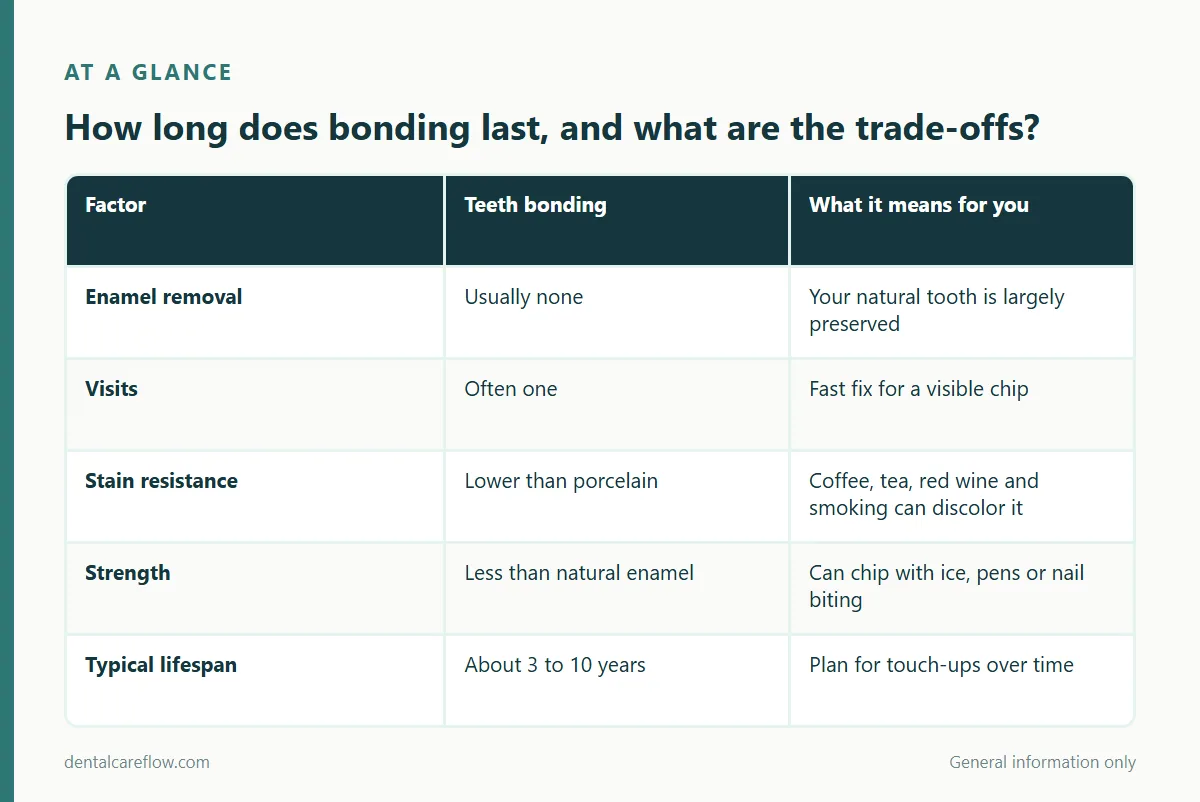
Bonding typically lasts about three to ten years before it needs a touch-up or replacement, according to both sources. Where you land in that range depends on your habits and how many teeth were treated.
| Factor | Teeth bonding | What it means for you |
|---|---|---|
| Enamel removal | Usually none | Your natural tooth is largely preserved |
| Visits | Often one | Fast fix for a visible chip |
| Stain resistance | Lower than porcelain | Coffee, tea, red wine and smoking can discolor it |
| Strength | Less than natural enamel | Can chip with ice, pens or nail biting |
| Typical lifespan | About 3 to 10 years | Plan for touch-ups over time |
If you are weighing bonding against veneers, our comparison of porcelain veneers vs composite veneers explains how the two materials differ.
Does dental insurance in the US cover bonding?
It depends on your plan and on why the bonding is done, so read your plan documents for how they treat cosmetic work versus repairs of damage. Bonding to repair a chipped tooth and bonding to close a gap for appearance are different reasons for treatment, and your plan may not handle them the same way. Ask your dentist's office to send a pre-treatment estimate to your insurer before you commit.
A few coverage facts are worth knowing:
- Medicare: Medicare.gov states that in most cases Original Medicare does not cover dental services like routine cleanings, fillings or extractions, and that you pay all costs for non-covered services, including most dental services. Cosmetic bonding is very unlikely to be covered under Original Medicare.
- Price range: Colgate (US) lists bonding at roughly $200 to $1,000 per tooth, depending on insurance coverage and location. Treat that as a broad guide rather than a quote; your dentist's fee will vary.
How do you care for bonded teeth?
Good daily habits stretch the life of composite resin:
- Brush twice a day with a soft brush and fluoride toothpaste, and floss daily (Cleveland Clinic).
- Colgate suggests avoiding staining foods and drinks for the first 48 hours after treatment.
- Do not chew ice, pens or hard candy, and do not bite your nails.
- Wear a mouthguard for sports and ask about a night guard if you grind your teeth.
- Call your dentist if the bonding feels sharp, changes your bite, or chips.
Questions to ask your dentist before bonding
- Is my problem small enough for bonding, or would a veneer or crown be more durable?
- Will any enamel be removed?
- How will you code this for my insurance, and can you send a pre-treatment estimate?
- Should I whiten my teeth first so the resin can be matched to the final shade?
For more on how the procedure is done in practice, see composite bonding procedure explained.
Sources
- Cleveland Clinic, Dental Bonding
- Colgate (US), What Is Tooth Bonding Used For?
- Medicare.gov, Dental services coverage
This article is general information and is not a substitute for advice from your own dentist.
Ask about treatment and costs
Two quick questions. General information only, no diagnosis.