
How Do Veneers Work? From Enamel Prep to Bonding
How do veneers work? Learn how thin shells bond to the front of teeth, what happens at each appointment, porcelain vs composite, and why most are permanent.
Editorially reviewed. This article has not been reviewed by a clinician. How we work

On this page
How do veneers work? A veneer is a thin, custom-made shell bonded to the front surface of a tooth. Your dentist usually removes a small amount of enamel so the shell sits flush, then cements it in place, changing the tooth's color, shape or length without covering the whole tooth the way a crown does.
Veneers are a cosmetic treatment, so understanding the mechanics matters before you commit: most types involve permanently removing some enamel, and in the US they are usually paid for out of pocket. This article walks through how veneers attach to teeth, what happens at each appointment, and what changes for your teeth afterward.
What is the basic idea behind a veneer?
ADA MouthHealthy describes veneers as custom-made, natural-looking coverings for your teeth, used for chipped, stained or crooked teeth and to mask gaps. The key difference from a crown is coverage. MouthHealthy explains that a crown covers the entire tooth, while a veneer covers the front surface only. Cleveland Clinic adds that because veneers are cosmetic, they improve appearance but do not strengthen teeth the way crowns can.
To work, a veneer needs two things: room to sit without looking bulky, and a strong bond to the tooth. Removing a thin layer of enamel creates the room; a dental cement creates the bond.
How do porcelain and composite veneers differ in how they work?
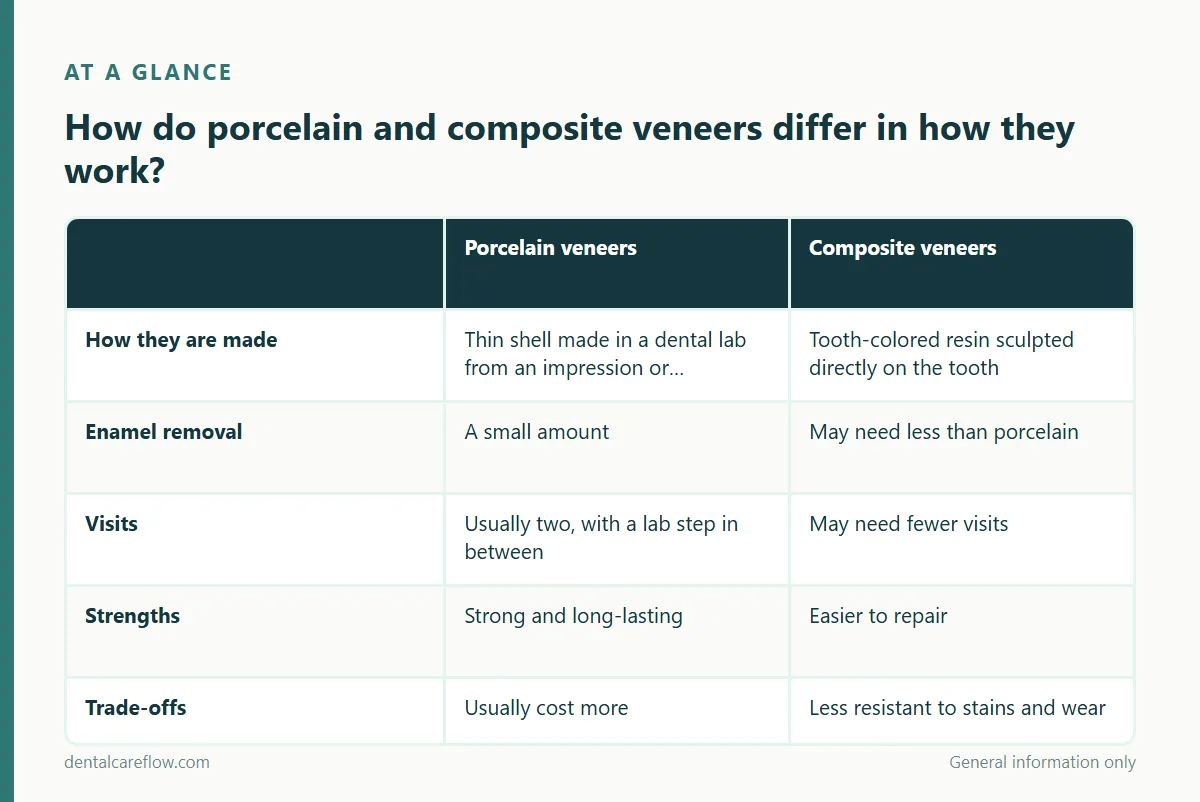
| Porcelain veneers | Composite veneers | |
|---|---|---|
| How they are made | Thin shell made in a dental lab from an impression or 3D scan | Tooth-colored resin sculpted directly on the tooth |
| Enamel removal | A small amount | May need less than porcelain |
| Visits | Usually two, with a lab step in between | May need fewer visits |
| Strengths | Strong and long-lasting | Easier to repair |
| Trade-offs | Usually cost more | Less resistant to stains and wear |
This comparison follows ADA MouthHealthy. Cleveland Clinic also describes no-prep or minimal-prep veneers, which still require some enamel removal and may not suit everyone, and removable "pop-on" veneers, which it says can make eating and speaking harder and have limited research behind them. For more detail, see porcelain veneers vs composite veneers.
What happens at each veneer appointment?
For porcelain veneers, Cleveland Clinic and MouthHealthy describe a similar sequence:
- Evaluation. Your dentist checks your teeth and gums. Cleveland Clinic notes veneers are an option if you are free of extensive cavities and gum disease, and serious oral health problems should be treated first.
- Preparation. A small amount of enamel is removed from the front of each tooth.
- Impressions or scan. The dentist takes an impression or 3D scan and sends it to a dental lab.
- Temporaries. The lab usually takes a few weeks. Temporary veneers can be placed in the meantime if needed.
- Try-in. At the second visit, the dentist checks the shape, color and fit.
- Bonding. The veneers are bonded with dental cement and your bite is adjusted.
Composite veneers skip the lab. MouthHealthy explains the dentist prepares the tooth, sculpts and bonds the material, hardens it with a special light, then polishes it. Cleveland Clinic notes most people return to normal activities the same day.
Are veneers reversible?
Mostly no. MouthHealthy states that treatment is not reversible because enamel is removed to place a veneer. Cleveland Clinic says most types are permanent, while no-prep and minimal-prep veneers can be reversible. If reversibility matters to you, ask your dentist which type you are being offered and how much enamel will be removed.
What changes after veneers are placed?
- Sensitivity. Cleveland Clinic lists increased sensitivity to heat and cold as a possible effect.
- Decay is still possible. MouthHealthy notes cavities can still form under or around a veneer.
- Lifespan. Cleveland Clinic puts it at about 10 to 15 years with proper care, and veneers can loosen or come off.
- Habits. MouthHealthy advises avoiding nail biting and chewing hard objects, and wearing a mouthguard for sports.
How do US insurance and Medicare treat veneers?
Cleveland Clinic notes veneers are usually not covered by insurance because they are cosmetic. Medicare.gov states that in most cases Original Medicare does not cover dental services, and you pay all costs for non-covered services. Ask for a written treatment plan and estimate before preparation begins.
For a broader overview, read our dental veneers guide.
Sources
- ADA MouthHealthy, Veneers
- Cleveland Clinic, Dental Veneers
- Medicare.gov, Dental services coverage
This article is general information and is not a substitute for advice from your own dentist.
Ask about treatment and costs
Two quick questions. General information only, no diagnosis.