Is a Dental Bridge Permanent? Fixed, but Not Forever
Is a dental bridge permanent? It's fixed in place but often lasts 5 to 15 years. See why bridges fail, how they compare with implants and how to care for one.
Editorially reviewed. This article has not been reviewed by a clinician. How we work

On this page
Is a dental bridge permanent? It is fixed, meaning it is cemented in place and only a dentist can remove it, but it is not lifelong. Cleveland Clinic puts the average lifespan of a bridge at five to 15 years, with some lasting longer with good care.
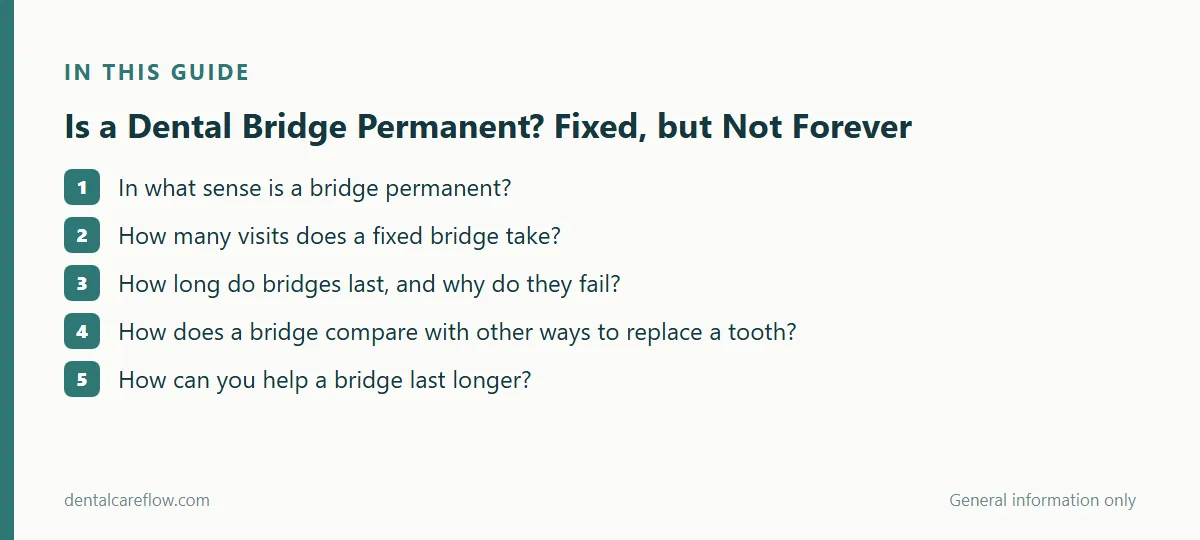
"Permanent" gets used in two different ways in dentistry: fixed in place, as opposed to removable, and lasting forever. A bridge is the first but not the second. This article explains what that means in practice, what tends to end a bridge's life and how it compares with other options.
In what sense is a bridge permanent?
Cleveland Clinic explains that bridges are fixed in place and called permanent because only a dentist can remove them, unlike partial dentures, which you take out yourself. A traditional bridge uses crowns on the teeth either side of the gap to hold one or more artificial teeth (pontics). Other designs include cantilever bridges, supported on one side only; Maryland bridges, which use metal wings bonded to the backs of neighboring teeth and are typically used for front teeth; and implant-supported bridges.
How many visits does a fixed bridge take?
Cleveland Clinic explains that traditional and cantilever bridges usually take two office visits. At the first, the supporting teeth are prepared, impressions are taken and a temporary bridge is placed; at the second, the final bridge is fitted and cemented. Some offices can make a bridge in one appointment using CAD/CAM technology. Maryland bridges also take two visits, with the second used to bond the wings. Implant-supported bridges involve several visits, including surgery, and implants typically need three to six months to fuse with the jawbone before the bridge is attached.
That process is part of why a bridge counts as permanent: the supporting teeth are reshaped for crowns, so going back to having no restoration there is not usually an option.
How long do bridges last, and why do they fail?
The five-to-15-year average from Cleveland Clinic hides a lot of variation. The most common reasons a bridge needs replacing relate to the teeth holding it up:
- Decay in the supporting teeth. Cleveland Clinic notes that decay or damage to the abutment teeth can weaken the bridge.
- Fracture of a supporting tooth.
- Gum problems from poor cleaning under the pontic, leading to inflammation or cavities.
- Wear or damage to the bridge itself.
- A loose bridge. Cleveland Clinic says a loose bridge is usually easy for a dentist to remove and recement.
If a bridge has to be taken off to treat decay or gum disease, Cleveland Clinic warns that it may break during removal and need replacing.
How does a bridge compare with other ways to replace a tooth?
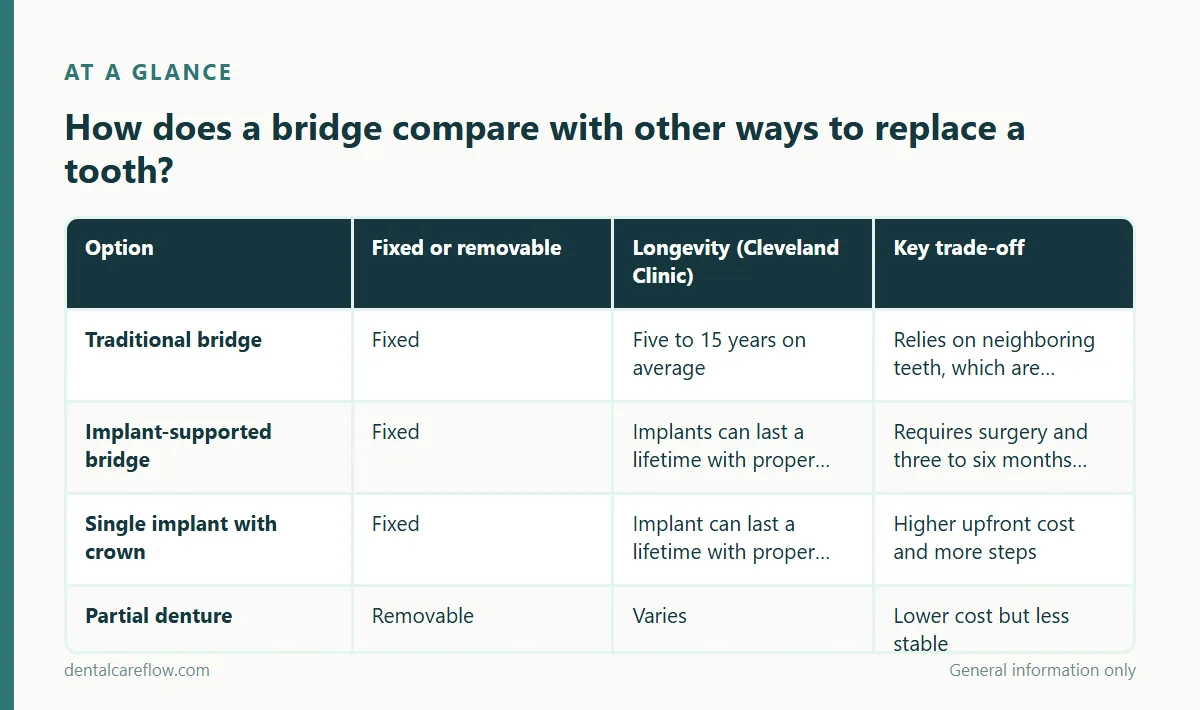
| Option | Fixed or removable | Longevity (Cleveland Clinic) | Key trade-off |
|---|---|---|---|
| Traditional bridge | Fixed | Five to 15 years on average | Relies on neighboring teeth, which are shaped for crowns |
| Implant-supported bridge | Fixed | Implants can last a lifetime with proper care; restorations around 15 years | Requires surgery and three to six months of healing before attachment |
| Single implant with crown | Fixed | Implant can last a lifetime with proper care | Higher upfront cost and more steps |
| Partial denture | Removable | Varies | Lower cost but less stable |
Cleveland Clinic notes that bridges are typically more affordable than implants, while implants generally last much longer and help preserve jawbone. For a cost-focused look, see our implants vs bridges cost comparison.
How can you help a bridge last longer?
- Brush twice daily and floss every day with a nonabrasive fluoride toothpaste.
- Clean under the bridge daily with floss threaders or interproximal brushes, as Cleveland Clinic recommends.
- Avoid extremely hard or chewy foods, and don't chew ice, pens, pencils or fingernails.
- Keep regular checkups so your dentist can spot decay at the edges of the supporting crowns early.
What should you ask your dentist before choosing a bridge?
- Which bridge design suits this gap, and why?
- How healthy are the teeth that would support it?
- What would replacing it involve in 10 or 15 years?
- Would an implant-supported option make more sense for me?
Sources
- Cleveland Clinic, Dental Bridges
- Cleveland Clinic, Dental Implants
This article is general information and is not a substitute for advice from your own dentist.
Ask about treatment and costs
Two quick questions. General information only, no diagnosis.