Is Deep Cleaning Really Necessary? How to Judge the Advice
Is deep cleaning really necessary? See when scaling and root planing is recommended, what untreated gum disease can do, and a checklist to weigh the advice.
Editorially reviewed. This article has not been reviewed by a clinician. How we work

On this page
Is deep cleaning really necessary? If you have been diagnosed with periodontitis, usually yes. Scaling and root planing is the standard first treatment for mild to moderate gum disease, and the CDC notes periodontitis cannot be reversed, only slowed and managed with professional care.
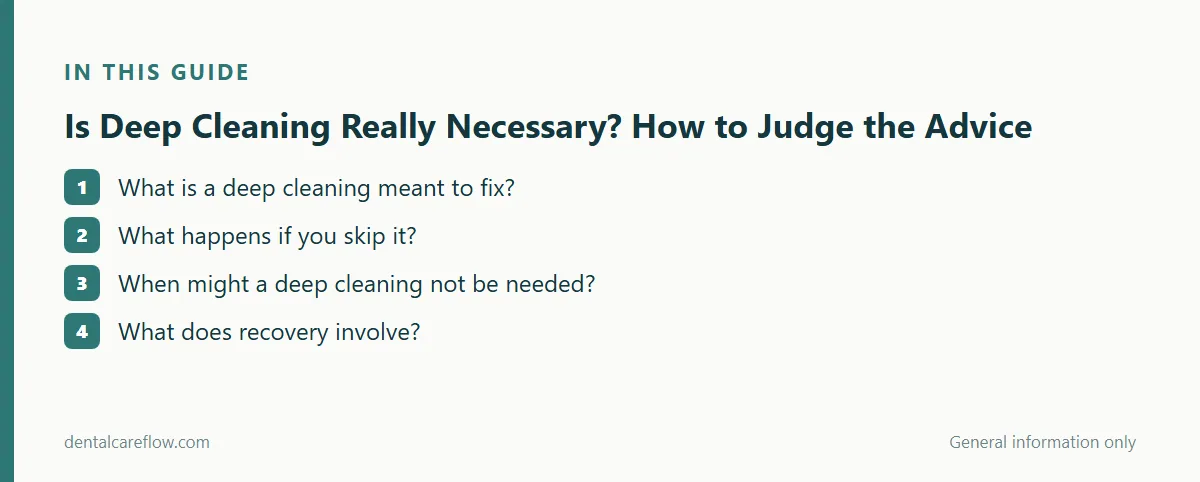
Being told you need a "deep cleaning" when you came in for a routine checkup can feel like an upsell, especially when it is billed as a separate procedure and your US dental plan may treat it differently. It is fair to ask why. This article explains when a deep cleaning makes sense, what can happen if gum disease is left alone, and how to judge the recommendation for yourself.
What is a deep cleaning meant to fix?
A deep cleaning, formally called scaling and root planing, removes plaque and tartar from above and below the gumline and smooths the tooth roots. Cleveland Clinic describes it as like a regular cleaning, except it reaches deeper beneath your gums, and says it is usually the first-line treatment for mild or moderate gum disease. The CDC and NIDCR both list it as a main non-surgical treatment for periodontal disease.
A regular cleaning is preventive. It is designed for healthy gums. Once infection has moved below the gumline, a regular cleaning simply does not reach the deposits that keep the disease going.
What happens if you skip it?
Gum disease does not stay still. NIDCR explains that if left untreated, it can spread to the bones that support the teeth, chewing can become painful, and in the worst cases teeth may become loose or need to be removed. Cleveland Clinic adds that the longer you wait, the more bacteria may grow, while early treatment can help prevent tooth loss and gum recession.
The CDC also points out that gum disease often becomes serious before you notice symptoms, so feeling fine is not proof that treatment is unnecessary.
Signs that support a deep cleaning recommendation
Your dentist bases the decision on examining your gums and teeth. These symptoms from the CDC and NIDCR are consistent with gum disease:
- Gums that bleed easily, or are red, swollen or tender
- Gums pulling away from the teeth, making teeth look longer
- Persistent bad breath
- Loose or sensitive teeth, or pain when chewing
- A change in your bite or in how a partial denture fits
Risk factors listed by the CDC include smoking, diabetes, poor oral hygiene, stress, genetics and hormonal changes. CDC data show about 62% of current adult smokers aged 30 and older had periodontitis.
When might a deep cleaning not be needed?
Not every case of bleeding gums means periodontitis. The CDC describes gingivitis, the mildest form of gum disease, as reversible, and NIDCR notes that early gum disease can often be reversed with daily brushing and flossing. If your gums are inflamed but there is no sign of deeper damage, your dentist may recommend a regular cleaning and better home care first.
How to evaluate the recommendation: a checklist
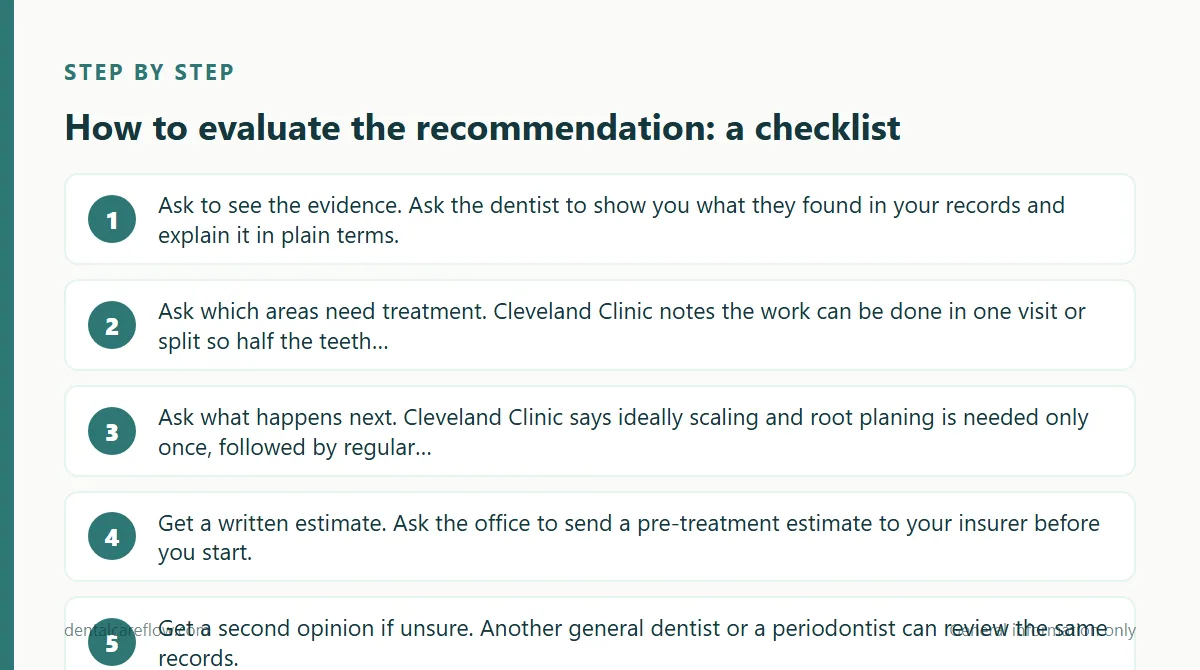
- Ask to see the evidence. Ask the dentist to show you what they found in your records and explain it in plain terms.
- Ask which areas need treatment. Cleveland Clinic notes the work can be done in one visit or split so half the teeth are treated at each of two appointments, depending on your situation and insurance.
- Ask what happens next. Cleveland Clinic says ideally scaling and root planing is needed only once, followed by regular cleanings and good home care.
- Get a written estimate. Ask the office to send a pre-treatment estimate to your insurer before you start.
- Get a second opinion if unsure. Another general dentist or a periodontist can review the same records.
What does recovery involve?
Cleveland Clinic describes the treatment as done with local anesthesia, with no incisions or stitches, and most people return to normal routines the same day. Temporary bleeding, tender gums and sensitivity to temperature are common, and sensitivity should fade within a month or two. Quitting tobacco can improve results, according to NIDCR.
Coverage notes for US patients
Medicare.gov states that in most cases Original Medicare does not cover dental services like routine cleanings, so check whether you have separate dental coverage. For adults on Medicaid, Medicaid.gov explains that each state decides which dental benefits to provide. NIDCR's list of lower-cost options, including dental school clinics and community health centers, can help if cost is the barrier.
Healthy gums also matter for future treatment; see dental implants with gum disease.
Sources
- CDC, Gum (Periodontal) Disease
- NIDCR, Gum Disease
- Cleveland Clinic, Scaling and Root Planing
- Medicare.gov, Dental services coverage
- Medicaid.gov, Dental Care
- NIDCR, Finding Low-Cost Dental Care
This article is general information and is not a substitute for advice from your own dentist.
Ask about treatment and costs
Two quick questions. General information only, no diagnosis.