
What Are Screwless Dental Implants? What the Label Can Mean
What are screwless dental implants? Where screws sit in a standard implant, what the label may refer to, and questions to ask your dentist.
Editorially reviewed. This article has not been reviewed by a clinician. How we work

On this page
What are screwless dental implants? The term isn't defined in FDA or Cleveland Clinic patient guidance, so it can describe different designs, and the safest step is to ask the provider exactly which implant system and attachment method they mean.
If you've seen ads for "screwless" implants, you may have assumed they skip surgery or avoid putting a post in the jaw. That isn't what the term usually signals. The patient information pages we reviewed from the US Food and Drug Administration (FDA) and Cleveland Clinic don't define "screwless implants" as a type at all. What they do explain is how implants are built and where screws normally appear, and that's the key to understanding what a provider might mean.
Where screws show up in a standard implant
A typical implant isn't one screw. It's a small system with several parts. According to the FDA, an implant system includes an implant body and an abutment, and may also include an abutment fixation screw. The FDA describes the parts this way:
- Implant body: placed in the jawbone in place of the tooth's root.
- Abutment: the connector that extends through the gums and holds the artificial tooth.
- Abutment fixation screw: usually used to attach the abutment to the implant body.
Cleveland Clinic describes the implant itself as a small, threaded post, which means the part in the bone is shaped much like a screw. It also explains that the abutment screws into the post. On top sits the restoration: a crown, bridge or denture.
So "screw" can refer to at least three different things: the threaded shape of the post, the small screw holding the abutment, or screws used to hold the final teeth. A product called "screwless" could be talking about any one of these.
Possible meanings of "screwless"
Because there's no standard definition in the sources we checked, here are the questions to clarify with whoever uses the term. We've avoided guessing at any specific brand's design.
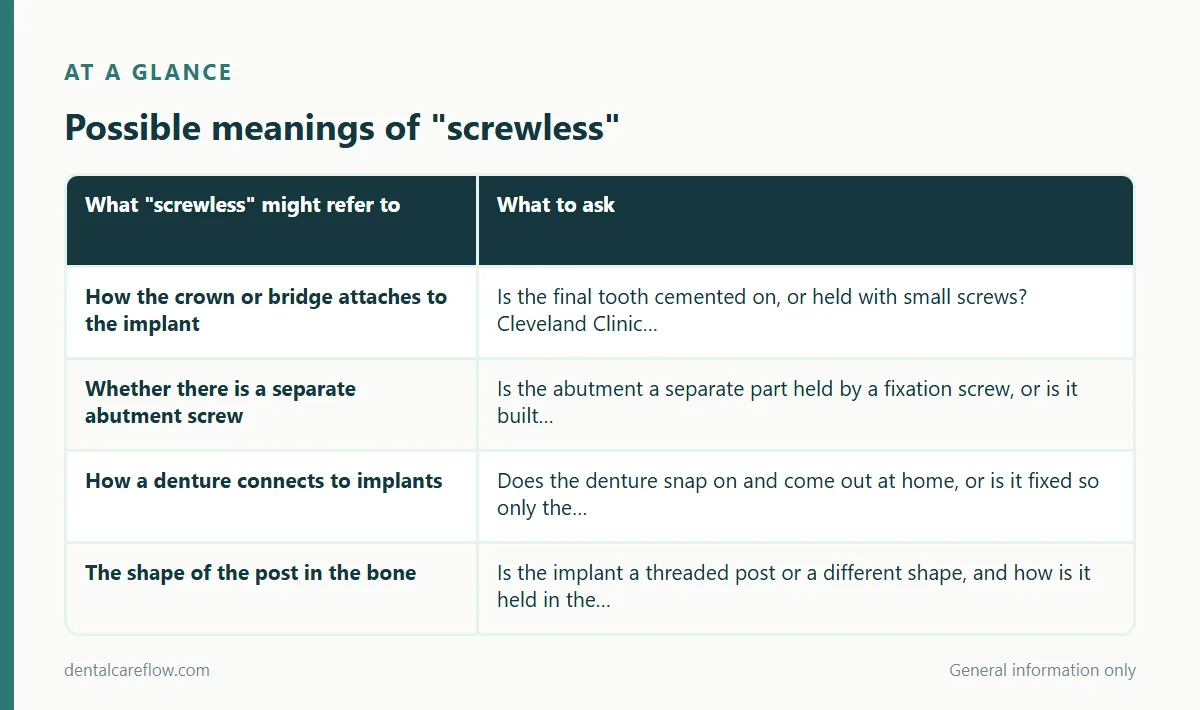
| What "screwless" might refer to | What to ask |
|---|---|
| How the crown or bridge attaches to the implant | Is the final tooth cemented on, or held with small screws? Cleveland Clinic notes that implant-supported bridges are attached with cement or small screws. |
| Whether there is a separate abutment screw | Is the abutment a separate part held by a fixation screw, or is it built differently? |
| How a denture connects to implants | Does the denture snap on and come out at home, or is it fixed so only the dentist can remove it? Cleveland Clinic describes both kinds of implant-supported dentures. |
| The shape of the post in the bone | Is the implant a threaded post or a different shape, and how is it held in the bone? |
What doesn't change: surgery and healing
Whatever an implant is called, the part that replaces the root still goes into the jawbone. Cleveland Clinic describes the surgery as placing the post in prepared jawbone, followed by a healing period of about three to nine months while the bone fuses to the implant, a process called osseointegration. Cleveland Clinic calls that fusion critical for stability and long-term success. The FDA likewise says to expect healing to take several months or longer.
The same candidacy questions also apply. Cleveland Clinic lists active gum disease, bone disorders, poor oral hygiene, severe jawbone loss and unmanaged diabetes among the factors that can make someone a poor candidate, and notes that smoking or vaping may disrupt healing. A label on the product doesn't change any of that. If you want to know what to expect at a first appointment, see our guide to the dental implant consultation.
Why the attachment method matters
The way parts are joined has practical effects, which is why it's worth asking about. The FDA lists "looseness or twisting" from abutment screw loosening as one possible complication of implant systems. A different connection design may have its own maintenance considerations, so ask how the specific system is checked, tightened or repaired over time.
The FDA also lists other risks that apply to implants generally, regardless of design:
- damage to nearby natural teeth during placement
- sinus perforation or jawbone fracture during surgery
- poor bite function
- implant failure linked to infection or delayed healing, which the FDA says is more likely with uncontrolled diabetes or smoking
- numbness after surgery
The FDA defines implant failure as implant looseness or loss, and notes it can require another surgery to fix or replace the system.
Questions to ask before choosing
- What exactly makes this implant "screwless," and which part does that refer to?
- What brand and model is it? The FDA recommends asking and keeping a record of it.
- Is the final tooth cemented, screw-retained or removable?
- If a part loosens or a crown breaks, how is it repaired?
- How long is healing expected to take in my case?
- Am I a good candidate, given my bone, gums and overall health?
Frequently asked questions
Are screwless dental implants a different procedure?
Not necessarily. The FDA and Cleveland Clinic pages we reviewed don't describe "screwless" as a separate category. A post is still placed in the jawbone and needs time to heal.
Do screwless implants avoid surgery?
No implant described in these sources avoids surgery. The implant body is surgically placed in the jaw.
Is screwless better than a regular implant?
The sources we checked don't support a general claim either way. Which design fits depends on your situation and your dentist's assessment.
Are mini implants the same as screwless implants?
The authoritative patient pages we checked don't equate the two, and mini implants are a separate topic. Ask your provider which system they're actually recommending.
How long do implants last?
Cleveland Clinic says implants can last a lifetime with good hygiene and regular dental visits, while crowns and bridges on top typically last around 15 years.
Sources
- US Food and Drug Administration, Dental Implants: What You Should Know
- Cleveland Clinic, Dental Implants: Types, Purpose & Benefits
- Cleveland Clinic, Dental Bridges: Types & Who Needs Them
- Cleveland Clinic, Implant Supported Dentures: Process, Benefits & Care
This article is general information and doesn't replace advice from your own dentist.
Ask about treatment and costs
Two quick questions. General information only, no diagnosis.