
Can You Have Braces With Dental Implants? Planning Both
Can you have braces with dental implants? Often yes, but implants do not move. Learn how they act as anchors, why sequence matters, and what to ask.
Editorially reviewed. This article has not been reviewed by a clinician. How we work

On this page
Can you have braces with dental implants? Yes, in many cases, but the implant itself will not move: braces shift the natural teeth around it, so planning and the order of treatment matter a great deal.
Adults who already have an implant, or who need both an implant and straighter teeth, often worry that the two treatments conflict. They can work together, and orthodontists sometimes use an implant as a fixed anchor. The catch is that an implant is locked into the jawbone, so its position has to suit the final bite. Here is how braces and implants interact, and what to ask your dental team.
How do braces move teeth, and why are implants different?
The ADA's MouthHealthy site explains that traditional braces realign teeth by applying pressure: brackets are cemented to the teeth, joined by a wire that is adjusted over time to gradually shift the teeth and jaw. Natural teeth respond to that pressure and move through the bone.
An implant behaves differently. It is a post placed in the jawbone, and bone grows around it over time; Cleveland Clinic says this fusion takes roughly three to nine months. Once fused, the implant is held rigidly. A 2021 case report in Head & Face Medicine put it plainly: all the teeth could be moved except the implant, which cannot be relocated with an orthodontic appliance alone. The authors compared implants to ankylosed teeth, which are fused to the bone and also resist orthodontic movement.
Can an implant help braces work?
Sometimes it does. Because a fused implant stays put, orthodontists can use it as an anchor to push or pull other teeth. A 2019 article in the Dental Press Journal of Orthodontics describes using implants for "absolute anchorage" during orthodontic movement, then using the same implants later to support replacement teeth. The authors note that skeletal anchorage does not allow the anchor itself to move, which supports more predictable results, and that adults with missing back teeth often need this kind of multidisciplinary approach.
Longer-term data are limited but encouraging. A 2026 retrospective study followed 58 implants in 24 people who had treated advanced gum disease, for an average of almost 12 years. Implants used as orthodontic anchors showed no significant difference in bone loss or peri-implant infection compared with implants that were not, and none were lost. The authors caution that the study was small and from a single specialist center, and that poor follow-up care was linked to more bone loss.
Should braces come before or after an implant?
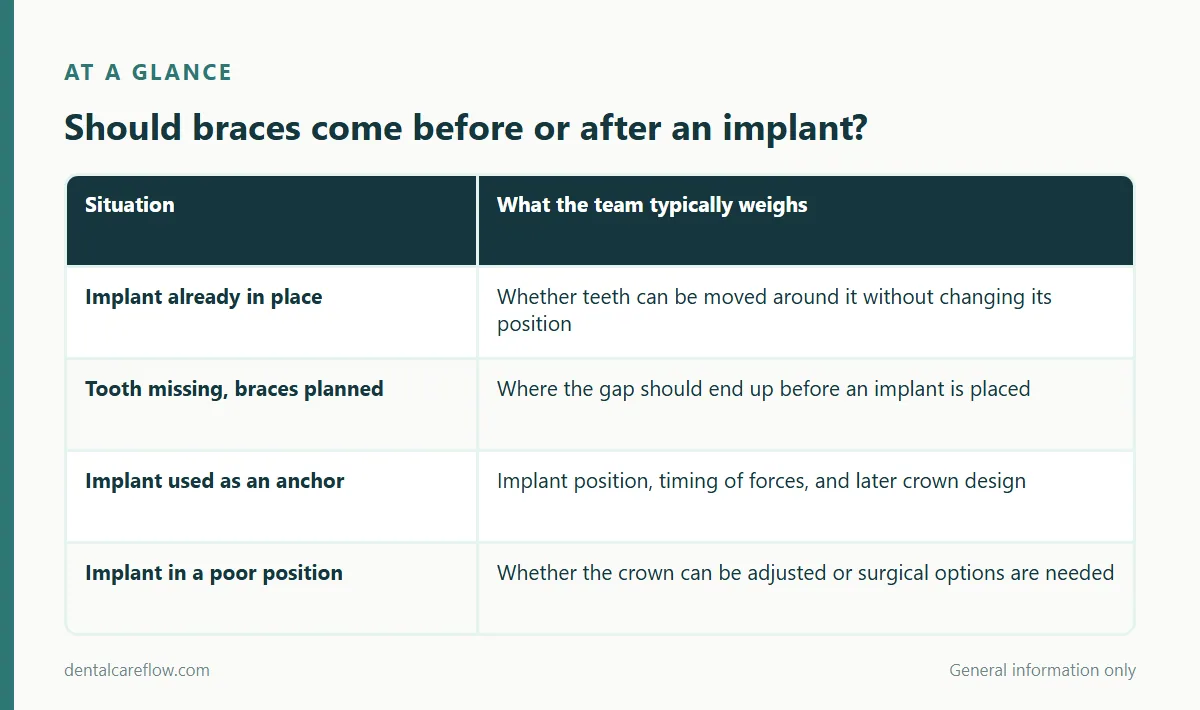
This is a decision for your dental team, and it depends on your case. What the research stresses is that the implant's position must match the planned final result. The 2019 article calls it fundamental to place the implant in the ideal position so the desired tooth movement and bite can be achieved, and recommends integrated planning among orthodontics, surgery, gum care and prosthodontics.
| Situation | What the team typically weighs |
|---|---|
| Implant already in place | Whether teeth can be moved around it without changing its position |
| Tooth missing, braces planned | Where the gap should end up before an implant is placed |
| Implant used as an anchor | Implant position, timing of forces, and later crown design |
| Implant in a poor position | Whether the crown can be adjusted or surgical options are needed |
What if an implant is in the wrong spot?
Because braces cannot move it, a poorly positioned implant is harder to fix than a crooked tooth. The Head & Face Medicine authors describe how an implant placed at a poor angle can leave a crown that looks too long and a gum line that does not match, and they note that if the implant is misplaced from the start, esthetic problems follow. Correction options they discuss include surgically removing the implant, moving a block of bone with the implant attached, or specialized techniques that combine bone cuts with orthodontic forces. Each involves surgery, which is why careful planning up front matters.
What should you ask before starting braces?
- Will my implant serve as an anchor, or will teeth be moved around it?
- Does the final tooth position work with where my implant sits?
- Will my implant crown need to be changed once the teeth have moved?
- Who is coordinating the plan between the orthodontist and the dentist or surgeon who placed or will place the implant?
- Would clear aligners be an option for my case?
The ADA notes that orthodontic care can come from a general dentist or an orthodontist, depending on the dentist's experience and how complex the case is, and that removable aligners are an option under a dentist's or orthodontist's direct supervision. If you are still planning an implant, our guide to an implant consultation lists questions worth bringing. Age also matters: Cleveland Clinic says implant candidates are typically at least 18 and done growing, a topic covered in our article on age limits.
Frequently asked questions
Can braces damage a dental implant?
Research on implants used as anchors found they withstood orthodontic forces over many years, though the evidence comes from small studies. Your team will plan forces and timing around the implant.
Will my implant need a new crown after braces?
Possibly. If the teeth around it move, the crown's shape may no longer match. Ask about this before treatment starts.
Is there an age limit for braces?
The ADA says healthy teeth can be treated orthodontically at any age, although treatment usually begins between ages 8 and 14.
Do I need a retainer afterward?
Yes, typically. The ADA says braces are usually followed by a retainer that holds teeth in their new positions.
Sources
- American Dental Association (MouthHealthy), Braces
- American Dental Association (MouthHealthy), Implants
- Cleveland Clinic, Dental Implants
- Bousquet P, et al. (Head & Face Medicine, 2021), The application of orthodontic bone stretching for correcting malpositioned dental implants
- Miguel JAM, Freitas TEVS (Dental Press J Orthod, 2019), Immediate orthodontic load on dental implants: an option for adult treatment
- Dung SZ, Tzeng IS (J Funct Biomater, 2026), Dental implants used for orthodontic anchorage in patients with treated Stage IV periodontitis
This article is general information and does not replace advice from your own dentist.
Ask about treatment and costs
Two quick questions. General information only, no diagnosis.