What Are Mini Dental Implants? Uses, Limits and Questions
What are mini dental implants? Learn how these narrow implants differ from standard ones, who they may suit, what the evidence shows and what to ask first.
Editorially reviewed. This article has not been reviewed by a clinician. How we work

On this page
What are mini dental implants? They are narrow implants, generally defined as less than 3 millimeters in diameter, usually made as a single piece with a ball-shaped top. They are used where a standard implant may not fit, including to help hold a removable denture in place when there is not enough jawbone.
Mini implants are often presented to US denture wearers as a quicker, less involved option. Some of that is fair, but the evidence base is thinner than for standard implants. This article sets out how minis differ from conventional implants, who they tend to suit, and the questions to ask before agreeing to them.
How are mini implants different from standard implants?
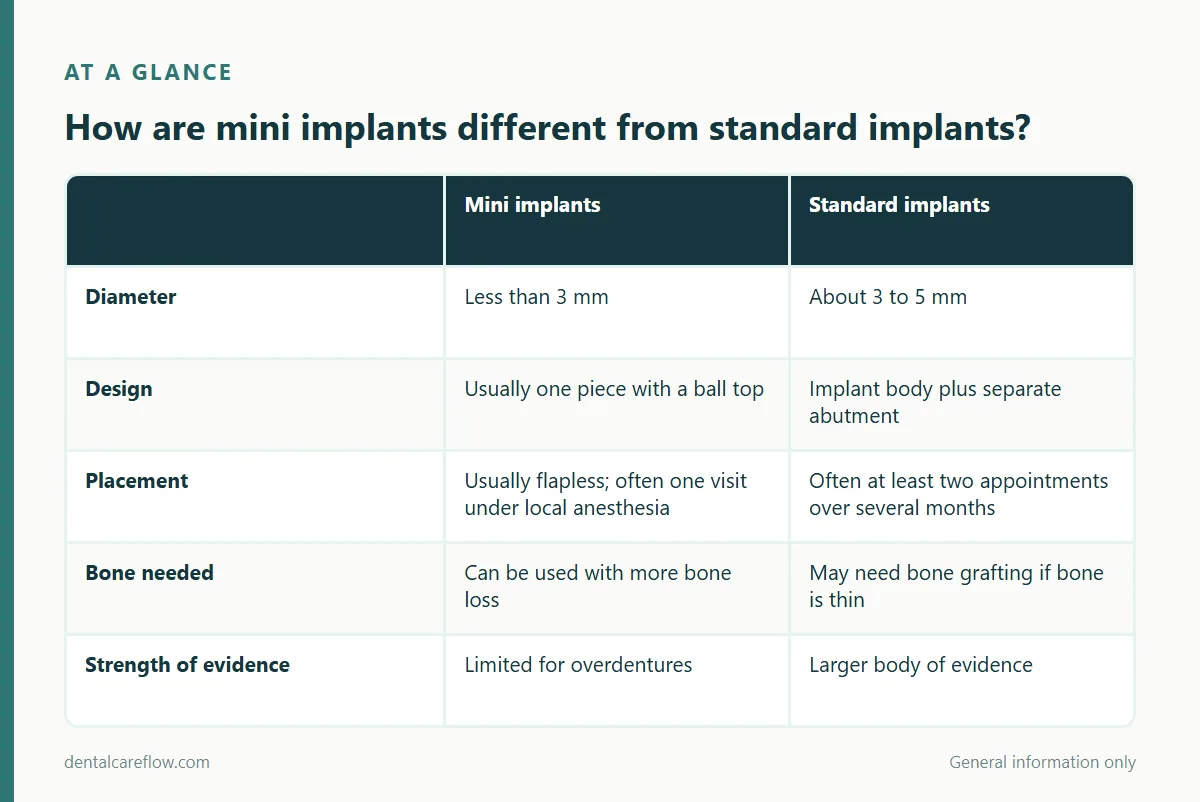
The FDA describes a typical dental implant system as an implant body placed in the jawbone, an abutment that extends through the gum, and usually a screw that connects the two. Mini implants simplify that design. Colgate describes them as a one-piece screw less than 3 mm in diameter with a ball-shaped end that protrudes from the jawbone, compared with conventional two-piece implants of about 3.25 to 5 mm.
| Mini implants | Standard implants | |
|---|---|---|
| Diameter | Less than 3 mm | About 3 to 5 mm |
| Design | Usually one piece with a ball top | Implant body plus separate abutment |
| Placement | Usually flapless; often one visit under local anesthesia | Often at least two appointments over several months |
| Bone needed | Can be used with more bone loss | May need bone grafting if bone is thin |
| Strength of evidence | Limited for overdentures | Larger body of evidence |
The table draws on Colgate and a 2017 systematic review in the International Journal of Implant Dentistry.
Who might be a candidate for mini implants?
Colgate lists people who lack the ability to undergo more invasive surgery, enough time for repeat dental visits, or enough jawbone for a full-sized implant. The 2017 review notes the main advantage is that minis can be used in people with a large amount of bone loss, and lists less invasive placement, shorter healing time, no need for bone grafts and fewer complications as reported benefits.
The review focused on overdentures, meaning dentures that clip onto implants. If you are weighing that kind of option, our comparison of dental implants vs dentures covers the broader trade-offs.
What are the limits of mini implants?
Be cautious about claims that minis are equal to standard implants in every case. The 2017 systematic review found mini-implant overdentures tended to give good patient satisfaction, but it was based on only two studies with 177 patients, and the authors concluded there is a definite lack of evidence to support mini-implants for overdentures. Ask your dentist what evidence supports minis for your specific case, upper or lower jaw.
The FDA's general list of implant risks also applies: damage to nearby teeth or tissue, infection or delayed healing, nerve injury, and loosening. It notes that smoking and uncontrolled diabetes raise the risk of healing problems and implant failure.
What does the procedure involve?
According to Colgate, dentists can usually place mini implants in one visit using local anesthesia, and no sutures are needed. The review notes they are usually placed with a flapless technique, meaning the gum is not opened up the way it is for many standard implants.
Questions to ask before choosing mini implants
- Why do you recommend minis over standard implants for me?
- How many implants will hold my denture, and in which jaw?
- Which brand and model will you use? The FDA suggests keeping this information for your records.
- What happens if one loosens, and what maintenance should I expect?
- How do I clean around them? Colgate advises brushing twice daily, flossing once a day and regular dental visits.
Are mini implants covered in the US?
Medicare.gov states that Original Medicare does not cover most dental services, and Medicaid.gov explains that adult dental benefits are set state by state. If you have a private dental plan or a Medicare Advantage plan with dental benefits, ask for a written pre-treatment estimate before you commit. For people with significant bone loss weighing their options, see dental implants for bone loss patients.
Sources
- FDA, Dental Implants: What You Should Know
- Colgate (US), What Are Mini Dental Implants?
- Sivaramakrishnan G, Sridharan K. International Journal of Implant Dentistry, 2017, Comparison of patient satisfaction with mini-implant versus standard diameter implant overdentures
- Medicare.gov, Dental services coverage
- Medicaid.gov, Dental Care
This article is general information and is not a substitute for advice from your own dentist.
Ask about treatment and costs
Two quick questions. General information only, no diagnosis.