
What Are the Benefits of Teeth Sealants? What CDC and ADA Say
What are the benefits of teeth sealants? How they block cavities in molars, who should get them and when, and their limits, per the CDC, NIDCR and ADA.
Editorially reviewed. This article has not been reviewed by a clinician. How we work
On this page
So, what are the benefits of teeth sealants? They form a thin protective coating over the grooves of back teeth, keeping out the food and germs that cause cavities, and the ADA says they can cut the risk of decay in molars by nearly 80%.
Sealants are among the simplest preventive treatments in dentistry. They don't involve drilling or numbing, they go on in a single visit, and public health agencies such as the CDC actively support getting them to children who might otherwise miss out. Below is what the CDC, the National Institute of Dental and Craniofacial Research (NIDCR) and the American Dental Association (ADA) say about how sealants work, who they help most and where their limits are.
What a dental sealant actually is
NIDCR describes dental sealants as thin plastic coatings that protect the chewing surfaces of the back teeth. They are painted on as a liquid and quickly harden into a shield over the tooth.
The reason that shield matters is anatomy. Molars have deep pits and grooves on their chewing surfaces. Food and bacteria settle into those grooves, where a toothbrush has trouble reaching. A sealant fills them in, so there's less space for decay to start. The CDC describes it as a barrier that protects chewing surfaces from the germs and food particles that cause cavities.
The main benefits of teeth sealants
Here is what the agencies list, in plain terms:
- Fewer cavities in molars. According to the ADA's MouthHealthy site, sealants have been shown to reduce the risk of decay by nearly 80% in molars. The CDC adds that, applied soon after adult molars come in, they can prevent up to 80% of cavities for 2 years and continue to protect against 50% of cavities for up to 4 years.
- Protection that lasts for years. The CDC says sealants provide protection against cavities for many years, and the ADA notes they often last several years before they need to be reapplied.
- They may stop early decay. The ADA says sealants can keep cavities from forming and may even stop early stages of decay from becoming a full-blown cavity.
- Quick, with no drilling. Both NIDCR and the ADA describe the process as simple and say it should not hurt, and the CDC notes children can eat and drink normally right after.
- Easy to monitor. Because some sealants are clear, the ADA says your dentist can keep an eye on the tooth underneath.
The CDC also points to the flip side: children aged 6 to 11 without sealants are almost three times more likely to have cavities in their molars than children who have them.
Who should get sealants, and when
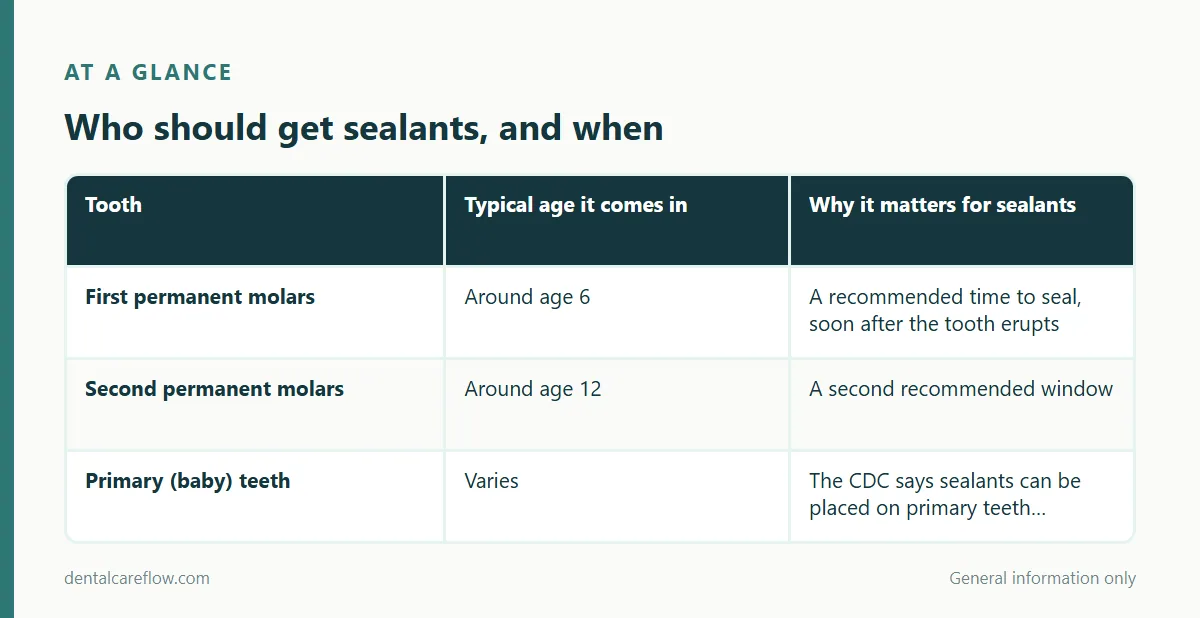
Timing is a big part of the benefit. NIDCR says children should get sealants on their permanent molars as soon as those teeth come in, because the sooner sealants are placed, the less chance decay has to start. The usual windows, according to the CDC and the ADA, are:
| Tooth | Typical age it comes in | Why it matters for sealants |
|---|---|---|
| First permanent molars | Around age 6 | A recommended time to seal, soon after the tooth erupts |
| Second permanent molars | Around age 12 | A second recommended window |
| Primary (baby) teeth | Varies | The CDC says sealants can be placed on primary teeth starting at age 2 |
Adults aren't excluded. The ADA states that children and adults can both benefit from sealants, but the earlier you get them, the better. Whether they make sense for a particular adult tooth is a question for your dentist, who can see whether the grooves are already filled or decayed.
How sealants are placed
The ADA outlines the steps:
- The dentist cleans and dries the tooth.
- An acidic gel is placed on the chewing surface, which roughens it so the sealant bonds well.
- The gel is rinsed off and the tooth is dried again.
- The sealant is painted into the grooves.
- A special blue light hardens it.
According to the CDC, sealants can be applied by dentists, dental hygienists or other qualified dental professionals, depending on state rules. That's why you may see them offered not only in dental offices but also in community clinics and school programs that use portable equipment.
School sealant programs
The CDC says school sealant programs can make a big difference in children's oral health. They reach kids who don't get regular dental care and those at higher risk for cavities, and they spare students from missing class for a dental appointment. NIDCR also lists school sealant programs, along with dental offices and community clinics, as places children can get them. If your child's school offers one, the school or your local health department can usually explain how it works.
Limits and safety questions
Sealants are a strong preventive tool, but they aren't a complete one:
- They don't replace brushing and flossing. The ADA is direct on this point: sealants are no substitute for daily cleaning.
- They protect chewing surfaces only. The sealant covers the grooves on top of the tooth. Fluoride toothpaste and flossing still do the work on the other surfaces.
- They need checking. The ADA says your dentist will check sealants at regular visits and reapply them as needed.
- Side effects. Aside from a possible allergy, the ADA says there are no known side effects.
- BPA. The ADA acknowledges that sealants contain a tiny amount of BPA but says it is not enough to cause harm, and that everyday exposure from things like receipts, cosmetics and dust is higher.
On coverage, NIDCR says some medical insurance, including Medicaid, and almost all dental insurance cover sealants. Plans differ, so it's worth checking the details of yours. If you're comparing what preventive care costs against treating a cavity later, our guide to what a cavity filling costs with insurance walks through how plans usually handle fillings.
Frequently asked questions
Are sealants only for kids?
No. The ADA says children and adults can both benefit, though the earlier they're placed, the better. Ask your dentist whether they make sense for your teeth.
Does getting a sealant hurt?
NIDCR and the ADA both say getting sealants should not hurt. There is no drilling, and the CDC notes children can eat and drink normally afterward.
How long do sealants protect teeth?
The CDC says they protect against cavities for many years, and the ADA says they often last several years before needing to be reapplied. Your dentist checks them at regular visits.
Can a sealant go over early decay?
The ADA says sealants can be placed over early decay and may stop it from becoming a full cavity. Whether that's appropriate for a specific tooth is your dentist's call.
Are sealants safe?
According to the ADA, aside from a possible allergy there are no known side effects, and the small amount of BPA in sealants is not enough to cause harm.
Sources
- CDC, About Dental Sealants
- National Institute of Dental and Craniofacial Research, Dental Sealants
- American Dental Association (MouthHealthy), Sealants
This article is general information and doesn't replace advice from your own dentist.
Ask about treatment and costs
Two quick questions. General information only, no diagnosis.