What Is General Dentistry? Services, Referrals and Visits
What is general dentistry? See which services a US general dentist provides, when you are referred to a specialist, how often to visit and low-cost options.
Editorially reviewed. This article has not been reviewed by a clinician. How we work

On this page
What is general dentistry? It is the everyday, broad-scope care provided by a general dentist: checkups, cleanings, x-rays, fillings, crowns and other repairs, and coordinating referrals to specialists. In the US, general dentists hold a DDS or DMD degree.
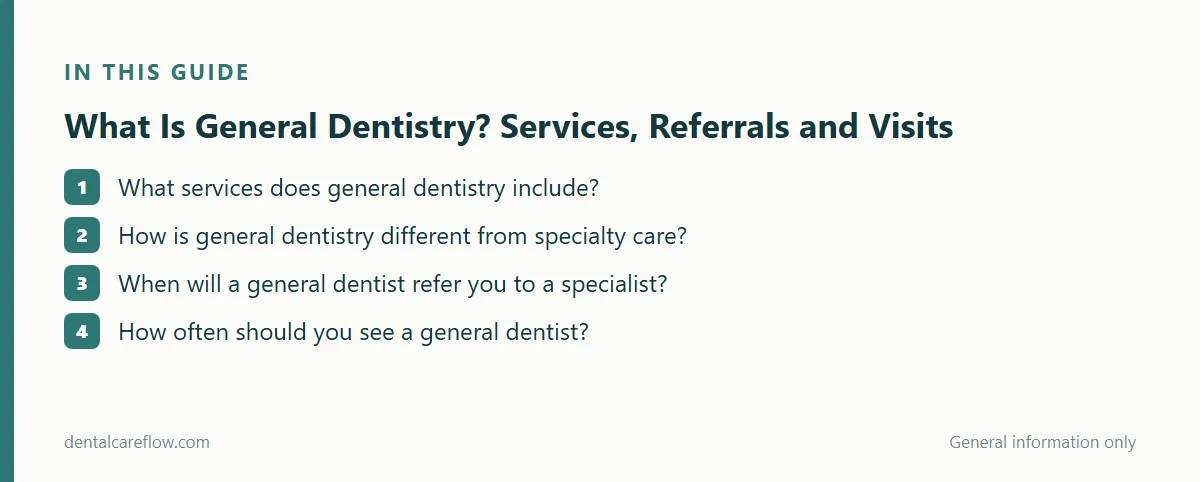
Think of a general dentist as the dental equivalent of a primary care provider. Cleveland Clinic puts it simply: general dentists take care of your overall oral health, while dental specialists step in when you have a specific need. This article maps out what usually falls inside general dentistry, what typically gets referred out, and how to make the most of having a regular "dental home."
What services does general dentistry include?
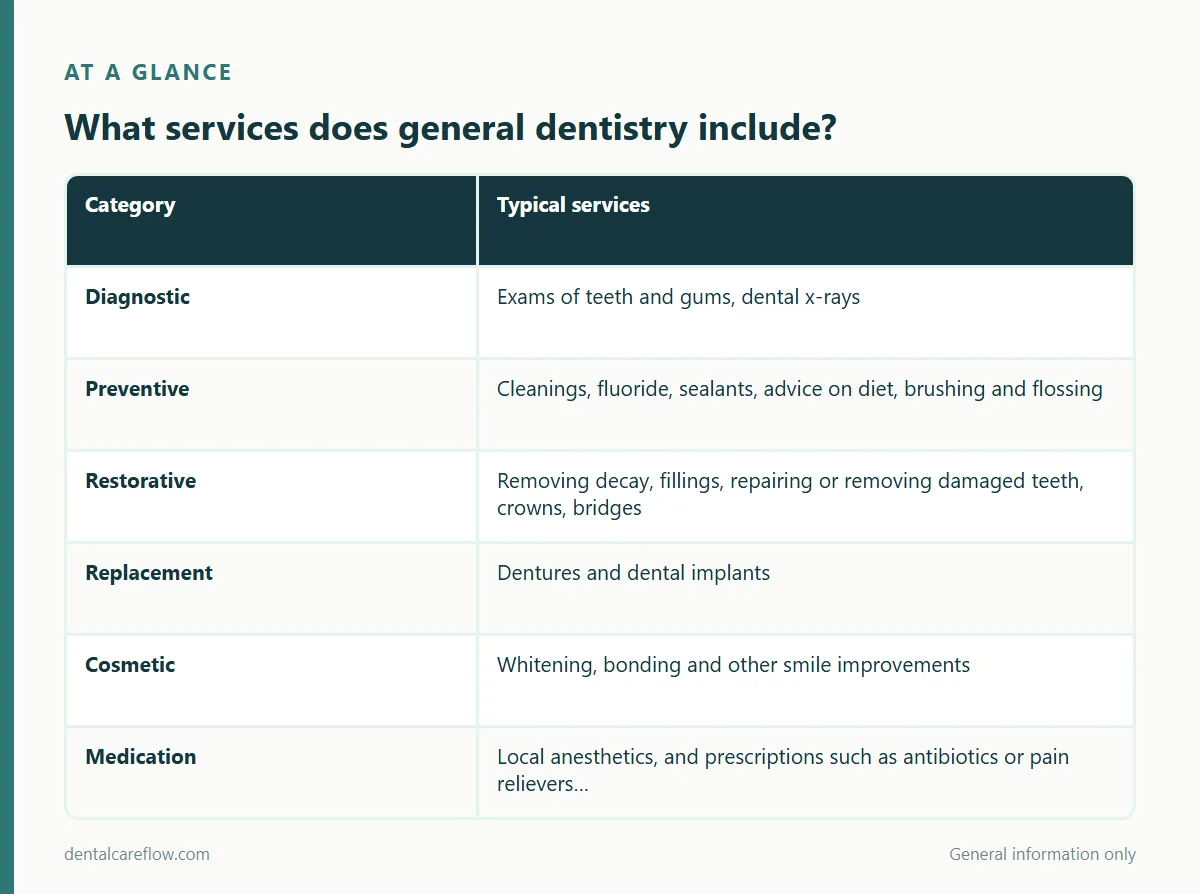
Cleveland Clinic and the US Bureau of Labor Statistics (BLS) describe a wide range of work. Grouped by purpose:
| Category | Typical services |
|---|---|
| Diagnostic | Exams of teeth and gums, dental x-rays |
| Preventive | Cleanings, fluoride, sealants, advice on diet, brushing and flossing |
| Restorative | Removing decay, fillings, repairing or removing damaged teeth, crowns, bridges |
| Replacement | Dentures and dental implants |
| Cosmetic | Whitening, bonding and other smile improvements |
| Medication | Local anesthetics, and prescriptions such as antibiotics or pain relievers when needed |
Cleveland Clinic notes that general dentists offer a broad range of services, from sealants and teeth whitening to fillings and dental implants. BLS lists removing decay, filling cavities, repairing or removing damaged teeth, administering anesthetics, prescribing medication, examining x-rays and making models for dentures among typical duties.
How is general dentistry different from specialty care?
The ADA's National Commission on Recognition of Dental Specialties and Certifying Boards recognizes 12 dental specialties, including endodontics, orthodontics and dentofacial orthopedics, periodontics, prosthodontics, pediatric dentistry, and oral and maxillofacial surgery. General dentistry is not one of them; it is the base everyone starts from.
Training reflects this. BLS states that general dentists do not need training beyond dental school, while specialties typically require a two- to four-year residency. Cleveland Clinic estimates eight years of school for a general dentist and 10 to 11 years for a specialist.
When will a general dentist refer you to a specialist?
There is no single rule; it depends on the dentist's experience and your case. Common examples, matching the specialists Cleveland Clinic describes:
- A complex or surgical extraction, including impacted wisdom teeth: oral surgeon
- Root canal on a difficult tooth: endodontist
- Advanced gum disease: periodontist
- Braces or clear aligners: orthodontist
- Complex crowns, bridges or full dentures: prosthodontist
- Children's dental care: pediatric dentist
How often should you see a general dentist?
Cleveland Clinic says the ADA recommends regular exams and cleanings and that twice a year works for many people, though some need more frequent visits. The CDC recommends seeing a dental provider at least once a year, or more often if advised, partly because gum disease can become serious before you notice symptoms.
Cleveland Clinic also lists reasons to book sooner: a toothache or abscess, chipped or broken teeth, jaw pain, mouth sores, persistent bad breath, swollen or bleeding gums, sensitivity, or grinding.
Finding general dentistry if cost is a barrier
NIDCR lists several lower-cost routes in the US:
- Federally funded community health centers that charge based on income
- Dental school and dental hygiene school clinics, where students treat patients under supervision
- State and local health department programs, which you can find by calling 2-1-1
- Medicaid and CHIP; Medicaid.gov notes that dental services are covered for all children enrolled in Medicaid, while adult benefits vary by state
Medicare.gov notes that Original Medicare does not cover most dental services, so check what separate dental coverage you have.
If you are missing teeth and wondering where a general dentist fits in, our guide to the best dental solution for missing teeth explains the main choices.
Sources
- Cleveland Clinic, What Is a Dentist?
- US Bureau of Labor Statistics, Occupational Outlook Handbook: Dentists
- National Commission on Recognition of Dental Specialties and Certifying Boards (ADA), Recognized Dental Specialties
- CDC, Gum (Periodontal) Disease
- NIDCR, Finding Low-Cost Dental Care
- Medicaid.gov, Dental Care
- Medicare.gov, Dental services coverage
This article is general information and is not a substitute for advice from your own dentist.
Ask about treatment and costs
Two quick questions. General information only, no diagnosis.