Is a Dentist a Doctor? DDS, DMD and MD Compared
Is a dentist a doctor? Yes, a doctor of dentistry. See how a DDS or DMD compares with an MD in US training, licensing, prescribing and insurance coverage.
Editorially reviewed. This article has not been reviewed by a clinician. How we work

On this page
Is a dentist a doctor? Yes. In the United States a dentist holds a doctoral degree, either a DDS (Doctor of Dental Surgery) or a DMD (Doctor of Dental Medicine), and Cleveland Clinic describes dentists as doctors who diagnose and treat oral health conditions. They are not medical doctors (MDs), though.
That distinction is where most of the confusion comes from. People ask whether they can call their dentist "Dr.," whether a dentist went to medical school, and whether a dentist can prescribe medication. This article answers each of those questions with a US focus and shows where a dentist's role overlaps with your physician's and where it does not.
What kind of doctor is a dentist?
A dentist is a doctor of dentistry. ADA MouthHealthy explains that DDS and DMD are equivalent degrees awarded by accredited dental schools, using the same curriculum requirements. Cleveland Clinic puts it this way: like physicians, dentists are doctors who help support your overall health. So addressing your dentist as "Dr." is correct.
The difference is the type of doctorate. According to the Bureau of Labor Statistics, physicians typically need an MD (Medical Doctor) or DO (Doctor of Osteopathic Medicine) degree, while dentists typically need a DDS or DMD from an accredited dental program.
How does a dentist's training compare with a physician's?
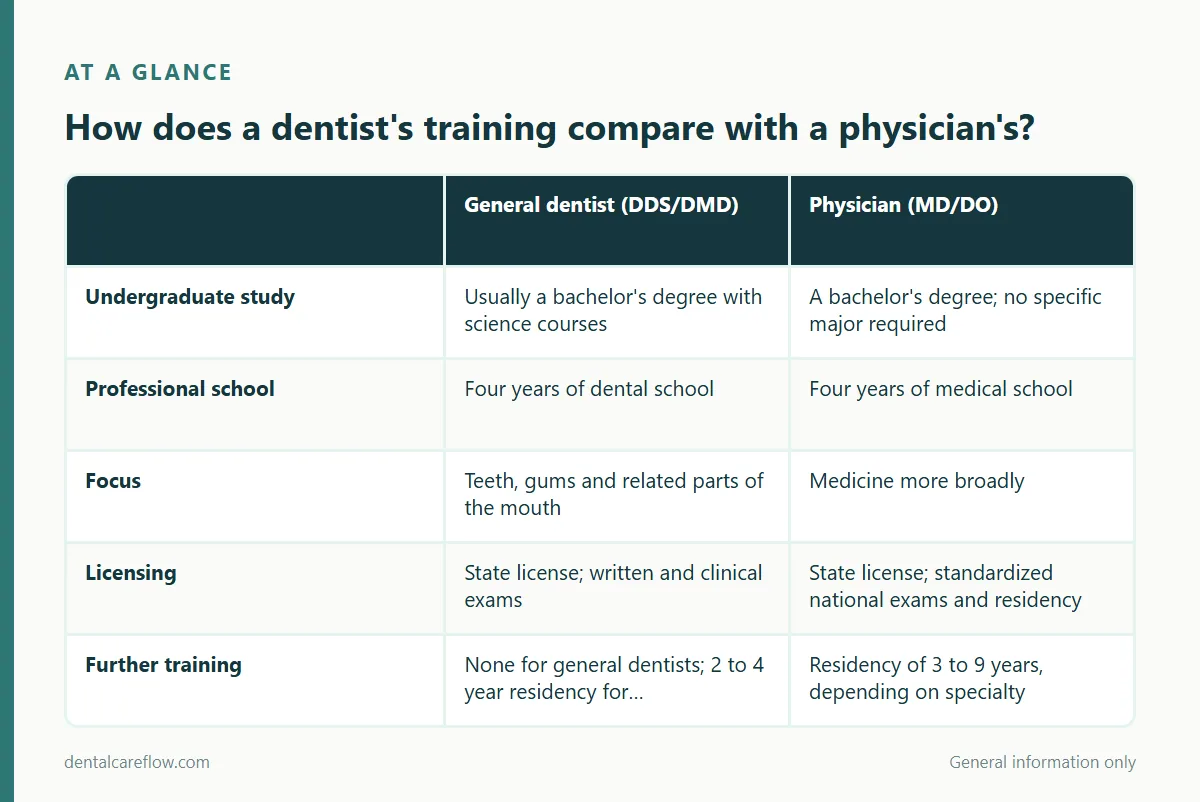
| General dentist (DDS/DMD) | Physician (MD/DO) | |
|---|---|---|
| Undergraduate study | Usually a bachelor's degree with science courses | A bachelor's degree; no specific major required |
| Professional school | Four years of dental school | Four years of medical school |
| Focus | Teeth, gums and related parts of the mouth | Medicine more broadly |
| Licensing | State license; written and clinical exams | State license; standardized national exams and residency |
| Further training | None for general dentists; 2 to 4 year residency for specialties | Residency of 3 to 9 years, depending on specialty |
The table draws on the Bureau of Labor Statistics profiles for dentists and for physicians and surgeons. MouthHealthy describes the education of a general dentist, three or more years of undergraduate study plus four years of dental school, as on par with medical school. Cleveland Clinic estimates about eight years of school for a general dentist and 10 to 11 years for a dental specialist.
Can a dentist prescribe medication?
Yes, within their field. The US Bureau of Labor Statistics lists prescribing medications and administering anesthetics among a dentist's typical duties. Cleveland Clinic gives examples such as antibiotics, pain relievers, sedatives and anti-anxiety medicines when they are needed for dental care. A dentist will not usually manage conditions outside the mouth, such as blood pressure or diabetes, which is why your dentist may ask for your medical history and sometimes coordinate with your physician.
What does a dentist do that a physician usually does not?
According to BLS and Cleveland Clinic, dentists:
- Examine teeth and gums and read dental x-rays
- Remove decay and fill cavities
- Repair or remove damaged teeth
- Provide preventive care such as cleanings, fluoride and sealants
- Make models and measurements for dentures and other appliances
- Offer cosmetic treatment to improve the look of your smile
This is also why US hospital emergency departments are not a substitute for a dentist. A study in the Journal of Public Health Dentistry notes that emergency departments typically do not have oral health care providers on staff and usually manage dental problems with pain relief and antibiotics.
Is a dentist covered like a doctor by US insurance?
Not necessarily. Your medical plan and your dental coverage may be separate, so check both. Medicare.gov states that in most cases Original Medicare does not cover dental services such as routine cleanings, fillings and extractions. For Medicaid, Medicaid.gov explains that dental benefits for adults are left to each state, while dental services are covered for all child enrollees. Check your own plan documents before treatment.
Quick answers
- Should I call my dentist "Dr."? Yes.
- Is a dentist an MD? No, unless they also completed a separate medical degree. BLS notes that oral and maxillofacial surgery training may lead to a joint MD.
- Are DDS and DMD different? No, they are equivalent degrees.
If you are considering treatment outside the US, our guide on whether Turkish dentists are qualified explains how to check credentials abroad.
Sources
- Cleveland Clinic, What Is a Dentist?
- ADA MouthHealthy, DDS and DMD
- US Bureau of Labor Statistics, Occupational Outlook Handbook: Dentists
- US Bureau of Labor Statistics, Occupational Outlook Handbook: Physicians and Surgeons
- Journal of Public Health Dentistry (via PubMed Central), Pharmacologic Management of Non-Traumatic Dental Conditions in US Emergency Departments, 2018–2022
- Medicare.gov, Dental services coverage
- Medicaid.gov, Dental Care
This article is general information and is not a substitute for advice from your own dentist or physician.
Ask about treatment and costs
Two quick questions. General information only, no diagnosis.