
Should I Get a Dental Implant or a Bridge? Weighing the Trade-Offs
Should I get a dental implant or a bridge? Compare anchoring, timeline, lifespan and effects on nearby teeth, plus questions to ask your dentist.
Editorially reviewed. This article has not been reviewed by a clinician. How we work

On this page
Should I get a dental implant or a bridge? Both replace missing teeth well, but they differ in how they're anchored, how long treatment takes, how long they tend to last and whether healthy neighboring teeth are reshaped, so the right choice depends on your mouth and is made with your dentist.
Neither option is universally better. An implant is a post placed in the jawbone that acts like an artificial root. A traditional bridge uses the teeth on either side of a gap as anchors. This guide lays out the trade-offs described by Cleveland Clinic and the US Food and Drug Administration (FDA) so you can walk into your consultation with clear questions.
How each option works
Dental implant. Cleveland Clinic describes implants as small, threaded posts that surgically replace missing teeth. The post sits in the jawbone, a connector called an abutment attaches to it, and a crown, bridge or denture goes on top. Most implants are titanium, and some are ceramic. The FDA notes that implants support artificial teeth to restore a person's ability to chew or their appearance.
Dental bridge. According to Cleveland Clinic, a bridge uses crowns that fit over the natural teeth on each side of a gap, with artificial teeth filling the space between them. There are several types:
- Traditional: crowns on both ends, used when healthy natural teeth sit on both sides of the gap.
- Cantilever: a crown on only one end, used when there's a natural tooth on just one side. Cleveland Clinic notes it is less strong than a traditional bridge.
- Maryland (resin-bonded): metal wings bonded to the backs of neighboring teeth instead of crowns, typically used for front teeth because it can't handle back-tooth chewing forces.
- Implant-supported: a bridge that rests on implants rather than natural teeth, generally used when three or more teeth in a row are missing.
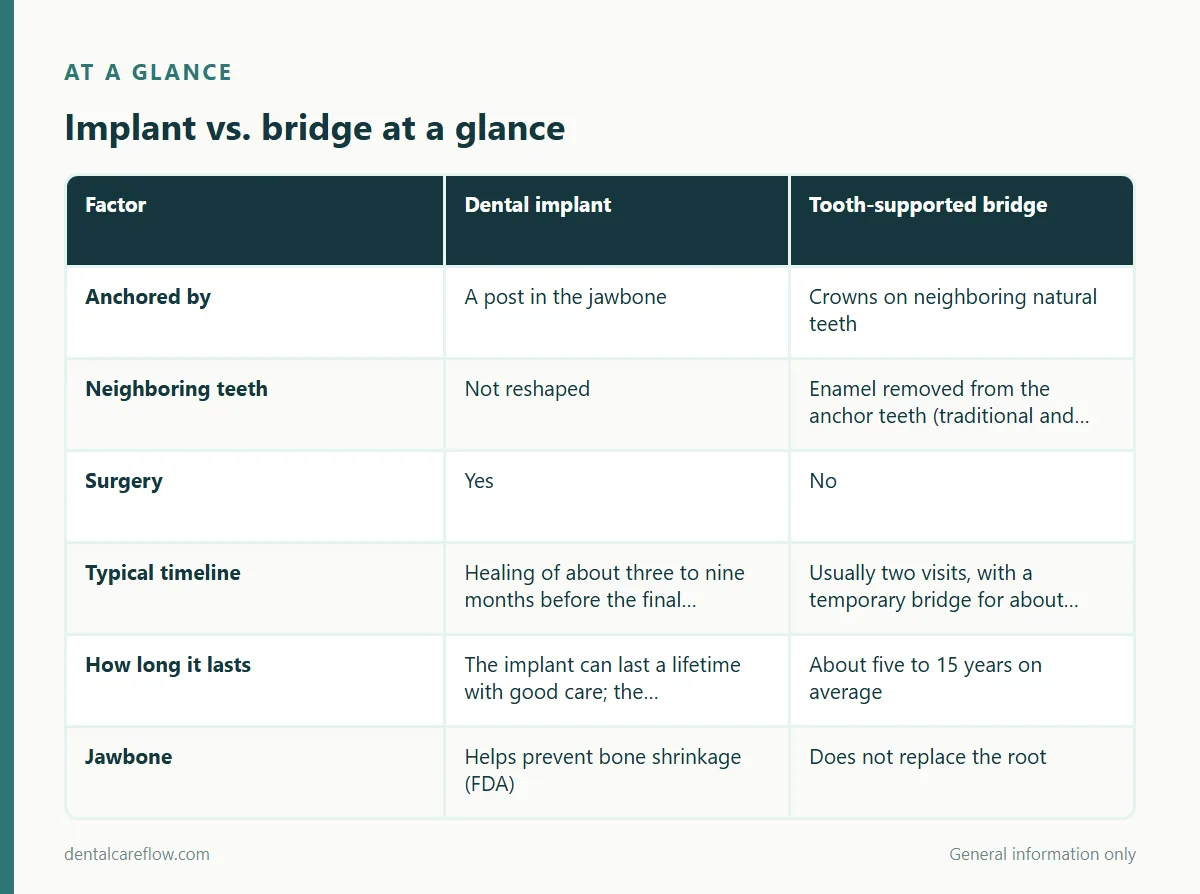
Implant vs. bridge at a glance
| Factor | Dental implant | Tooth-supported bridge |
|---|---|---|
| Anchored by | A post in the jawbone | Crowns on neighboring natural teeth |
| Neighboring teeth | Not reshaped | Enamel removed from the anchor teeth (traditional and cantilever types) |
| Surgery | Yes | No |
| Typical timeline | Healing of about three to nine months before the final tooth (Cleveland Clinic) | Usually two visits, with a temporary bridge for about two to four weeks |
| How long it lasts | The implant can last a lifetime with good care; the crown on top typically lasts around 15 years | About five to 15 years on average |
| Jawbone | Helps prevent bone shrinkage (FDA) | Does not replace the root |
The case for a bridge
A bridge avoids surgery, and treatment is usually quicker. Cleveland Clinic describes a typical process: the dentist numbs the area, reshapes the anchor teeth, takes impressions, places a temporary bridge, and cements the final bridge at a second visit. Some offices use digital CAD/CAM systems to make a bridge in one appointment.
Bridges also restore chewing and speech, look natural, and keep neighboring teeth from drifting into the gap. Whether those advantages outweigh the downsides in your case, for example if the neighboring teeth are already heavily restored or if implant surgery isn't a good fit for you, is a judgment your dentist makes after an exam.
The main downside is the effect on the anchor teeth. Cleveland Clinic notes that reshaping removes enamel, which can't be undone, and that decay or injury to those anchor teeth can weaken the bridge. Cleaning under a bridge also takes extra effort with floss threaders or small interdental brushes.
The case for an implant
An implant replaces one tooth without involving its neighbors. Cleveland Clinic points out that implants don't require removing enamel from adjacent teeth, which a traditional bridge does. The FDA lists benefits including restoring chewing and appearance, helping prevent jawbone shrinkage, preserving surrounding bone and gums, and helping keep adjacent teeth stable. Cleveland Clinic adds that implants generally last much longer than bridges.
The trade-offs are time and surgery. The jawbone needs to fuse to the implant, a process called osseointegration, before the final tooth goes on. Cleveland Clinic puts healing at about three to nine months, and the FDA says to expect healing to take several months or longer. Some people also need a bone graft first. The FDA lists possible complications, including damage to nearby teeth, sinus perforation or jawbone fracture during surgery, infection, numbness after surgery, and loosening of the abutment screw.
Factors your dentist will weigh
When Cleveland Clinic describes who is a good fit for each option, a few themes come up repeatedly:
- Health of the neighboring teeth. A traditional bridge needs strong teeth on both sides of the gap.
- Jawbone volume. An implant needs enough healthy bone, or a graft to build it up.
- Gum health and general health. Active gum disease, uncontrolled diabetes and smoking can affect healing. The FDA says overall health is an important factor in deciding if someone is a candidate.
- Age. Implants are typically placed in adults 18 and older who have finished growing, and bridges are generally not placed in children.
- How many teeth are missing and where. Bridges commonly replace one to three teeth in a row, while implant-supported bridges are used for three or more.
- Your preferences. How you feel about surgery, treatment length and cleaning routines matters too.
Cost is part of the decision for most people. We cover it separately in dental implants vs. bridges: cost comparison.
Questions to ask at your consultation
- Are my neighboring teeth healthy enough to anchor a bridge, and do they already need crowns?
- Do I have enough bone for an implant, or would I need a graft?
- What would the timeline look like for each option in my case?
- What would I wear in the gap while I heal?
- For an implant, which brand and model would you use? The FDA suggests keeping this on record.
- How would I clean each option day to day?
Frequently asked questions
Which lasts longer, an implant or a bridge?
Cleveland Clinic says implants generally last much longer than bridges. Bridges last about five to 15 years on average, while an implant can last a lifetime with good care, though the crown on top may need replacing.
Does a bridge damage the teeth next to the gap?
A traditional or cantilever bridge requires removing enamel from the anchor teeth, which can't be reversed. Decay or injury to those teeth can also weaken the bridge.
Is a bridge faster than an implant?
Usually. A bridge typically takes two visits a few weeks apart, while an implant needs months of healing before the final tooth is placed.
Can implants and bridges be combined?
Yes. An implant-supported bridge rests on implants instead of natural teeth and is generally used when three or more teeth in a row are missing.
Who decides which option is right?
You and your dentist together, based on an exam, imaging, your health history and your preferences.
Sources
- Cleveland Clinic, Dental Bridges: Types & Who Needs Them
- Cleveland Clinic, Dental Implants: Types, Purpose & Benefits
- US Food and Drug Administration, Dental Implants: What You Should Know
This article is general information and doesn't replace advice from your own dentist.
Ask about treatment and costs
Two quick questions. General information only, no diagnosis.